The Togolese education system has long operated under a shadow of financial exploitation, with families bearing the brunt of a costly and opaque process. The abrupt announcement by the newly appointed Minister of National Education, Mama Omorou, to terminate the practice of delivering exam results via SMS has exposed a systemic financial drain that persisted for generations under the administration of Faure Gnassingbé.
The revelation: a financial trap disguised as convenience
During a routine inspection on May 30, 2026, at the BAC I correction centers in Tokoin and Agoè-centre high schools, Minister Omorou delivered a scathing critique of the SMS-based result delivery system. Describing it as a deliberate financial trap and a waste of public resources, he uncovered a mechanism that preyed on the anxiety of families awaiting their children’s academic outcomes.
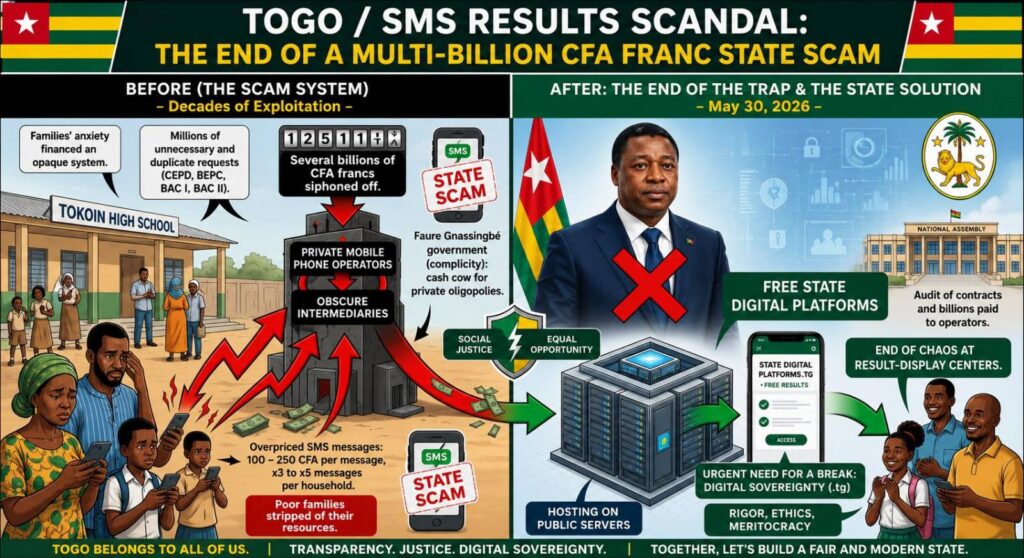
The process was as cynical as it was lucrative. For each national examination—CEPD, BEPC, BAC I, or BAC II—families participated in a ritual of redundancy. Fathers, mothers, uncles, and even candidates themselves would send multiple overpriced SMS messages (each costing between 100 and 250 CFA francs) to obtain identical results. Tens of millions of redundant queries were generated annually, funneling millions of francs into the coffers of private telecom operators and shadowy intermediaries.
A calculated financial hemorrhage over decades
While the minister has not yet released official financial audits, preliminary estimates paint a staggering picture. With hundreds of thousands of candidates sitting for national exams each year in Togo, and each family sending an average of three to five messages per exam session, the volume of SMS traffic ballooned into the tens of millions per year.
When extrapolated over the past 15 to 20 years of the current administration, the financial loss is estimated in the billions of CFA francs. This staggering sum did not benefit the public education system. Instead, it flowed primarily to private telecom giants and unaccountable intermediaries, all operating under state-granted concessions that remained unchallenged until now. The result was a systemic transfer of wealth from vulnerable families to private oligopolies, with tacit approval or complicity from outgoing authorities.
The path forward: building a transparent digital future
Minister Omorou’s decision to abolish the SMS system is a necessary first step, but it introduces a significant challenge: replacing it with an equitable and efficient alternative. Eliminating SMS-based results must not revert the system to the chaos of overcrowded bulletin boards, where families endure hours of anxiety and potential disorder.
The Togolese government, which has championed digital integration through the Ministry of Digital Economy, now faces an urgent imperative: the creation of state-managed, free, and secure digital platforms for result publication. This transition must prioritize three core principles:
- Digital sovereignty: Exam results must be hosted on government-controlled servers under the .tg domain, ensuring full state oversight and data security.
- Absolute transparency: Access to results must be entirely free for all candidates, funded through the national education budget to uphold fairness and equal opportunity.
- Modern accessibility: Results should be disseminated in waves via lightweight web portals and email systems, compatible with basic mobile devices—a simple yet effective technological solution.
Redefining educational ethics
Beyond the financial scandal, the minister used the inspection tour to reinvigorate the role of examiners, emphasizing that rigor, ethics, and meritocracy must once again guide the nation’s education system. His announcement signals a fundamental ideological shift: protecting families from institutionalized fraud is not just about recovering lost funds but restoring faith in a fair and just education system.
The road ahead demands courage. Will the government follow through by auditing past contracts with telecom operators to uncover the full extent of the financial misappropriation? Only then can justice be served, and the future of Togolese youth be secured from further exploitation.