The state ceremony that centred a nation, not a family
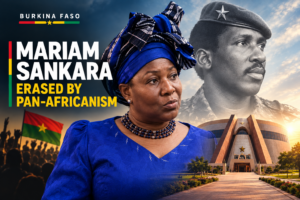
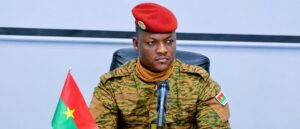
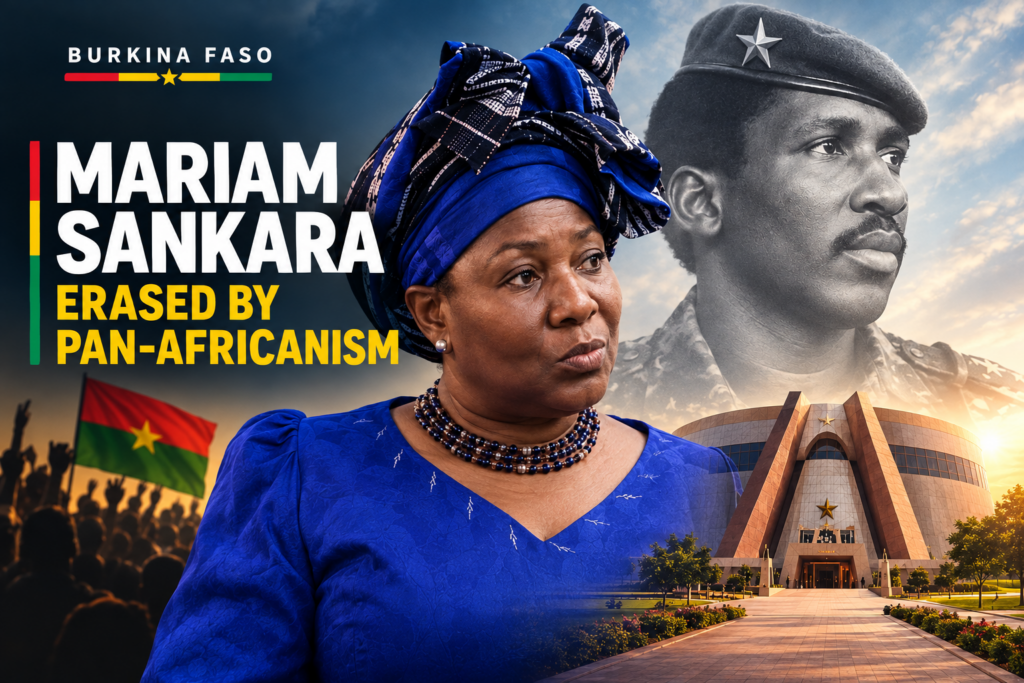
On 17 May 2025, at the site of the former Conseil de l’Entente in Ouagadougou, Burkina Faso staged a grand inauguration of the mausoleum dedicated to Thomas Sankara and his twelve companions. The event, held under the patronage of Captain Ibrahim Traoré, was led by Prime Minister Rimtalba Jean Emmanuel Ouédraogo. The prime ministers of Senegal, Ousmane Sonko, and Chad, Allah-Maye Halina, were in attendance, alongside representatives of the Alliance of Sahel States and numerous pan-African figures from several continents. Twenty-one cannon shots rang out. Solemn speeches, revolutionary symbols and an eye-shaped architectural design by Francis Kéré: everything was choreographed to give the occasion an international dimension.
It was there, before the cameras, that Nathalie Yamb received the title of Knight of the Order of the Stallion from the Burkinabè authorities. A pointed tribute to a figure of contemporary pan-African activism, in the name of Sankara’s memory.
Neither Yamb nor any of the dignitaries present uttered Mariam Sankara’s name. Not a word for the widow, not a word for the children, not a word for the family. And the family, for its part, was absent. As in February 2023, during the reburial of the remains.
A global ceremony dedicated to Thomas Sankara, under the spotlight, where the man is celebrated without a glance for the woman who carried his name and his struggle alone for more than thirty years.
Three regimes, three uses of one dead man
But behind this absence lies a deeper question: to whom does Thomas Sankara’s memory now belong? To his family, which bore the weight of his assassination and exile for decades? To the Burkinabè state, which now seeks to turn his memory into national heritage? Or to a generation of pan-African activists who claim Sankara as one of the ideological fathers of their struggle?
It is precisely in this contradiction that the unease resides. Thomas Sankara has gradually moved from the status of victim of a political assassination to that of national hero, then continental and pan-African symbol. The mausoleum inaugurated in 2025 is officially presented as a tool designed to “safeguard, preserve and promote” his political legacy. But this institutionalisation of memory raises an unavoidable question: can a man’s memory be sanctified while the voice of those who lived intimately through his disappearance is marginalised?
Under Blaise Compaoré, the man who took power after the assassination of 15 October 1987, Mariam Sankara was forced into exile. She lived for more than twenty years in Montpellier. Her status as widow of a former president was never recognised. Speaking of Sankara was an act of resistance. Everything was done to erase her image and that of her husband. Only after Compaoré’s fall in 2014 could she return, and only then could the trial of the alleged assassins finally open in 2021.
During those long years, Mariam Sankara nevertheless never ceased to carry her husband’s memory. She was not a mere spectator of Sankarist history. She was one of the few survivors directly linked to the man, his family and his journey. Her struggle also formed part of the search for truth and justice around the assassination of 15 October 1987.
This is what makes the current situation particularly paradoxical. For decades, Sankara’s memory was fought or stifled. Today, it is everywhere: in official speeches, ceremonies, monuments, streets, pan-African references and institutional initiatives. Sankara’s name has become politically and symbolically unavoidable.
But at the very moment when this memory finally becomes official, the voice of the one who defended it when doing so carried considerable personal risk appears to have been relegated to the background.
From rehabilitation to state doctrine
Under Roch Marc Christian Kaboré, Sankara’s official rehabilitation accelerated. The memorial project was launched. But in a context where the authorities also sought to woo Compaoré’s nostalgic electorate, going so far as to evoke a possible return of the former president, Sankara became a malleable symbol, useful according to the needs of the moment.
The memorial project did not, moreover, originate with Ibrahim Traoré. The International Committee for the Thomas Sankara Memorial recalls that the project was officially launched as early as 2 October 2016. It therefore passed through several political sequences before culminating in the mausoleum inaugurated in 2025.
This clarification matters: the history of the memorial cannot be entirely rewritten as a work born with the current regime. It is the result of a much longer process, carried both by civil society actors and by different governments.
Under Ibrahim Traoré, the memorial became a mausoleum. The appropriation of the Sankarist figure turned into state doctrine. Sankara’s name served to legitimise a power born of a coup de force, before being gradually kept at a distance once that power was consolidated. The shift is visible: first claiming Sankara, then asking that comparisons with him stop.
Above all, one must observe the transformation of vocabulary. Sankara is no longer merely presented as a former assassinated president or as the father of the 1983 revolution. He has become an official reference, a national hero, a central element of the political and historical narrative of contemporary Burkina. The mausoleum itself is presented by its promoters as an instrument for safeguarding and promoting his political legacy.
In other words, memory is no longer merely preserved: it is organised, scripted and institutionalised.
And that is where another question arises: when a state officially appropriates the memory of a former leader, what becomes of his family’s moral right to contest the way that memory is organised?
Three regimes. Three different uses of the same dead man. And in all three cases, the same woman – the one who knew and lost him most intimately – remained on the margins. Silenced under Compaoré. Instrumentalised under Kaboré. Bypassed under Traoré.
A family position that was never merely circumstantial
The Sankara family never endorsed the staging of 2023, nor that of 2025. As early as February 2023, it declared that it felt “crushed by the force of public authority”. It had refused the burial of Thomas Sankara’s remains at the very site of his assassination, considering that this place, too heavily charged, could not be a place of solace. It had asked for a space that would bring people together rather than divide them. The state overrode this.
The family’s position was therefore not circumstantial opposition. In its statement of 16 February 2023, Mariam Sankara, her two sons and Thomas Sankara’s brothers and sisters proposed several alternatives: the Dagnoën cemetery, the Garden of Friendship or the Yennenga Garden. Above all, they asked that the site of the murder remain a preserved historical space and not necessarily become the burial place.
The family explained at the time that its various attempts to reach a compromise had remained unanswered and asked the president of the Transition to suspend the decision.
Despite this opposition, the reburial took place on 23 February 2023 at the Memorial site. The Burkinabè press noted Mariam Sankara’s absence at the ceremony.
This detail is far from trivial. It creates a symbolic fracture that persists today: the state organises Thomas Sankara’s public memory, while his family contests part of the terms according to which that memory is staged.
Whether one wants to use Sankara to establish legitimacy, or to stifle him in order to erase an inconvenient counter-model, the result for his family has always been the same. It is excluded from the decisions that concern it most directly, while the figure of the dead husband is fetishised.
There is a historical irony here that is difficult to ignore. Thomas Sankara had built part of his political discourse around sovereignty, dignity and the refusal of relations of domination. Yet on the question of his own memory, his family says it was confronted with a decision by public authority that it had not wished for.
The pan-African paradox
The paradox is even more striking when this memory is now mobilised in the name of pan-Africanism. Political leaders, activists, intellectuals and figures from several countries claim Sankara’s legacy. But the question remains: can one claim his legacy without hearing the voice of his widow and children when they contest the way that legacy is institutionalised?
Pan-Africanism should not, however, be merely a succession of speeches, symbols and ceremonies. It should also question the way individuals, families and communities concerned are involved in decisions taken in the name of their memory.
For the risk, by dint of turning Sankara into a continental icon, is that the real man disappears behind the historical figure. The husband disappears behind the revolutionary. The father disappears behind the national hero. The assassinated man disappears behind the pan-African symbol.
And with him gradually disappears the one who was his companion, the mother of his children and one of the main guardians of his memory during the years when his name was still politically dangerous.
Sankara serves, as long as he is useful. His family continues to pay the price.
The question is therefore no longer only how Burkina Faso honours Thomas Sankara. It is whether, by transforming Sankara into state heritage and a pan-African icon, the country still accepts hearing those who lived his story before it became an official narrative.
For a truly pacified memory is not measured by the number of monuments built, the cannon shots fired or the list of dignitaries present at a ceremony. It is also measured by a state’s capacity to listen to those whose grief precedes the ceremonies.
And on this ground, the Sankara file remains far from closed.