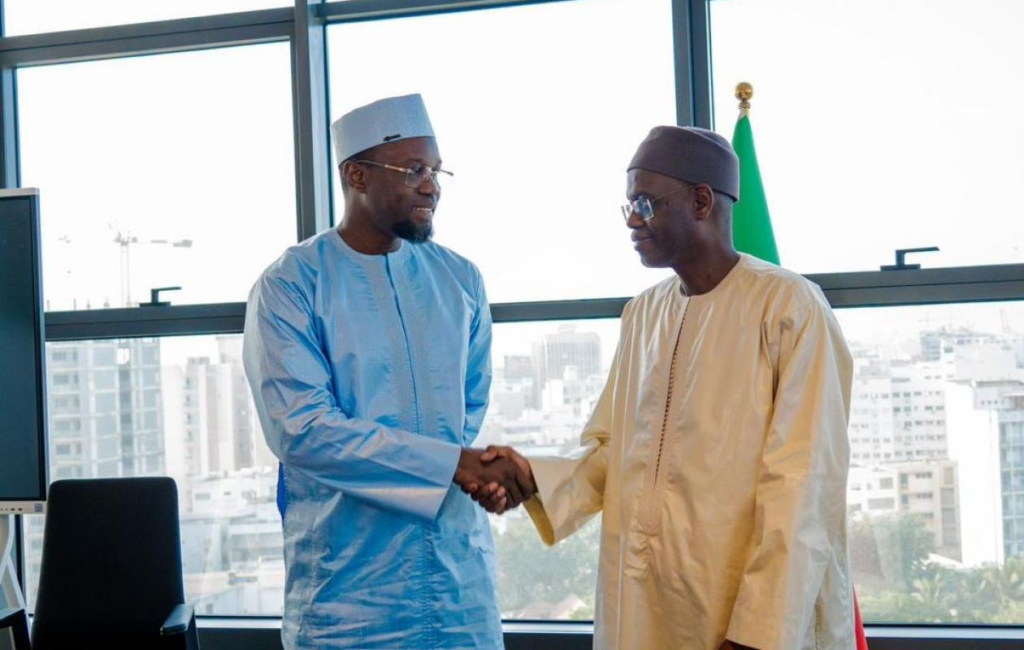
Senegal’s Prime Minister office has undergone a significant structural overhaul following the appointment of Al Aminou Lô in May 2026. This transition, which replaced Ousmane Sonko, has led to a strategic redistribution of key state institutions and services.
The reorganization aligns with Decree No. 2025-1431, which outlines the allocation of government services, public establishments, national companies, and state-owned enterprises among the Presidency, the Prime Minister’s office, and various ministries.
Ousmane Sonko’s administrative legacy
During his tenure as Prime Minister, Ousmane Sonko implemented sweeping internal reforms to streamline operations. One of the most notable measures was Decree No. 2025-1929, issued on November 27, 2025, which introduced several specialized bodies to support government initiatives. These included:
- A reform monitoring and orientation unit;
- A government services inspection body;
- A committee dedicated to asset valorization and recycling initiatives;
- A procurement commission.
The General Secretariat of the Government also saw the creation of new entities, such as a unit responsible for preparing Council of Ministers meetings and tracking institutional dossiers, alongside the National Information Access Commission.
Al Aminou Lô’s structural adjustments
With Al Aminou Lô at the helm, the Prime Minister’s office has been reshaped to enhance efficiency. Notably, the Technical Secretariat of the National Committee for Local Content Monitoring—previously under the Ministry of Petroleum and Mines—has been integrated into the Prime Minister’s cabinet.
Conversely, certain departments have been transferred out of the Prime Minister’s jurisdiction. For instance, the National Civil Service and Volunteering Directorate now falls under the Ministry of Youth and Sports.
Another key change involves the Government Information and Communication Bureau (BIC-Gouv), which has been moved to the Ministry of Communication and Institutional Relations. This shift follows the leadership of journalist Mame Gor Ngom, who previously oversaw the bureau within the Prime Minister’s office.
The National Observatory of Places of Deprivation of Liberty has also been reassigned, now reporting to the Ministry of Justice.
Additionally, the government has discontinued the position of State Secretary for Government Relations and Spokesperson, opting instead for a full minister responsible for Communication and Institutional Relations—a role that now includes government spokesperson duties.
These adjustments reflect a broader effort to clarify administrative responsibilities and strengthen the division of labor between the Prime Minister’s office and line ministries.