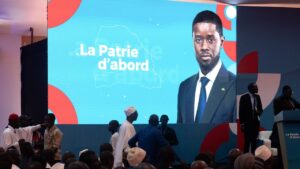
Senegal’s President Bassirou Diomaye Faye has taken a decisive step forward by unveiling KIIRAAY – Les Patriotes Républicains, his new political party, in Dakar on Saturday, July 25. The formal announcement, delivered during a constituent general assembly held at a capital city hotel, marks the President’s political independence from the African Party for Independence, Labour, Ethics, and Fraternity (PASTEF), the movement that propelled him to power in March 2024. The new party adopts the motto ‘La Patrie d’abord’ (The Homeland First), positioning itself from the outset on national sovereignty and institutional resilience.
a clear break from ousmane sonko
The emergence of KIIRAAY comes amid growing public rifts between President Faye and his former mentor Ousmane Sonko, who remains PASTEF leader and Prime Minister. Once seen as the dynamic duo behind a shared wave of change, the two figures have seen their paths diverge in recent months, culminating in this organisational split. For the President, having his own party structure frees him from an increasingly uncomfortable political dependency and equips him with a tool fully aligned with his executive decisions.
The name choice carries deliberate symbolism. In Wolof, kiiraay means protection, a concept that contrasts sharply with the confrontational tone PASTEF had long embraced. While the old party championed sovereignty through rupture, the new formation pledges allegiance to patriotism, republicanism, and institutional stability. This semantic shift reflects the President’s repositioning toward a more centrist, state-centric approach as he consolidates power.
patriotic and republican priorities
KIIRAAY’s blueprint, unveiled during the constituent assembly, prioritises national interest, the strengthening of republican institutions, and the upholding of the rule of law. These priorities signal a shift from protest politics to statecraft and governance. The label ‘Les Patriotes Républicains’ aims to reconcile two imperatives: devotion to sovereignty—a hallmark of the Faye-Sonko alliance since the 2022 legislative elections—and fidelity to republican norms, a message directed at administrative, economic, and diplomatic elites.
This framing carries implications for Senegal’s international partners. Since assuming office, President Faye has sent repeated signals of openness to creditors and investors while renegotiating key hydrocarbon and mining contracts. By founding a party explicitly centred on institutions, he seeks to reassure markets of policy predictability at a time when Dakar aims to maintain access to financial markets and its relationship with the International Monetary Fund.
reshaping Senegal’s political landscape
The launch of KIIRAAY immediately alters the balance of power. PASTEF, now without presidential backing, retains a strong grassroots base but loses the symbolic leverage of the presidency. Traditional opposition groups, from the Senegalese Democratic Party to factions of the Benno Bokk Yaakaar coalition, must recalibrate their strategies in the face of a presidential majority now equipped with its own partisan backbone. The big question is how much of PASTEF’s apparatus—particularly the deputies elected in November 2024—will migrate to the new party.
The political calendar heightens the stakes. Upcoming local elections and preparations for the 2029 presidential vote will serve as early tests for KIIRAAY. The party must quickly prove its ability to build grassroots networks, articulate a distinct policy agenda, and mobilise beyond the activist base inherited from the 2024 campaign. Practically, the contest will also hinge on control of party resources, administrative ties, and regional economic networks.
For President Bassirou Diomaye Faye, the political equation shifts from personal loyalty to the institutional construction of a presidential force. This move ushers in a new chapter for Senegal’s political scene.