Sénégal: may’s social tensions escalate across key sectors
May in Sénégal has become synonymous with social upheaval, uniting workers, students, and public officials in a chorus of discontent. But is this a pattern or mere coincidence?
Why May in Sénégal is a month of reckoning
Since 1968, May has been etched in history as a month of social and political contestation. It begins with the International Workers’ Day—a day dedicated to labor rights, fair wages, and social justice. For Sénégal, this month now mirrors the global spirit of activism, with university protests, labor strikes, and political demonstrations converging into a charged atmosphere.
The timing is no accident. The 1st of May, rooted in the fight for workers’ rights, sets the tone for a month that also evokes the legacy of May 68 in France—a period of student-led uprisings that evolved into a broader labor movement. The ideological ripple effects of those events reached Sénégal and other former French colonies, embedding in local consciousness the idea of May as a month of resistance.
Transport workers strike: a battle over digital ticketing systems
The Association de Financement des Professionnels du Transport Urbain (AFTU) called for a strike on May 1, paralyzing urban transport in Dakar. The dispute centers on electronic ticketing systems, with AFTU accusing an unnamed operator of mismanagement. The Dakar Court of First Instance intervened, ordering the suspension of new ticketing machines and the seizure of those already deployed. The workers’ frustration stems from perceived lack of consultation and unfair labor practices.
Meanwhile, the Fondation Trade Point Sénégal held a press conference to highlight internal governance failures, citing deteriorating workplace conditions, unjustified mass hiring, and a toxic managerial climate.
Ageroute’s HR director exposes leadership failures
At the Agence des Travaux et de Gestion des Routes (Ageroute), HR Director Cheikh Ahmed Tidiane Thiam publicly criticized the agency’s new management, accusing it of lack of transparency, poor human capital management, and abrupt layoffs of 23 staff members. His statements underscore tensions between administrative decisions and workforce stability.
University students demand unpaid scholarships
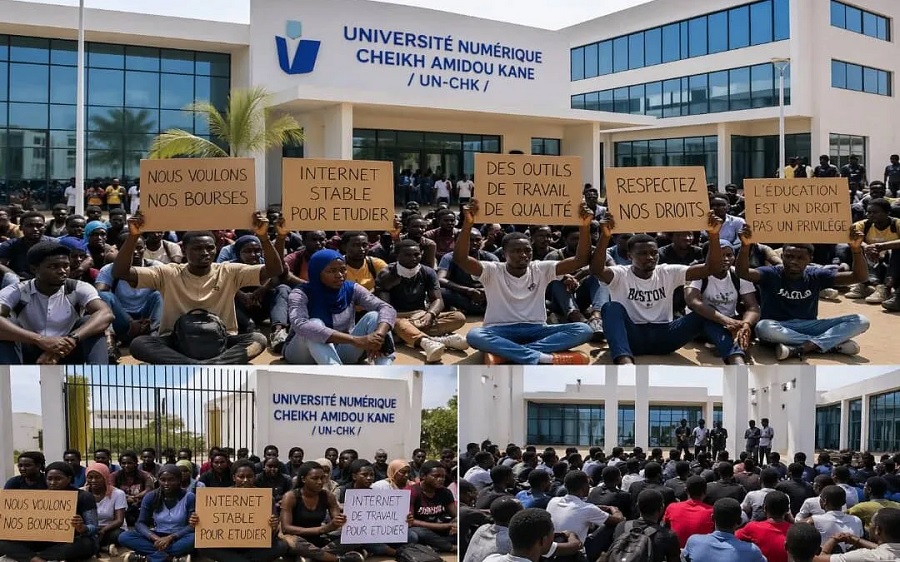
Students from the 10th promotion of the Université Numérique Cheikh Hamidou Kane (UN-CH) took to the press, alleging they had only received two years of scholarship funding out of the three promised for their three-year degree program. Their protest highlights broader concerns over educational funding and student welfare in Sénégal’s digital university system.
A month of collective defiance
From transport workers to university students, from public-sector employees to private-sector advocates, grievances are converging. The intensity of protests across sectors suggests that May in Sénégal is no longer a month of isolated incidents but a synchronized wave of social unrest. Whether driven by policy failures, mismanagement, or unmet demands, the message is clear: authorities must act.