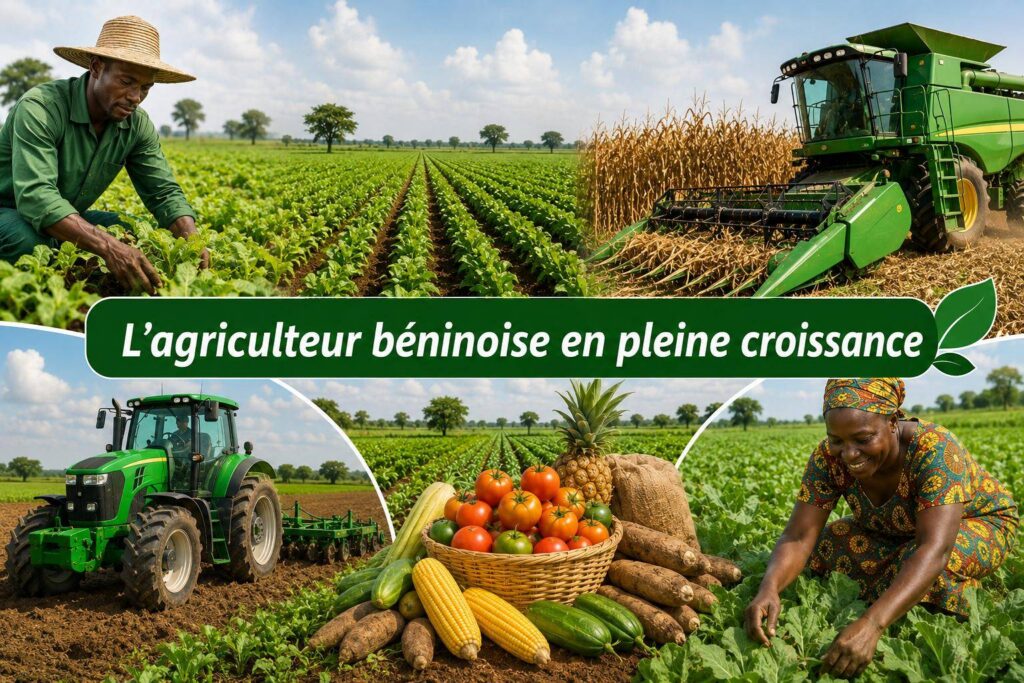
Since the change in governance in 2016, Bénin has witnessed a profound transformation within its agricultural sector. Through a proactive policy approach featuring substantial subsidies, accelerated mechanization, and meticulous land management, the nation has achieved unprecedented production levels. From cotton to pineapple, and including maize and soybean, Béninese agriculture has firmly established itself as the primary engine of national economic growth and a vital guarantor of food security.
The remarkable expansion of strategic sectors: a testament to success
Over a few short years, Bénin’s agricultural campaigns have reached new heights. The ambitious development plans spearheaded by President Patrice Talon’s administration have yielded significant results, propelling production volumes to record levels.
Maize, a staple of local diets, stands as a prime example of this success. Production, which hovered below 1.3 million tonnes in 2016, surged to 2.5 million tonnes by 2025. With internal needs estimated at 1 million tonnes, Bénin now enjoys substantial self-sufficiency. This structural surplus, however, presents the challenge of regulating cross-border flows to ensure stable and accessible prices in local markets.
The soybean sector perfectly illustrates the country’s industrialization strategy. Nearly negligible in 2016 with 140,000 tonnes, production first exceeded 422,000 tonnes by 2022 before continuing its rapid ascent. For the 2024-2025 campaign, production reached an historic 606,016 tonnes, more than quadrupling the initial volume. This achievement primarily supplies the modern processing plants within the Glo-Djigbé Industrial Zone (GDIZ), while also allocating a significant portion for export.
Rice follows a similar positive trajectory. Paddy rice production escalated from 204,000 tonnes before 2016 to 525,000 tonnes by 2022, reaching 1 million tonnes in 2025.
The ‘white gold,’ cotton, remains a flagship of Béninese agriculture. In 2015, the country harvested barely 269,000 tonnes. Since 2016, the average annual production has consistently exceeded 640,000 tonnes, peaking at 766,273 tonnes in 2021. This sustained excellence positions Bénin as a leading cotton producer in Africa, with the ambitious target of one million tonnes still in sight.
Among other cash crops, pineapple recorded a 93% increase, rising from 244,000 tonnes before 2016 to 470,000 tonnes in 2022, with projections to reach 600,000 tonnes soon. Finally, cashew nut production doubled with a 105% increase, climbing from 91,000 tonnes to 187,000 tonnes in 2023, accompanied by a 34% rise in yield. For this sector, the State directly supports producers by subsidizing the purchase price of certified seedlings by 500 FCFA out of a total cost of 600 FCFA.
The shield of subsidies: 110 billion FCFA against input crises
These achievements would not have been possible without substantial and direct financial backing from the State. Confronted by an international environment marked by soaring prices for fertilizers and chemical inputs, which threatened to make these essential products unaffordable, the Talon administration took decisive action to safeguard the farming community.
For the successive agricultural campaigns from 2022 to 2025 (encompassing the 2022-2023, 2023-2024, and 2024-2025 seasons), an extraordinary sum of 110 billion FCFA was injected through subsidies. This robust political decision helped stabilize the cost of production factors, thereby preventing a collapse in yields and shielding Bénin from the threat of food insecurity.
Water management and mechanization: ending archaic farming practices
Another cornerstone of this transformation lies in the modernization of infrastructure and production techniques. Béninese agriculture, long dependent on unpredictable climatic conditions, is progressively breaking free thanks to hydro-agricultural developments. Before 2016, only 6,200 hectares were developed, representing a mere 2% of the national potential. Post-2016, the situation dramatically improved: 25,440 hectares have been developed across 67 communes, quadrupling the previous area. The medium-term objective is to develop 50,000 hectares to bolster the sector’s resilience and enhance producer prosperity.
Concurrently, the arduousness of farm labor is diminishing due to accelerated mechanization. The mechanization rate, which was below 8% before 2016, has doubled. Over 400,000 hectares have been mechanically plowed through the introduction of 5,000 tractor kits, subsidized at half price by the State. To ensure the sustainability of these investments, training initiatives have been implemented, producing 6,000 qualified tractor operators and 300 mechanics. The immediate benefits for farmers include significant savings in time and money, with the government aiming to raise the mechanization rate to 30% by the end of 2026, with 8,000 kits in operation.
Financial restructuring and sustainable ecosystem management
Regarding financing, the previously less effective instruments (FNDA and FADeC-Agriculture) have been replaced by thoroughly restructured tools. The National Fund for Agricultural Development (FNDA) has become the primary vehicle for agricultural credit, funding over 3,000 projects totaling more than 19 billion FCFA. Similarly, the Fund for Support to Communal Development (FADeC-Agriculture) has facilitated 330 communal investments, leveraging 68 billion FCFA. The short-term goal remains continuous governance improvement to impact thousands more projects.
This revitalization is accompanied by a significant ecological awareness. While 80% of Béninese soils exhibited low fertility before 2016, the adoption of sustainable management approaches has enabled the rehabilitation of over 3 million hectares, improving their fertility while protecting them from degradation.
Furthermore, the cleanup and repopulation of water bodies, once polluted and under-exploited, have revitalized the fisheries sector. Overall fisheries production has surged by 79%. A tangible sign of this ecological and regulatory resurgence is the renewed export of Béninese seafood products, particularly shrimp, to the European Union market. Animal production has also seen substantial gains, with increases of 53% for meat and 43% for eggs, alongside strong prospects to cover 75% of national needs.
Towards a territorial market-oriented agriculture
By implementing a genuine territorialization of agricultural development, marked by strengthened governmental functions and targeted promotion of specific sectors, the Béninese government has successfully restructured the rural economy from the ground up. Access to international markets has significantly improved, and strategic partnerships are strengthening daily.
In less than a decade, the bold policy choices and unprecedented financial support from President Patrice Talon’s administration have transformed the perception of land in Bénin. Agriculture is no longer a reluctant subsistence activity but a dynamic, modern, and competitive economic sector. The ongoing challenge is to sustain this trajectory of good governance and enhance oversight tools to ensure that the generated wealth durably benefits every producer across our rural communities.