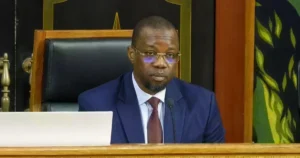
In Sénégal, the ongoing discussion surrounding the alleged “slush funds” from the previous administration has taken a more personal turn. Babacar Bâ, a prominent civil society figure known for his engagement in public governance debates, is now directly challenging the consistency of Prime Minister Ousmane Sonko. Bâ criticizes the head of government for basing a significant part of his anti-corruption rhetoric on denouncing clandestine funds, while simultaneously acknowledging a political fund of 1.7 billion FCFA linked to his own party, Pastef.
scrutiny over perceived contradiction on opaque funds
Since the political transition in March 2024, the executive branch, led by the Diomaye Faye-Ousmane Sonko duo, has prioritized the fight against opaque financial channels inherited from the past regime. The condemnation of “caisses noires,” or discretionary funds operating outside standard budgetary procedures, forms a core element of the official narrative on accountability.
Babacar Bâ, however, contends that this stance crumbles under rigorous examination. He points out that the Prime Minister himself publicly recognized substantial funds collected by his party, without providing precise documentation of the mobilization channels or the contributors. For Bâ’s detractors, the cited amount of 1.7 billion FCFA far surpasses the ordinary standards for political party financing in Sénégal.
the paradox of a 1.7 billion fcfa political fund
The issue of political party financing remains a grey area within Senegalese law. The nation currently lacks a legal framework as stringent as those found in several other West African democracies concerning donation limits or the oversight of party resources. This regulatory void frequently fuels mutual suspicions among political formations.
For Babacar Bâ, the paradox lies precisely in this disparity between the government’s firm discourse on transparency and the relative opacity of the ruling party’s claimed resources. His reasoning questions the very nature of this fund: if it originates from militant contributions, the sheer magnitude of the amount raises eyebrows given the demographics of its members. If it stems from identified donor contributions, he argues, transparency would necessitate detailed public disclosure.
It is important to note that a political party’s right to raise funds for its campaigns is not inherently disputed. The critique primarily centers on the symmetry of expectations. A government that elevates the traceability of public funds to a cardinal principle must, in this interpretation, apply the same standards to its own political apparatus.
a lasting debate on transparency in Senegal
Babacar Bâ’s intervention unfolds amidst a charged political atmosphere. Investigations initiated by the Cour des comptes and various administrative commissions into previous public finance management have dominated headlines for months. Each revelation fuels a confrontational narrative between proponents of the former majority and the new governing authorities.
In this context, Babacar Bâ’s challenge aims to shift the focus of the debate. Rather than merely pitting one political faction against another, he raises the fundamental question of normative consistency: the fight against opaque funds, by this logic, can only be credible if applied uniformly to both public actors and the political formations they represent. The question of Pastef’s funding, largely overshadowed by the electoral dynamics of 2024, is thus resurfacing as the party solidifies its institutional grip.
For international investors and partners keenly observing Sénégal’s governance trajectory, this debate is far from insignificant. The robustness of political financing transparency mechanisms is a key indicator monitored by donors and rating agencies. A legislative tightening, frequently discussed within civil society circles, could emerge as a natural consequence of this controversy. Babacar Bâ has publicly called for Prime Minister Sonko to provide clarification on this 1.7 billion FCFA fund.