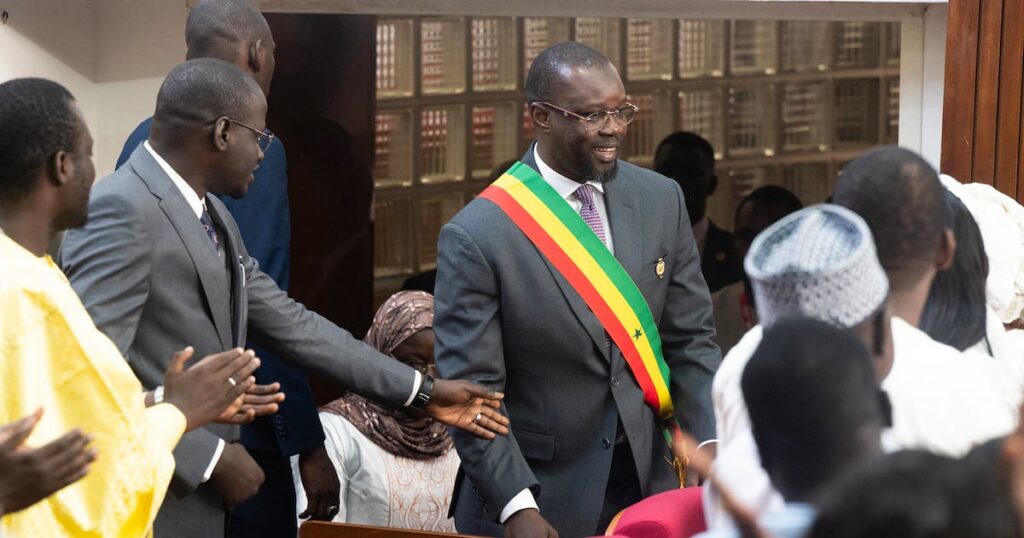
In Dakar, the balance of power is already tilting. Just days after being dismissed by President Bassirou Diomaye Faye, former Prime Minister Ousmane Sonko has regained influence by securing the presidency of Senegal’s National Assembly. This victory, driven by the overwhelming majority of his party, Pastef (Patriotes africains du Sénégal pour le travail, l’éthique et la fraternité), which holds 130 of the 165 seats, marks a significant shift in the country’s political landscape. Sonko succeeds Malick Ndiaye, who resigned on May 24, and assumes office despite strong opposition protests—a clear display of political dominance.
what’s at stake in Senegal’s evolving power struggle
Senegal is grappling with deep-rooted tensions: institutional instability, strained relations with the International Monetary Fund (IMF), soaring national debt, and mounting political pressure ahead of the 2029 elections. Alioune Tine, founder of the think tank AfrikaJom Center and a prominent voice in Senegalese civil society, warns of the risks posed by a prolonged confrontation between the president and his former ally, Sonko.
Who holds the upper hand in the feud between President Bassirou Diomaye Faye and Ousmane Sonko?
Alioune Tine explains that the outcome remains uncertain, but one thing is clear: Senegal has entered a phase of heightened uncertainty and friction. The Pastef party and Sonko’s movement are determined to reclaim political momentum, despite the country’s economic challenges. “This is a period of democratic turbulence in Senegal,” Tine emphasizes.
We are navigating uncharted waters in Senegal’s democracy.
sonko’s parliamentary victory: a strategic power grab
Sonko’s election as Assembly president is more than a political maneuver—it’s a calculated assertion of control. While legal ambiguities surround his eligibility, the political reality is undeniable: the Pastef majority has installed its own leader at the helm of the legislature. “This is a forceful demonstration of power,” Tine notes, adding that the move reflects a deliberate strategy to shift authority away from the executive.
What does this institutional battle reveal about Senegal’s democracy?
The current crisis highlights the deep-seated tensions that have plagued Senegalese politics since the 2000 political transition. Successive transitions have often been marred by violence and instability. Today, with the rise of populist forces, power struggles and rhetorical confrontations dominate the political arena. “Bicéphalisme has never worked in Senegal since the 1960s,” Tine points out.
Shared leadership has repeatedly failed in Senegal’s history.
a parliament in control: the new face of senegalese governance
With Sonko at the helm of the Assembly, the balance of power is shifting. The legislature is poised to take the lead in shaping policy, potentially dictating terms to the executive branch. Sonko’s rhetoric remains uncompromising, amplifying tensions with President Faye. “All future prime ministers will face constant threats of censure,” Tine warns.
Can President Faye govern effectively under these conditions?
The specter of a no-confidence motion looms large, casting a shadow over governance. Every new prime minister appointed by Faye could be at risk of being ousted—a precarious situation that risks undermining stability and investor confidence.
the road to 2029: a looming political showdown
The race for the 2029 presidential election is already underway. Since the “Terra Meeting”—Sonko’s strategic political rally held to outline post-2024 plans—the competition has been intensifying. Observers warn that without careful navigation, Senegal could face a scenario where the current presidential mandate is cut short.
What’s next for Senegal’s political future?
The power struggle between Sonko and Faye is far from over. With Sonko’s party controlling Parliament and Faye leading the executive, the stage is set for a prolonged battle. The question remains: Can Senegal’s institutions withstand the pressure, or will political instability derail progress?