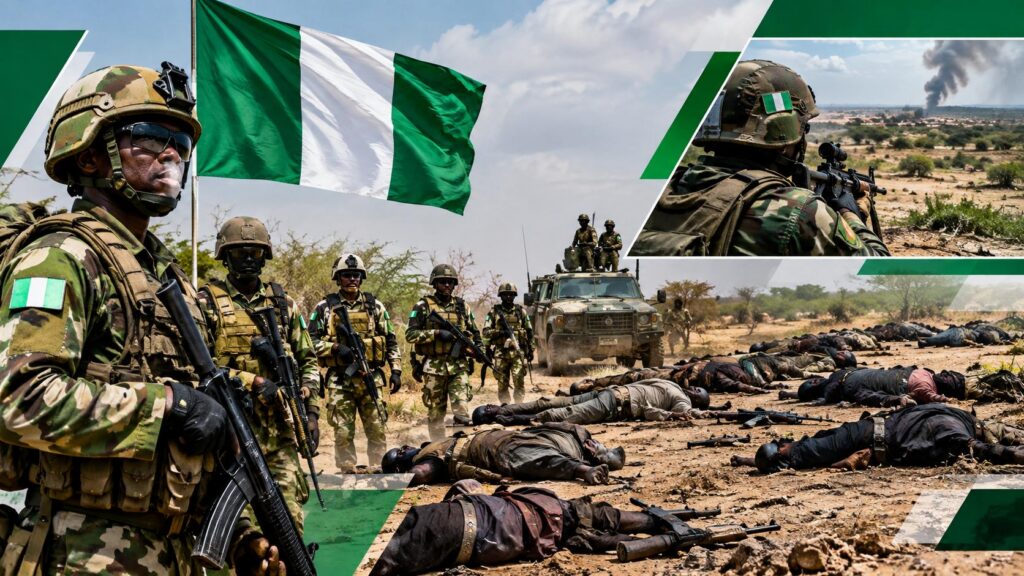
Behind the headlines of battlefield victories lies a deeper strategic shift in Nigeria’s fight against jihadist insurgencies. As the military transitioned leadership of Operation Hadin Kai in Maiduguri, newly released data reveals not just the scale of combat successes but the intricate web of logistical support that sustained Boko Haram and ISWAP for years. These insights expose how intelligence-driven operations dismantled the financial and supply networks that once made insurgent strongholds virtually impregnable.
From battlefield victories to financial warfare
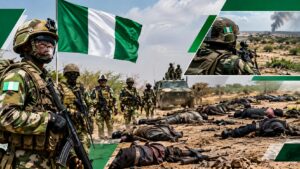
The Nigerian Armed Forces have neutralized over 1,100 fighters and dismantled critical supply chains in the Northeast since April 2025. But according to outgoing Joint Task Force Hadin Kai commander Major General Abdulsalam Abubakar, the real turning point came not from bullets alone, but from severing the financial lifelines that fueled the insurgency.
The military’s latest offensive did more than destroy frontline positions. Intelligence-led raids across Sambisa Forest, the Mandara Mountains, and Lake Chad shorelines uncovered and dismantled 758 suspected logistics operatives—middlemen responsible for procuring food, fuel, weapons, and communication gear. These individuals, often local residents or small-scale traders, had long operated in the shadows, enabling jihadist factions to sustain prolonged campaigns with minimal public visibility.
By targeting these networks, the military didn’t just reduce firepower on the battlefield—it eroded the insurgents’ ability to recruit, pay fighters, and maintain control over civilian populations in occupied zones.
Armor seizures and bomb threats: the overlooked cost of insurgency
While casualty counts dominate headlines, the sheer volume of recovered weaponry paints a stark picture of the militants’ operational capacity. In just months, Nigerian forces seized 475 firearms—ranging from assault rifles to heavy machine guns—alongside thousands of rounds of ammunition. Equally significant was the discovery and neutralization of 295 improvised explosive devices (IEDs), a persistent threat that has long crippled military mobility and civilian movement in the region.
Each IED represents a calculated investment in terror infrastructure: locally manufactured explosives, detonation systems, and coordinated placement. Their removal signals a critical erosion of the insurgents’ ability to conduct large-scale ambushes or sabotage key infrastructure.
Surge in defections: families fleeing the jihadist grip
The combined impact of battlefield pressure and targeted intelligence operations has triggered an unprecedented wave of defections. Since April 2025, 969 individuals, including active fighters and their families, have surrendered or fled insurgent-held areas. This dramatic shift reflects a growing realization among rank-and-file members that the tide is turning irreversibly against the extremist factions.
Under Nigeria’s Disarmament, Demobilization, and Reintegration (DDR) program, former combatants and dependents receive medical evaluation, trauma counseling, and vocational training to facilitate their reintegration into society. The program’s rapid expansion in recent months underscores both the scale of the challenge and the military’s commitment to sustainable peacebuilding.
Rescuing the forgotten: civilians freed from jihadist captivity
Perhaps the most poignant outcome of the intensified campaign has been the rescue of 638 civilians—men, women, and children—held in makeshift detention centers and training camps across the Northeast. Many were abducted during night raids on remote villages, where entire households were forcibly conscripted or used as human shields.
Each rescue operation requires coordinated assaults on fortified positions, often under heavy fire, followed by immediate medical and psychological screening to address malnutrition, trauma, and infectious diseases. Survivors are then transferred to civilian authorities and humanitarian partners for long-term support and family reunification.
What lurks beneath success: the fragile path to recovery
Despite these advances, the region remains on the brink. Over 40,000 lives have been lost and more than two million people displaced since Boko Haram launched its insurgency in 2009. ISWAP, a splinter group aligned with the Islamic State since 2016, continues to exploit porous borders and weak governance to launch ambushes and plant IEDs.
The handover of Operation Hadin Kai leadership arrives at a pivotal moment. While the momentum of recent operations offers hope, sustained security will depend on consolidating territorial gains, rebuilding civilian trust, and dismantling remaining support networks. Without these measures, the cycle of violence—born of poverty, ignorance, and extremist ideology—could resurface with renewed vigor.
The human cost behind the numbers
The military’s progress is undeniable. But behind every statistic lies a story: a farmer displaced from his land, a child born in captivity, a former fighter questioning his allegiances. The real victory will not be measured in body counts or weapon seizures, but in restoring dignity, hope, and stability to a region that has known far too little of both.