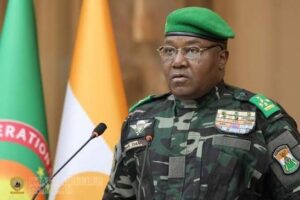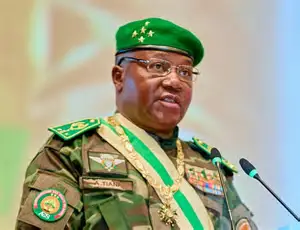
The general commanding Niger’s transitional government, Abdourahamane Tiani, faces a mounting crisis as his forces struggle against a multifaceted terrorist threat and simmering discontent within the ranks. In a desperate attempt to avert disaster in the capital, he has adopted a dual strategy: covert negotiations with armed factions and a sweeping internal military crackdown.
the say talks: a calculated gamble with high risks
On March 24, a discreet meeting near the town of Say marked a pivotal shift in Niamey’s approach. By dispatching a four-member delegation to engage with the Group for the Support of Islam and Muslims (GSIM), General Tiani abandoned his previous stance of absolute intransigence in favor of a pragmatic survival strategy.
Two key tactical priorities emerged from this covert engagement:
- Realigning enemy priorities: With the Islamic State in the Greater Sahara (EIGS) demonstrating its lethal capabilities—most recently with the January attack on Diori-Hamani Airport—the government seeks to neutralize the GSIM through dialogue. The goal is to transform a draining three-way conflict into a more manageable bilateral confrontation.
- Lessons from Bamako’s crisis: Niger watches closely as the GSIM tightens its stranglehold on the Malian capital. By addressing the demands of the Hanifa katiba—such as prisoner releases and an annual tribute—Niamey hopes to secure critical supply routes and breathing space.
internal fractures: the ticking time bomb of unpaid wages
Yet no grand strategy can succeed without a united and motivated army. The recent dismissal of the commander of the Battalion for Security and Intelligence (BSR) in Tahoua, following complaints over unpaid salaries—soldiers received just 800 F CFA instead of the promised 1,200—exposes deep structural weaknesses.
The BSR, once a cornerstone of joint operations with American special forces before their 2024 expulsion, now symbolizes the broader turmoil within Niger’s military. Budget cuts and logistical failures have left troops demoralized. The crisis prompted Colonel Mamane Sani Kiaou, chief of staff of the army, to intervene directly, underscoring how internal dissent may pose an even graver threat than external insurgencies.
a shifting security landscape and new alliances
The surge in covert negotiations coincides with a broader realignment of Niger’s geopolitical ties. Following the withdrawal of French and American troops, Niamey has pivoted toward the Alliance of Sahel States (AES) and forged new partnerships with Russia and Turkey.
While these alliances have brought military advisors and equipment—including surveillance drones—into the country, the operational reality remains challenging. The loss of high-precision aerial intelligence, previously provided by the Niamey and Agadez bases, has forced the junta to reinvent its ground-level diplomacy with former adversaries.
the irony of continuity: echoes of the Bazoum era
The irony runs deep: the transitional government’s tactics increasingly mirror those of the regime it overthrew. Though the July 26, 2023 coup was justified by the alleged security failures of former President Mohamed Bazoum, General Tiani now finds himself relying on the same tools—namely, negotiation as a counterinsurgency tactic.
Under Bazoum, such dialogue was pursued openly, as with the case of kidnapped nun Suellen Tennyson. Today, however, Niamey must operate in secrecy, fearing that any concession to the GSIM could be perceived as weakness by hardline supporters and AES allies, particularly those tied to Al-Qaeda.
The road ahead is fraught with peril. While engaging the GSIM to isolate the EIGS may be a rational move, it carries immense political risks. By entertaining demands for tribute payments or territorial concessions, the junta risks legitimizing armed groups in the long term. For General Tiani, the true battle is no longer seizing power—it is holding together an army that is counting every franc while the enemy counts every inch of conquered territory.