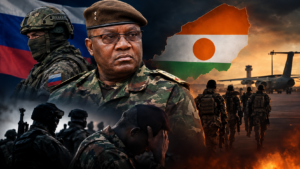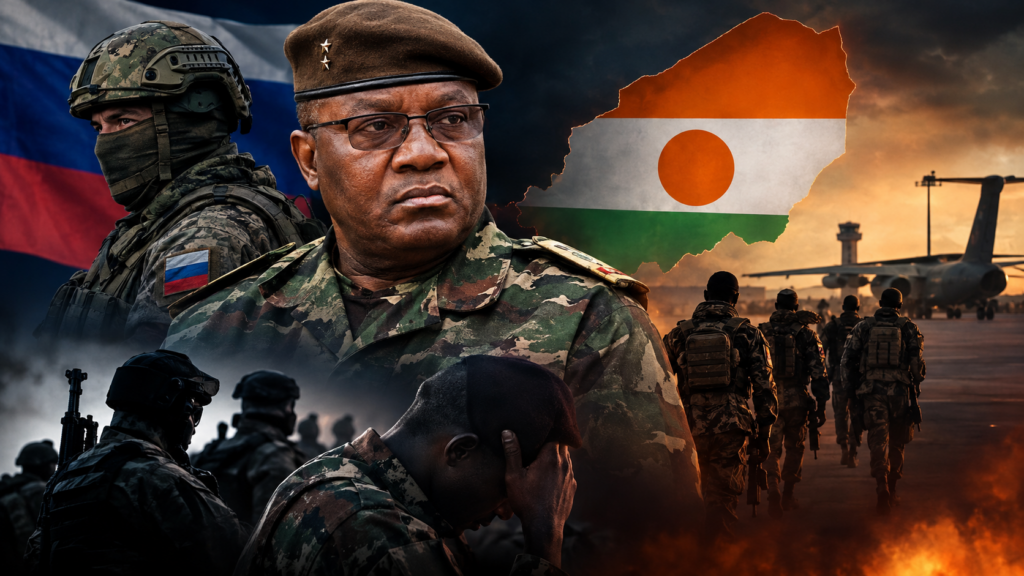
The night of August 28-29, 2026, stands as one of the most turbulent episodes of Abdourahamane Tiani’s rule. In Niamey, soldiers mostly young elements from the special forces mutinied. They targeted Base 101 at Diori-Hamani International Airport, sensitive sites, and the presidential palace area. For nearly twenty-four hours, military power hung in the balance. Crucially, Russian Africa Corps fighters played a decisive role in retaking the air base, providing ground and air support to loyalist forces.
The mutiny that became a purge
After the fighting, arrests multiplied. More than 500 soldiers were detained, mainly from the special forces. Others reportedly disappeared or left the country. Then came the sweeping reorganization of the command chain. On September 11, Moussa Salaou Barmou, chief of defense staff and former special forces commander, was dismissed and replaced by General Mamane Sani Kiaou. Days later, Barmou was placed under surveillance, possibly house arrest. Officially, the regime cited “dysfunctions” in the command chain during the mutiny. But that explanation leaves considerable ambiguity, because Barmou was no ordinary officer. He knew the special forces from the inside and had commanded them. His opposition to a Russian intervention against Nigerien soldiers during the August 29 crisis reportedly fueled suspicions against him.
Russia’s role at the heart of the matter
Since 2023, Tiani has deeply reoriented Niger’s security policy toward Moscow after breaking with several Western partners. When his power was directly threatened by the mutiny, the Russian Africa Corps found itself at the center of the response. The symbolism is powerful: Nigerien soldiers rising against their own command, and to restore order, the regime relies on Russian fighters. The Africa Corps participated in operations to retake the air base, and the Russian intervention helped end the mutiny, with deaths and arrests among the mutineers. This raises a key question: did the Russian intervention merely save Tiani’s power, or did it also help reshape the balance of power within the Nigerien army?
Barmou: the general who became inconvenient?
The case of Moussa Salaou Barmou deserves special attention. He had taken part in the July 2023 coup and became one of the new regime’s key figures. But his military background and ties to certain American networks set him apart from Tiani’s assumed pro-Russian turn. When the special forces found themselves at the heart of the mutiny, the chief of defense staff mechanically became a central figure. Could the regime trust him? Could his adversaries blame him for the insubordination of units he once commanded? And above all, what happened between him and Russian officials during the most critical hours of the mutiny? The answers remain incomplete. But one thing is documented: days after the crisis, Barmou lost his post.
“Liquidation”: an accusation that demands proof
Some accounts now present the events as Tiani’s desire to “liquidate” special forces hostile to the regime. This accusation is extremely serious. Available information does establish significant repression after the mutiny, with mass arrests and a restructuring of the military hierarchy. However, at this stage, it does not publicly establish that a general order to “liquidate” the special forces was given by Tiani. This is precisely where the real investigative work begins. Who gave the orders during the clashes? Which units opened fire? How many soldiers were killed? How many are detained? Under what conditions? Which officers were questioned or sidelined? And what exact role did Russian fighters play in ground and air operations? These are questions to which the Nigerien regime has still not provided complete public answers.
The paradox of a regime that promised to restore the army
Tiani had justified the 2023 seizure of power by the need to restore security and put the army back at the center of national defense. Three years later, part of the armed forces turns against the regime. And when the crisis erupts, the regime calls on a foreign military partner to retake strategic infrastructure before carrying out a deep reorganization of its own military apparatus. The problem thus goes beyond the Barmou case alone. It touches the very heart of the security model built by Tiani. When a military regime must rely on foreign forces to contain a mutiny of its own soldiers, then sideline part of its command after the fighting, it is no longer just a disciplinary crisis. It is a sign of a deep fracture within the apparatus that holds power. And behind official statements, appointments, and arrests, one question remains: how much more blood will be spilled before the truth about the night of August 28-29 finally emerges from the barracks?
By Georges Essomba — Regional Policy and International Economics