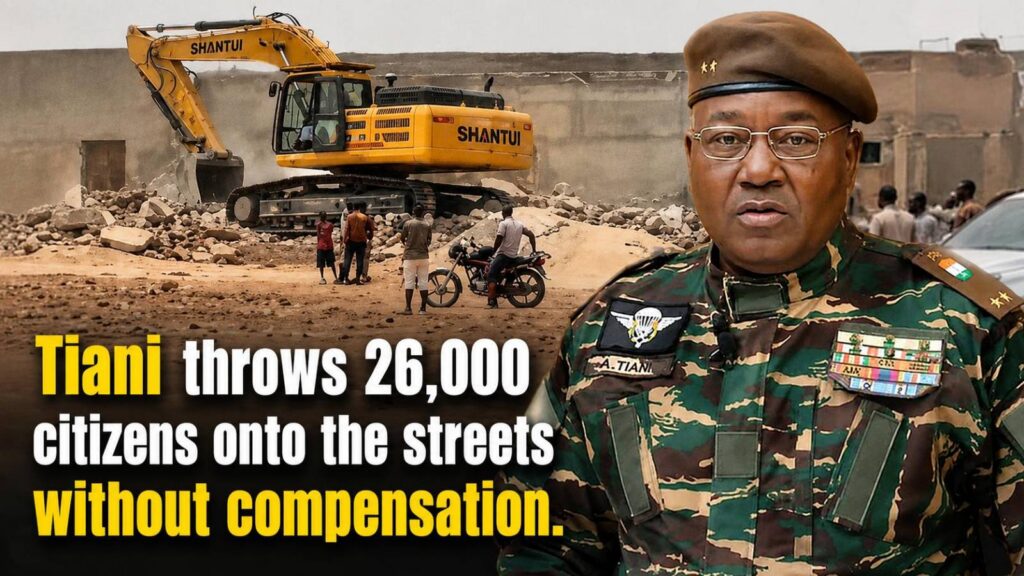
The announcement of a mass eviction involving 26,000 individuals in Niamey has ignited widespread condemnation across civil society. By executing this sweeping operation without any support measures or relocation plan, the transitional government, led by General Abdourahamane Tiani, has prioritized brute force over fundamental human rights. The question now arises: is this the governance approach Niger deserves?
« I barely slept last night! » declared Maikoul Zodi, a prominent figure in Niger’s civil society, in response to what can only be described as a humanitarian crisis unfolding. Displacing 26,000 people overnight is tantamount to erasing an entire small town from the map. While authorities often cite urban planning or security imperatives to justify such demolition waves, the methods employed here skirt dangerously close to illegality and inhumanity.
Flagrant disregard for national and international laws
Governance cannot be reduced to signing eviction decrees from the polished halls of the National Council for the Safeguarding of the Homeland (CNSP). At its core, governance means protection. Yet, by plunging thousands of families into absolute precarity, the putschist regime has flouted the most basic legal frameworks.
As Maikoul Zodi rightly emphasizes, Nigerien domestic law—as well as international treaties, particularly those concerning economic, social, and cultural rights ratified by Niger—strictly regulate public land release procedures. Any large-scale space liberation requires:
- A prior commodo and incommodo inquiry,
- A rigorous census of affected populations,
- And above all, fair compensation and a viable relocation plan before any execution.
Without these critical safeguards, this operation can only be classified as a « forced eviction, » a practice explicitly prohibited under international law and constituting a blatant violation of human rights.
Thousands of lives abandoned to fate
The cold, bureaucratic term « forced eviction » masks harrowing human realities. Behind it lie thousands of children abruptly cut off from education, women, the elderly, and low-income workers thrust into homelessness and extreme poverty.
Amid a socio-economic landscape already suffocating under successive crises, how can a government deliberately cast its own citizens onto the streets without considering their future? What alternative is offered to these 26,000 souls? None. They are simply abandoned to their grim fate.