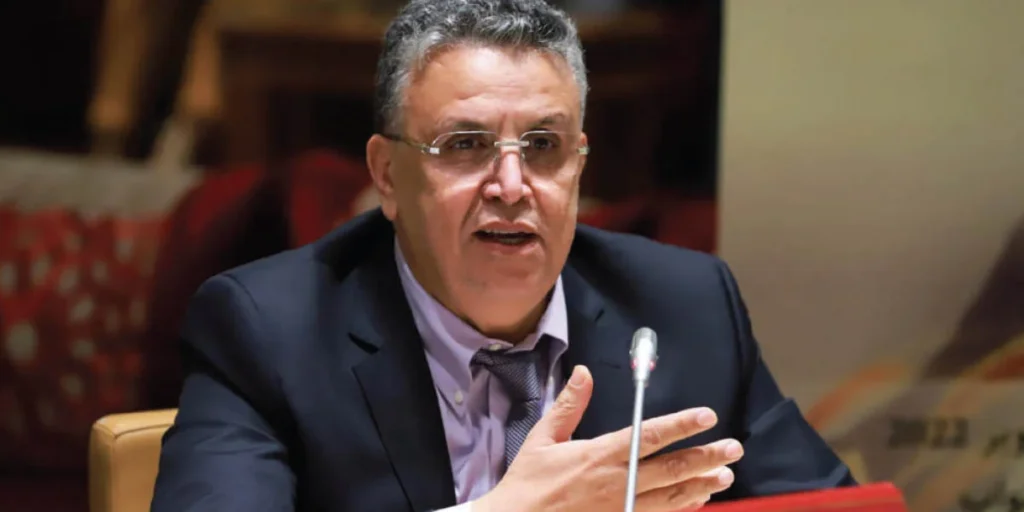
The Moroccan government has once again emphasized its claims to Ceuta and Melilla, two territories it regards as integral parts of its national sovereignty. During a recent interview, Minister of Justice Abdellatif Ouahbi stated that Rabat remains committed to pursuing these historical claims through dialogue and strategic patience. While acknowledging that the issue frequently arises in bilateral discussions between Morocco and Spain, he underscored that the matter remains open for negotiation.
Addressing the recent surge in irregular migration—particularly the large-scale crossings into Ceuta on July 30 and 31—Minister Ouahbi called on Spain to take full responsibility for the repatriation of unaccompanied Moroccan minors who entered Spanish territory. He also criticized Spain’s approach, noting that while Morocco is expected to curb irregular departures, those who successfully reach Spain gain access to legal procedures, creating an imbalance in shared responsibilities.
The minister further stressed the need for both nations to align their legal frameworks and operational strategies in combating illegal migration. “Morocco cannot be Europe’s border guard,” he stated, emphasizing that countering irregular migration requires a collaborative effort rather than unilateral action.
The following day, Spain’s Ministry of Foreign Affairs firmly rejected Morocco’s sovereignty claims over Ceuta and Melilla. Officials reiterated that the status of these territories is not—and will never be—up for negotiation, affirming that Ceuta and Melilla are “permanently and internationally recognized as integral parts of Spain’s territorial integrity.”
Diplomatic tensions rise as Spanish officials react
During a visit to Ceuta, Spanish Foreign Minister José Manuel Albares avoided addressing Morocco’s claims, focusing instead on the recent migration crisis. He acknowledged Morocco’s willingness to accept the return of unaccompanied minors who entered during the recent influx, framing it as a positive step in bilateral cooperation.
The president of Melilla, Juan José Imbroda, took a more confrontational stance, publicly questioning Morocco’s ability to manage its own affairs. “What purpose do Ceuta and Melilla serve if you cannot control your own people and your youth are fleeing?” he remarked in a widely circulated statement. The representative, affiliated with Spain’s Partido Popular (PP), described the migration situation as an “international embarrassment” for Morocco, urging the country to handle the crisis with greater dignity.
In response, Morocco’s Ministry of the Interior highlighted the shared responsibility of both nations in managing migration flows. The department cautioned against online calls encouraging further crossings on August 15, emphasizing that effective solutions to irregular migration and human trafficking require coordinated action rather than placing the burden solely on one side.