Mali’s sovereignty crisis: a regional domino effect
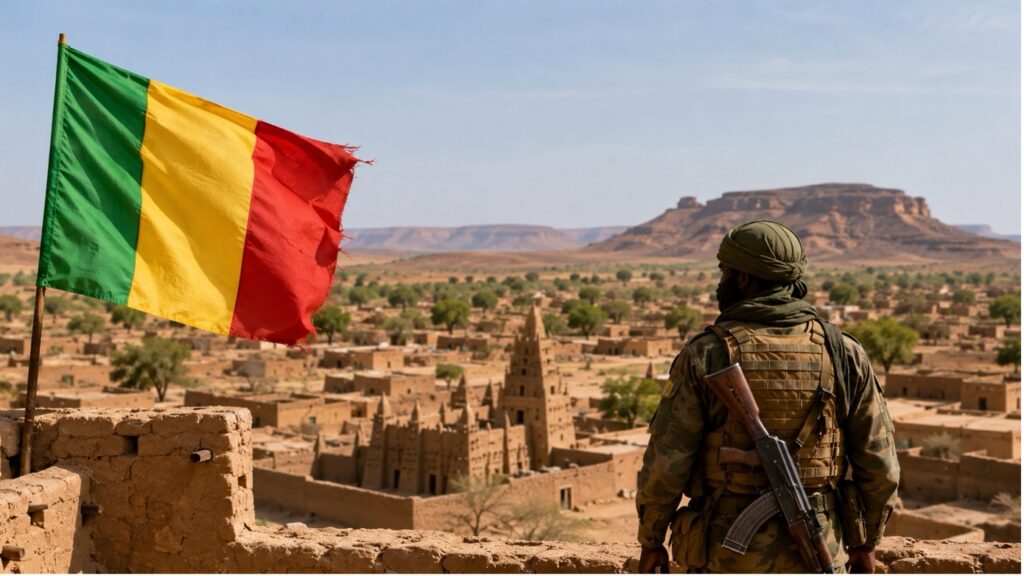
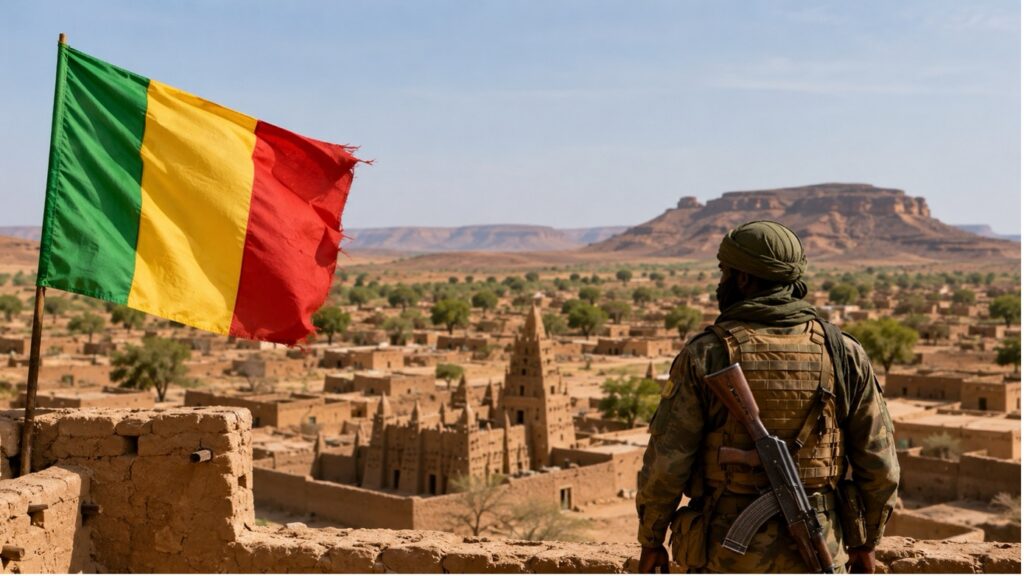
For over a decade, Mali has been trapped in a multidimensional crisis reshaping Sahel geopolitics. The gradual erosion of central state authority has fragmented the territory, where armed groups and foreign powers now vie for control. Long a cornerstone of Western counterterrorism strategies through Operation Serval (2013) and Barkhane (2014), Mali underwent a historic shift in 2022 by demanding the withdrawal of French troops. This move marked a strategic pivot toward Russia, elevating sovereignist rhetoric to the heart of its political narrative.
The juncte’s ambition crystallized in September 2023 with the creation of the Alliance of Sahel States (AES), alongside Burkina Faso and Niger. The bloc aimed to redefine regional balances outside Western influence. Yet this quest for full sovereignty now faces harsh military and diplomatic realities. Coordinated attacks by the JNIM and FLA, compounded by internal instability and Russia’s paramilitary repositioning, threaten to unravel the alliance’s foundations.
How does Mali’s current security collapse and the negotiated withdrawal of Africa Corps from Kidal expose the fragility of the AES’s sovereignist project amid Algeria’s and Russia’s competing influences?
Collapse of Mali’s command: from April 25 offensive to Kidal’s fall
The crisis escalated with a series of warning signs: the targeted assassination of a Malian soldier in Konna on April 20, followed by the Islamic State in the Sahel’s attack on Tessit on April 22. The porous defense lines exposed the regime’s vulnerability. The arrests of prominent generals—Abass Demblélé and Kéba Sangaré—revealed a climate of terror where special forces prioritized regime survival over national security. The departure of French forces left a security void that indigenous solutions, despite Russian support, failed to fill.
The arrival of Wagner Group-led Africa Corps intensified violence against civilians under an anti-insurgency framework, exemplified by the Mourrah operation. Failing to stabilize the territory, the junta’s sovereignist narrative collided with operational failure. By April 25, an unprecedented offensive struck key hubs: Mopti, Konna, Sévaré, Bourem, Gao, Bamako’s international airport, and the Kati garrison. A car bomb destroyed the defense minister’s residence, killing Sadio Camara and severely injuring generals Modibo Koné and Oumar Diarra. President Assimi Goïta’s exfiltration marked the collapse of the politico-military command, laying bare the regime’s core vulnerability.
That evening, the JNIM claimed responsibility in an official statement and, alongside the FLA, announced the capture of Kidal. On April 26, Africa Corps negotiated a withdrawal corridor before abandoning the city, leaving behind equipment and munitions. By April 27, the presidency remained silent while the army cited a mere repositioning, starkly at odds with ground realities. Local and regional sources reported disorderly troop movements, desertions, and communication blackouts between headquarters.
Between April 28 and May 1, the situation deteriorated rapidly. Coordinated attacks paralyzed vital routes linking Gao, Ménaka, and Ansongo, isolating the East’s main garrisons. The Malian security apparatus showed signs of rupture, with loyalist units retreating to Ségou and Koulikoro under dual pressure—armed groups and internal disorganization. Clashes between army factions fueled rumors of an impending coup, while Goïta’s prolonged absence intensified speculation about a power vacuum. By May 2, diplomatic efforts in Algeria and Mauritania sought a negotiated political solution, but their success hinged on an increasingly complex reality: the tactical alliance between the FLA and JNIM.
FLA–JNIM alliance: historical trajectories, asymmetric warfare, and strategic corridor control
The alliance between the Front de Libération de l’Azawad (FLA) and the Group for Support of Islam and Muslims (JNIM) has become a pivotal turning point in Mali’s crisis. Two distinct historical trajectories now converge toward a shared goal: ousting the junta and reshaping balances in the North and Center. Yet their primary objective remains regaining control of strategic spaces underpinning the Sahel’s criminal economies.
This convergence culminated in the coordinated attacks leading to Kidal’s fall and the accelerated disorganization of loyalist forces in the North and Center. The FLA draws from the Tuareg rebellions of the 1990s, 2006, and 2012, driven by identity and territorial claims long ignored by Bamako. The Tamanrasset (1991) and Algiers (2006, 2015) agreements attempted to address these grievances, but incomplete implementation fueled lasting marginalization. Post-2015 purges and tribal rivalries weakened Tuareg structures, paving the way for the FLA’s emergence as the most recent and structured expression of dissent.
The JNIM, born from the GSPC’s mutation and AQIM, consolidated its Malian foothold in the 2000s. Its 2017 merger—bringing together Ansar Dine, Al-Mourabitoune, and the Macina Katiba—placed the group under Iyad Ag Ghali’s unified command. Since 2025, the JNIM has pursued a dual strategy: positioning itself as a local political interlocutor while maintaining extreme violence, marked by grave human rights violations and decentralized power to align its Katibas with local entities. This approach allows it to expand influence in the Center and North by exploiting community tensions, corruption, and public service inefficiencies.
The FLA–JNIM alliance leverages advanced asymmetric warfare. The JNIM’s operational effectiveness relies on hybrid tactics, including vehicle-borne improvised explosive devices (VBIEDs) for breakthroughs and fast motorcycles for exploitation. Its arsenal features night infiltrations, intensive improvised explosive device (IED) use to paralyze army movements, targeted assassinations, and systematic harassment of isolated garrisons to erode troop morale and break local command chains. Mastery of drones and anti-aircraft warfare gives it an edge in mobile combat, as seen in Tinzaouaténe, though it struggles to hold fortified positions. The FLA contributes critical territorial expertise: intimate knowledge of tracks, extreme mobility, lightning strikes, tribal network exploitation, and the ability to hold symbolic zones like Kidal—a feat confirmed by Africa Corps’ negotiated withdrawal.
Beyond military aspects, the conflict is a struggle for resource control, both licit and illicit. By securing the Kidal–Gao–Mopti triangle, the JNIM and FLA aim to sanctuarize transit corridors vital to the war economy. Controlling these axes finances military activities through smuggling rents (gold, fuel) and illegal trafficking (narcotics, migration networks), transforming territorial control into a financial lifeline. This logic extends to the Bamako–Kayes–Bakel axis, where tolls are levied daily on the 3,000 trucks supplying Mali via Senegal’s Dakar port.
The locking of Saharan corridors saturated the army’s reaction capacity, transforming a mobile war into systemic collapse. The rapid fall of Kidal, Gao, and Sévaré underscored the FLA–JNIM’s complementary effectiveness against a headless Malian command. The regime’s pillars crumbled as rumors of a coup in Bamako swirled, confirming the crisis had transcended security to threaten the very existence of the Malian state.
The Islamic State in the Sahel: the prime beneficiary of Sahel chaos
The Islamic State in the Sahel (EIS) has become the most volatile and unpredictable actor. Since 2023, it has consolidated its foothold in the Ménaka–Ansongo corridor, exploiting state collapse and rivalries between armed groups to extend control over Mali–Niger borderlands. Unlike the JNIM, which seeks localization, the EIS pursues expansion through terror, eliminating perceived hostile communities and capturing trade routes. The collapse of Mali’s command opens a strategic space the EIS could exploit—either challenging the JNIM for jihadist leadership or seizing new sanctuaries in a fragmented territory.
With the AES unable to pool forces, the EIS emerges as the crisis’s prime potential beneficiary. This dynamic is amplified by Africa Corps’ precipitous withdrawal, leaving a security void neither Mali’s weakened army nor its regional allies can fill.
Africa Corps in Mali: the end of Russia’s exception
Since 2022, Russia has treated Mali as a security laboratory and strategic projection point into the Sahel. Moscow acts as a custom security broker, supplying weapons, instructors, mercenaries, and protection in exchange for mining concessions, logistical access, and political favors. Its strategy is purely extractive: securing gold and lithium deposits takes precedence over Mali’s development. Five years after Wagner’s initial deployment, paramilitary presence has institutionalized under Africa Corps, a 1,000–1,200-strong contingent (instructors, drone specialists, protection units) under direct Russian Defense Ministry oversight via a tactical headquarters in Bamako.
Despite this structured network, the security outcome is paradoxical. Violence has intensified, rural control has eroded, and rural zones remain beyond reach—illustrating the limits of a proxy security model. The model’s failure was starkly exposed by the late April 2026 reversals in Kidal and Gao. The negotiated withdrawal of Russian forces marked a major tactical rupture, transforming the strategic partner into a retreating actor. The JNIM’s direct outreach to the Kremlin, proposing a non-aggression pact while ignoring Bamako, sealed Mali’s diplomatic isolation and confirmed the junta no longer holds decision-making power.
Russia’s position is further weakened by Turkey’s rise as an alternative security player. Ankara now supplies Bamako with drones, guided munitions, light armored vehicles, and surveillance systems—equipment that is faster to deliver, more flexible, and often cheaper. This appeal is fueling internal rivalries within the junta: some officers lean toward Turkey, while others remain aligned with Moscow. This competition exacerbates command cohesion already strained by the death of Defense Minister Sadio Camara, the injuries of General Modibo Koné, and Goïta’s prolonged absence. The junta’s chief’s reliance on Turkish private forces for security suggests a rejection of Russian contingents, whose influence appears waning.
Russia’s Sahel posture has shifted from offensive sovereignism to defensive retreat. Africa Corps’ inability to secure vital axes or hold Kidal revealed structural limits of Moscow’s security offer against a multisectoral threat. Meanwhile, Turkey’s growing clout further diminishes Russia’s leverage in Mali, leaving a void that forces a return to regional diplomacy—where Algeria emerges as the silent pivot.
Algeria: the silent pivot of Sahel recomposition
Since the 1990s, Algeria has played a central role in managing Mali’s crisis, brokering the Tamanrasset (1991) and Algiers (2006, 2015) agreements. For Algiers, northern Mali is a vital buffer for national security. Its doctrine rests on two pillars: preventing foreign forces at its borders and maintaining a delicate balance among local armed groups in the Sahara.
Algeria seeks a Mali that is neither fully collapsed nor fully autonomous. Its strategy aims for relative stability that keeps Bamako dependent on its mediation. To achieve this, Algiers leverages historical ties with Tuareg communities while monitoring jihadist groups from the GSPC and AQMI, many of whose leaders emerged from Algeria’s 1990s insurgency. By keeping a watchful eye on these groups, Algeria ensures the Malian sanctuary does not become a rear base for attacks on its northern frontier.
Algeria’s Sahel strategy historically relied on the Tuareg lever, instrumentalizing Azawad movements as a permanent counterweight to Bamako. Yet this diplomatic architecture collapsed under a dual rupture. First, the Malian junta violated Algeria’s foundational doctrine by inviting massive Russian intervention. Second, rapprochement with Nouakchott accelerated under Algerian diplomatic stewardship, with Mauritania’s political support and regional partners’ financing.
Meanwhile, Morocco’s growing influence with the Malian junta has heightened Algeria’s regional vigilance. By facilitating the AES’s access to the Atlantic and strengthening economic partnerships, Rabat is extending its Sahel reach. For Algiers, Morocco’s presence on its southern border is interpreted as a strategic encirclement maneuver.
In the current crisis, Algeria emerges as the silent yet decisive actor. It refused Russian mercenaries’ presence in Kidal and secured Moscow’s withdrawal in line with its security doctrine. This positions Algiers as the indispensable mediator, though contested by Bamako, for any future political or military recomposition. Yet Algeria must contend with the AES’s emergence—a bloc politically united against foreign influences but struggling to translate rhetoric into real military capacity.
The AES: a political project hobbled by operational impotence
Established in September 2023, the Alliance of Sahel States (AES)—comprising Mali, Burkina Faso, and Niger—aspires to sovereign autonomy, emancipation from regional organizations, and resistance to international pressure. The bloc touts ambitious goals, from a joint counterterrorism force to a common market and a logistical corridor to the Atlantic. New partnerships with Russia, Turkey, Iran, and the UAE aim to support this vision. Yet these projects remain aspirational.
The AES’s joint force announcement is emblematic of its declarative nature. Lacking integrated command, shared doctrine, or operational capabilities, the alliance failed to intervene during Kidal’s fall or subsequent coordinated attacks. This chasm between political ambition and military reality highlights the bloc’s fragility. The three member states are mired in deep crises: eroding border control, economic asphyxiation from sanctions and investment droughts, and institutional instability exacerbated by successive purges. The rupture with ECOWAS further isolates the AES, depriving it of regional partners capable of compensating for its military weaknesses.
Thus, the AES appears less as a military alliance capable of stabilizing the region than as a political instrument to legitimize incumbent regimes.
Sahel dynamics: predictive analysis of regional recomposition scenarios
A predictive geopolitical lens reveals four potential trajectories for Sahel recomposition, contingent on evolving power balances and actor interactions. The central scenario anticipates persistent tensions, with the AES remaining a political framework devoid of military translation. A relative stabilization could emerge if Algerian mediation succeeds in brokering peace initiatives, reducing JNIM and FLA offensives. Yet the risk of rapid degradation looms: a major terrorist attack on a strategic target could precipitate systemic security and social collapse. A rupture scenario, triggered by an internal coup or social explosion, cannot be ruled out—potentially toppling the junta outright.
The Sahel at the mercy of a void: toward total regional recomposition
President Assimi Goïta’s tenure now hinges on a precarious conjuncture. Restoring credible command in a dislocated state apparatus is his central challenge. The deaths of Sadio Camara and Modibo Koné shattered the junta’s security backbone, while Goïta’s prolonged absence fuels speculation and internal rivalries. The army, weakened by purges and demoralization, is no longer a sovereignty instrument but a fragmented body—split between the National Guard, Ground Forces, and red berets—dependent on increasingly volatile external allies.
Since 2025, the JNIM’s blockade around Bamako has drained the capital’s resources, culminating in the April 25 offensive that exposed the political center’s vulnerability and accelerated social crisis. Mali is not just losing ground militarily; it is losing control of its sovereignist narrative. The withdrawal of Africa Corps, the rise of the FLA–JNIM alliance, Turkey’s growing influence, and Algeria’s diplomatic resurgence reveal a country once again contested as an arena of influence. External powers are redrawing regional balances as European powers disengage from the Sahel, focusing on other fronts.
In this recomposition, the Malian people bear the heaviest burden. They endure insecurity, diplomatic isolation, economic contraction, and political disenfranchisement. Sovereignty is confiscated by soldiers, armed groups, or foreign powers—each pursuing divergent agendas. The democratic project, weakened since 2012, recedes further as popular sovereignty becomes uncertain.
Burkina Faso may be the next vulnerable link. Porous borders, advancing armed groups, weakening institutions, and heightened dependence on external partners render it susceptible to spillover effects from Mali’s crisis. This conflict is no longer an isolated episode but the opening act of a destabilization sequence with repercussions far beyond the central Sahel.
The crisis in Mali demands an urgent evaluation of its potential European ripple effects—migration flows, illicit trafficking, and the emergence of armed groups capable of destabilizing Gulf of Guinea states. As states collapse, armed actors rise, and external powers compete, the Sahel is embarking on a profound recomposition whose tremors will echo across West Africa.