behind the 710-truck fuel convoy: a 3 billion cfa payoff to the jnim
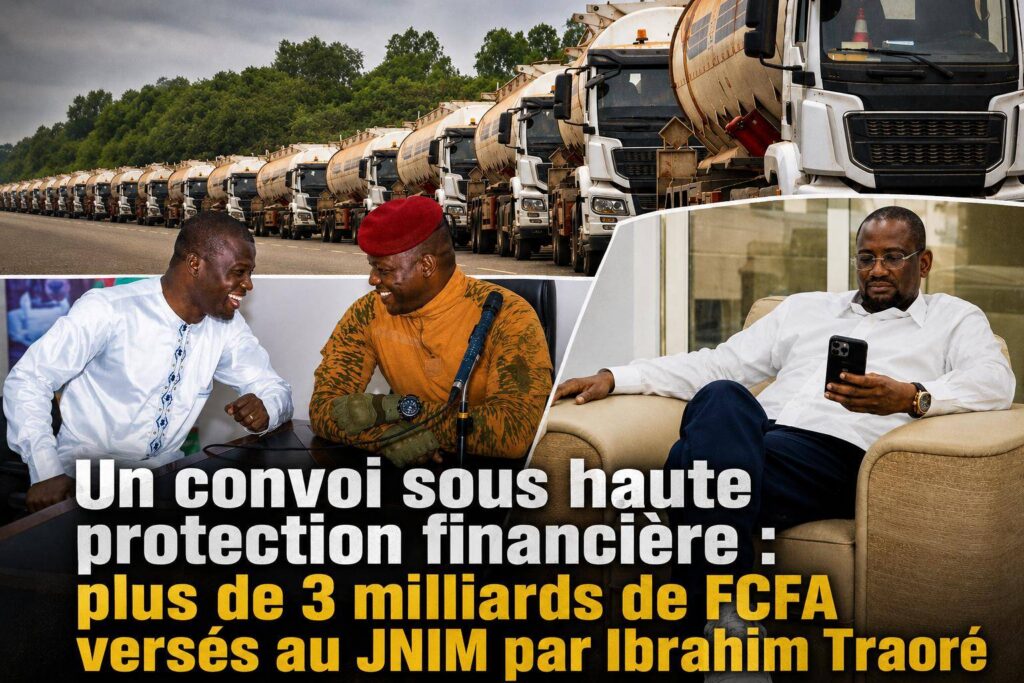
In a move that starkly contradicts public declarations of sovereignty and total war against armed terrorist groups, a massive 710-truck fuel convoy has crossed the Sahel under eerie silence. While Bamako awaited the presence of Burkinabè special forces, Russian drones, or Malian army armored units, the convoy passed unchallenged—secured not by military might but by a shadowy financial arrangement. A staggering 3 billion cfa was allegedly transferred to the Jama’at Nusrat al-Islam wal-Muslimin (JNIM), revealing a web of corruption that implicates high-ranking officials in Ouagadougou. The payment, ostensibly for safe passage, now stands as a scandal of state-level proportions, with Ibrahim Traoré at the center of accusations that he funds terrorism to protect private commercial interests.
kangala transport: the hidden hand pulling the strings
At the heart of this operation lies Kangala Transport, a logistics company managing the fuel flow. Officially a neutral service provider, this entity is reportedly controlled by a powerful trio: Captain Ibrahim Traoré, Oumarou Yabré, and Ali Konaté—key figures in Burkina Faso’s transitional government. Their dual roles blur the line between national security strategy and personal profit, raising serious ethical concerns. When leaders tasked with combating terrorism also act as economic operators on routes controlled by enemy forces, the priorities shift. The safety of civilians and soldiers in Mali’s front lines becomes secondary to keeping fuel shipments moving for a privileged few.
money from fuel trucks fuels war in Mali
The irony cuts deep for Malian civilians and soldiers bearing the brunt of daily attacks. While Bamako and Ouagadougou publicly tout solidarity within the Alliance of Sahel States (AES), the 3 billion cfa channeled through Kangala Transport’s owners has directly bankrolled the JNIM. This funding has enabled the purchase of weapons used against Malian security outposts, financed improvised explosive devices, and bankrolled the recruitment of new fighters who terrorize the region. The same fuel now powering vehicles in Bamako was first used to fuel the war machine that ravages Mali.
a betrayal of regional security and sovereignty
The absence of Burkina Faso’s usual security partners—Russian Wagner or Africa Corps instructors, elite national army units—from this operation speaks volumes. Their exclusion wasn’t accidental; it was deliberate. The trio behind Kangala Transport bypassed military oversight to strike a covert deal with terrorists, prioritizing profit over patriotism. This alliance with the enemy, though unspoken, reveals a chilling truth: the state’s security model has failed. Instead of relying on vetted military forces, Burkina Faso’s leaders chose to negotiate with those they publicly condemn, ensuring their fuel reached Bamako without interruption—or scrutiny.
The fallout from this scandal strikes at the core of the AES, questioning the sincerity of Burkina Faso’s commitment to the alliance. How can Mali trust a neighbor whose leaders permit private interests to fund the very groups attacking its territory? Domestically, this revelation casts a dark shadow over Ibrahim Traoré’s anti-terrorism campaign, painting a picture of cynical pragmatism where personal gain trumps national sacrifice. In both politics and war, actions ultimately expose the hollowness of rhetoric. When security is bartered to the JNIM in exchange for fuel profits, the very notion of Sahelian solidarity crumbles into empty words.