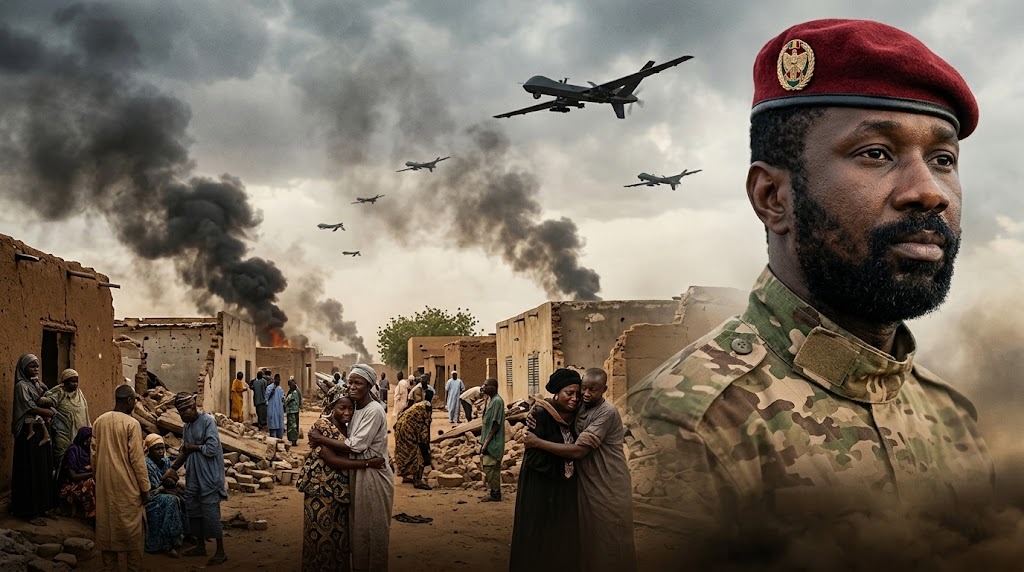
The drone war in Mali has entered a new and deeply contested phase. What was once presented as a precise, surgical tool for hunting armed groups has increasingly become the centre of a national argument about who protects civilians — and who answers for them when they die. Over three years, between September 2023 and September 2026, an estimated 731 civilians were killed in 199 strikes, according to ACLED data cited in a joint investigation by Jeune Afrique and Bellingcat, with contributions from The Sentry. The numbers are staggering, but it is the fallout — the public debate, the demands for answers and the uncertainty about what comes next — that is now shaping Mali’s trajectory.
The sound of drones and the fear it carries
In northern and central Mali, the low hum of an unmanned aircraft overhead has become a source of dread rather than reassurance. Over the past several years, Malian authorities have significantly expanded their aerial capabilities to counter armed groups. Turkish-made Bayraktar TB2 and Akinci drones, alongside combat aircraft, are now routinely deployed in operations conducted by the Malian Armed Forces (FAMa) and their Russian partners from the Africa Corps.
On paper, these systems are meant to strike identified targets from a distance with greater accuracy. On the ground, the investigation paints a far more troubling picture. Researchers examined nearly 60 strikes and independently reconstructed 12 of them, cross-referencing satellite imagery, videos, photographs, munition debris, witness accounts and geolocation data. In those twelve cases alone, they identified 146 civilian deaths.
At a broader level, the ACLED figures cited in the investigation record 199 strikes that primarily hit civilians and 731 civilian deaths over the three-year period from September 2023 to September 2026. These figures do not mean every victim has been individually identified or that legal responsibility for each strike has been established. They do, however, offer a measure of the scale of civilian losses attributed to this aerial campaign.
When children are among the dead
One of the most sensitive findings of the investigation concerns what operators may have known before firing. In some of the cases studied, witness testimony and collected evidence raise troubling questions about the decision to strike.
One phrase reported in the investigation captures the accusation with brutal clarity: “They saw the children, and they fired anyway.”
If established in the cases concerned, such a practice would raise major questions under the fundamental principles of international humanitarian law — particularly the distinction between combatants and civilians, and the obligation to take all feasible precautions to spare the population.
But the question extends beyond the operators sitting behind their screens. It concerns the entire chain that leads to a strike: intelligence gathering, target identification, operational validation, choice of munition and the order to fire.
A command chain that is hard to untangle
This is precisely where the investigation places its emphasis. Mali’s air war involves multiple actors: Malian forces, Russian partners from the Africa Corps and, in the case of Turkish drones, actors linked to their acquisition and use.
This overlapping of roles makes determining responsibility especially complex. Who identifies the target? Who confirms its military nature? Who gives the order to strike? Who controls the operation at the moment of firing? And above all, who is accountable for the victims when a strike hits a civilian population?
These questions take on particular weight in a conflict where Malian authorities regularly present their aerial operations as actions against armed groups.
Precision technology does not guarantee civilian protection
The arrival of drones has often been associated with the idea of a more precise war. An operator can observe an area remotely, track a target and choose the moment of attack without directly exposing soldiers to enemy fire.
But technology does not eliminate human error. Nor does it guarantee that intelligence is accurate.
On the contrary, in a region where armed groups move among civilian populations, where villages are isolated and where available information is sometimes fragmentary, identifying a combatant with certainty can prove extremely difficult.
The investigation highlights the contrast between the sophistication of the weapons used and the vulnerability of those living in conflict zones. For residents, a drone appearing in the sky does not necessarily distinguish a fighter from a herder, a trader or a child.
A war that leaves lasting marks
The available figures point to a significant shift in Mali’s air war. According to data cited in the investigation, the number of strikes causing civilian casualties has risen sharply compared with previous years.
This escalation comes as violence against civilians remains a major problem across the Sahel. Armed groups themselves are responsible for numerous attacks on civilians and are also developing growing capabilities in drones and explosive devices.
For Malian families, however, the distinction between different technologies and different chains of responsibility changes nothing about the final reality: when a strike hits a village, lives are lost.
The question raised by these revelations is therefore not only about the military effectiveness of drones. It is also about the limits that must govern their use.
As Sahelian armies acquire ever more sophisticated aerial capabilities, the question of accountability becomes unavoidable. A weapon capable of striking from several kilometres away does not relieve the user of the duty to verify the target.
In Mali, the hundreds of deaths documented in the data cited by the investigation serve as a stark reminder: in any technological war, the distance between the person who presses a button and the person who dies can be immense. But responsibility does not disappear with distance.