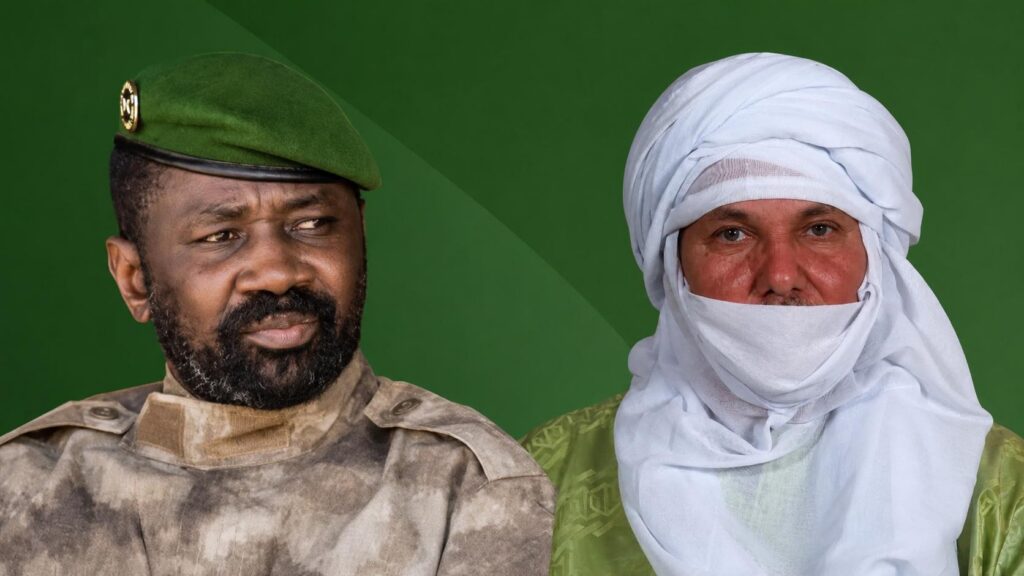
BAMAKO / ANEFIF — As Mali’s ruling junta projects an image of unshakable sovereignty, the ground reality tells a far grimmer story. Reports of renewed clashes in the North, the resurgence of Azawad rebel forces, and the devastating human cost of the junta’s alliance with Russian mercenaries paint a picture of a nation spiraling into an unprecedented political and military abyss. This stark assessment comes from Issouf Ag MAHA, a prominent Nigerien writer living in exile, whose latest analysis strips away the official rhetoric to expose the harsh truths gripping Mali.
Power obsession overshadows peace efforts
Since the 2020 coup, the military leadership had vowed to restore territorial integrity and end the insurgency. Yet six years later, the outcome is bleak. By unilaterally abandoning the 2015 Algiers Peace Accords in early 2024, the transitional authorities in Bamako closed the last avenue for political dialogue with northern rebel groups, reigniting full-scale warfare.
In his unfiltered commentary, Issouf Ag MAHA condemns what he describes as the junta’s « addiction to power, » arguing that survival at any cost has replaced the pursuit of lasting peace. As the capital tightens its grip on power, suppressing dissent, muzzling the press, and stifling opposition voices, its influence beyond Bamako’s walls continues to crumble. The harder the regime clings to control, the more its legitimacy erodes in the regions it claims to govern.
Anefif and Kidal: Where official narratives crumble
On July 4, 2026, heavy fighting erupted near Anefif, a strategic northern outpost where Malian troops and Russian-backed forces are dug in. According to Ag MAHA’s account, a reinforcement convoy dispatched from Gao was ambushed, inflicting heavy casualties and forcing a humiliating retreat. This setback is not an isolated incident.
The Malian Armed Forces suffered a humiliating defeat at Tinzawatène, followed by the Front de Libération de l’Azawad’s (FLA) recapture of Kidal. These events have upended the military balance, revealing the fragility of Bamako’s claims that the situation remains under control. Yet the junta persists in portraying an image of strength, even as the ground slips from beneath its feet.
The FLA’s recent tactical retreat of Malian and Russian forces from certain areas signals a deliberate political choice by the rebels. Ag MAHA highlights this move as an attempt to distance themselves from the junta’s brutal tactics and demonstrate adherence to the laws of war—a stark contrast to the government’s scorched-earth approach.
Africa Corps: A reign of terror for northern communities
The junta’s pivot toward Russia, embodied by the deployment of Africa Corps (formerly Wagner Group), has come at a horrific human cost. While this partnership frees Bamako from Western democratic pressures, it has plunged northern Mali into a nightmare of repression and violence.
Ag MAHA’s analysis paints a harrowing picture of civilian suffering, where entire communities are subjected to systematic brutality:
- Arbitrary arrests and enforced disappearances.
- Extrajudicial killings of civilians.
- A deliberate strategy of terror targeting local populations.
Despite mounting evidence, Bamako continues to deny these atrocities, deepening the crisis of national cohesion and pushing the country toward irreversible fragmentation.
The world looks away as Mali nears collapse
The Malian tragedy now unfolds under a veil of international indifference. Ag MAHA condemns the « deafening silence » of global powers, regional blocs, and the international media. He questions whether the world is waiting for a purely military resolution or if Mali has simply lost the attention it once commanded.
For the analyst, Mali is hurtling toward a point of no return, where the possibility of credible dialogue fades with each passing day. By prioritizing the illusion of total military victory over the principles of justice, equality, and diversity, the junta risks not rebuilding Mali but presiding over its definitive collapse.