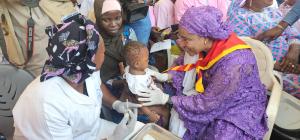
Mali leads global malaria fight with hybrid vaccination approach
The Republic of Mali has made history by becoming the first nation worldwide to implement a hybrid malaria vaccination strategy, marking a groundbreaking milestone in public health for Africa. This innovative approach combines age-based initial doses with seasonal booster shots, strategically aligning vaccine protection with peak malaria transmission periods.
Kalaban-Coro, Mali – On World Malaria Day, the Ministry of Health and Social Development of Mali, in partnership with Gavi, the Vaccine Alliance, UNICEF, and the World Health Organization (WHO), launched this pioneering vaccination initiative targeting children aged 5 to 36 months.
Why Mali’s hybrid approach is a game-changer
Mali’s unique vaccination strategy involves administering the first three doses continuously throughout the year based on age, followed by the fourth and fifth doses seasonally in May or June—just before the peak malaria transmission period from July to December. This timing maximizes vaccine efficacy when children face the highest risk of infection.
The hybrid model draws on evidence from Mali-based research, demonstrating that seasonal administration significantly enhances vaccine impact compared to year-round dosing. This approach ensures that children receive optimal protection precisely when they need it most.
Malaria burden in Mali and Africa
According to the WHO’s 2024 World Malaria Report, Mali accounted for:
- 3.1% of global malaria cases (8.15 million cases in 2023)
- 2.4% of global malaria deaths (14,328 deaths in 2023)
- One of the 11 countries with the highest malaria burden worldwide
- An increase of 1.4 million cases between 2019 and 2023
The African Region bears the heaviest global malaria burden, with 94% of cases and 95% of deaths reported worldwide.
Vaccine deployment and reach
The R21/Matrix-M vaccine will initially be rolled out in 19 priority districts across five regions: Kayes, Koulikoro, Mopti, Ségou, and Sikasso. Mali has secured 927,800 doses for this launch phase.
This initiative makes Mali the 20th African country to introduce malaria vaccination into its routine immunization program, with Gavi’s support. The country’s proactive stance underscores its commitment to combating a disease that disproportionately affects its youngest citizens.
Statements from global health leaders
Colonel Assa Badiallo Touré, Mali’s Minister of Health and Social Development, emphasized the collaborative effort behind this achievement:
« This malaria vaccine introduction represents a monumental step for Mali’s children and people. After decades of clinical trials and research, we now have a powerful new tool to protect our youngest citizens. While this vaccine is a critical advancement, it complements—not replaces—existing prevention strategies. We are fully committed to scaling this program to reduce the devastating impact of malaria on our communities. »
Dr. Sania Nishtar, Gavi’s CEO, highlighted the organization’s dedication:
« Gavi commends Mali’s government for its unwavering commitment to saving lives and reducing malaria’s devastating effects on families and communities. With 20 African countries now administering malaria vaccines and over 24 million doses delivered, sustained funding is critical to ensure equitable access. As long as resources permit, Gavi remains steadfast in supporting Africa’s fight against one of its deadliest diseases. »
Dr. Pierre Ngom, UNICEF Representative in Mali, added:
« The introduction of the malaria vaccine is a long-awaited breakthrough for Mali’s children. After 35 years of dedicated research, this vaccine offers a vital new shield against a deadly disease. While transformative, it is not a standalone solution. UNICEF supports the government’s community mobilization efforts, leveraging digital tools like U-Report to combat misinformation and promote vaccination alongside existing malaria prevention measures. »
Dr. Patrick Kabore, WHO Representative in Mali, reinforced the vaccine’s significance:
« The malaria vaccine represents one of the most important public health achievements in recent years—a crucial addition to our malaria-fighting arsenal. It protects children from this deadly disease while strengthening our broader efforts to alleviate malaria’s burden. »
Safety and efficacy of malaria vaccines
The RTS,S/AS01 and R21/Matrix-M vaccines, both WHO-prequalified and recommended, have demonstrated:
- Over 50% reduction in malaria cases during the first year post-vaccination in clinical trials (Phase 3).
- 75% reduction in malaria cases when administered seasonally in high-transmission zones—where half of child malaria deaths occur.
- Targeting P. falciparum, the deadliest malaria parasite in Africa.
Global malaria vaccination progress
Since 2023, over 24 million malaria vaccine doses have been delivered across Africa, with countries progressively expanding their programs. The 20 African nations introducing the vaccine now represent over 70% of the global malaria burden.
Countries like Nigeria (with the world’s highest malaria burden) and Chad (integrating malaria vaccines into a triple-deployment strategy for malaria, pneumonia, and diarrhea) are among those scaling up efforts. Fragile contexts like Sudan and the Democratic Republic of the Congo have also integrated malaria vaccination into broader health response plans.
By the end of 2025, an additional 13 million African children are expected to be protected by the malaria vaccine. Gavi’s strategic plan for 2026–2030 aims to fully protect 50 million more children with four doses—pending sufficient funding.
Addressing critical questions
Why target children under five?
Children under five face the highest risk of malaria-related death, accounting for over 75% of global malaria fatalities. Unlike adults, young children lack partial immunity developed over years of exposure, making them particularly vulnerable.
How does the hybrid strategy work?
Mali’s approach leverages the seasonal nature of malaria transmission, aligning vaccine protection with peak infection periods. This strategy, backed by evidence, enhances the vaccine’s impact by ensuring peak efficacy coincides with the highest risk.
What other prevention measures are in place?
The malaria vaccine complements Mali’s existing strategies, including:
- Insecticide-treated bed nets
- Seasonal malaria chemoprevention
- Intermittent preventive treatment in pregnancy
- Indoor residual spraying