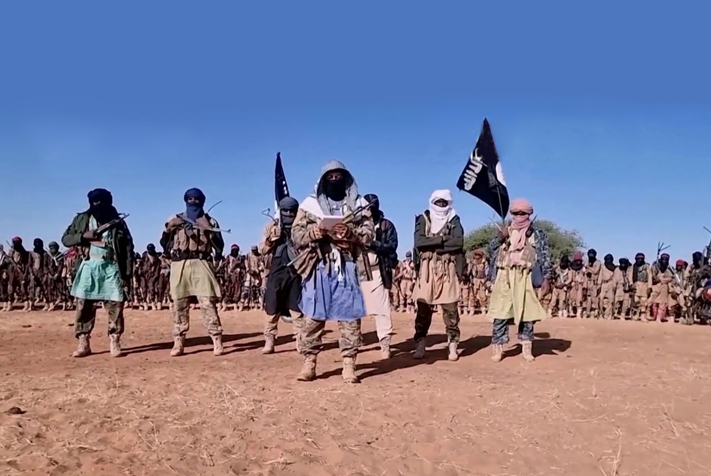
The Islamic State in the Sahel Province (ISSP) continues to exert significant influence in northeastern Mali, particularly in the Gao and Ménaka regions. Despite widespread attention on the Group for Support of Islam and Muslims (JNIM), the ISSP maintains a strong operational presence in key areas such as Ansongo, Ménaka, and the so-called “3 T” localities—Talataye, Tin-Hama, and Tessit—as well as Labbezanga.
Leadership and strategic adaptation
Under the command of Abou Al-Bara, who succeeded the late Adnan Abu Al-Walid Sahraoui in 2021, the ISSP has shifted its tactics since 2020. Moving away from high-profile public executions, the group now focuses on territorial control, local governance, and subtle coercion to embed itself within communities. This approach has allowed it to avoid excessive media attention while strengthening its networks and logistical capabilities.
The Malian Armed Forces (FAMa) have intensified their efforts against the ISSP, neutralizing key figures to disrupt its operations. In a recent operation conducted between May 14 and 15, 2026, a Malian airstrike targeted a high-ranking ISSP operative in Bara, Ansongo circle, alongside several affiliated fighters. Such operations underscore the persistent pressure on the group, even as it adapts to maintain its influence in frontier zones.
Operational focus and rivalry with JNIM
The ISSP’s activities remain concentrated along the Mali-Niger border, where it exerts control over critical trade and movement corridors. Localities such as Talataye, Tin-Hama, Tessit, Labbezanga, and Ménaka are central to its operations, allowing the group to assert dominance over regional dynamics. While the JNIM garners headlines for its high-profile attacks—such as the coordinated operations around Bamako in April 2026—the ISSP operates with a quieter, more insidious strategy.
Historically, tensions between the ISSP and JNIM were mitigated by a tacit understanding that limited direct confrontations. However, this fragile truce has eroded since 2020. Recent military offensives by Malian forces have temporarily aligned the two groups against a common enemy, though no formal peace agreement has been established. The ISSP’s focus remains on consolidating its territorial foothold and influencing local armed factions to secure its long-term survival.
Escalating threats and adaptive tactics
Data from the Armed Conflict Location & Event Data Project (ACLED) highlights a troubling trend: in the first quarter of 2026, 86% of Islamic State activities occurred in Africa, with a notable increase in the use of armed drones, motorized assaults, and economic pressure against both urban and rural targets. The ISSP has repeatedly targeted civilian and military infrastructure along the Ménaka-Ansongo-Tessit-Labbezanga axis, exploiting local vulnerabilities to impose its de facto rule.
A coordinated operation involving Nigerian and U.S. forces on May 16, 2026, resulted in the elimination of a key ISSP figure, Abu-Bilal Al-Minuki, near Lake Chad. Yet, the group’s threat persists, particularly in the “3 T” localities and Labbezanga, where its territorial control and influence over local armed groups remain intact.
Future outlook and regional implications
The ISSP’s ability to sustain its presence in northeastern Mali—despite military pressure and the glare of international cooperation—demands a sustained and strategic response. Its focus on discreet governance, economic leverage, and strategic corridor control ensures that the group remains a formidable challenge to regional stability. As Malian forces and international partners adapt their strategies, the ISSP continues to exploit gaps, reinforcing the urgent need for targeted operations in the Niger-Mali borderlands to dismantle its networks and restore security.