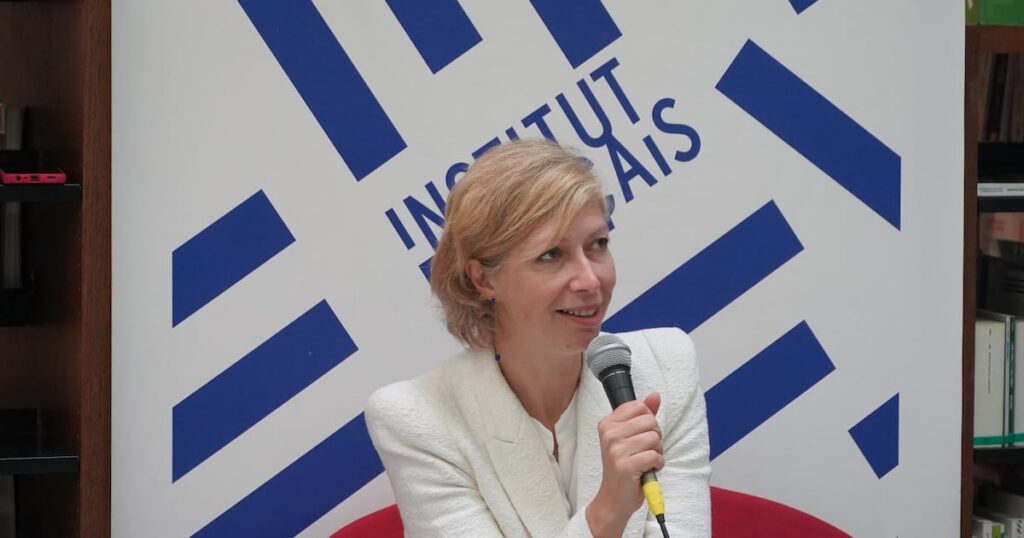
Anne-Claire Legendre made a clear declaration at her Casablanca press conference on June 22: this marked her first official visit to Morocco in her capacity as President of the Institut du monde arabe (IMA).
Morocco has been an IMA founding member since 1982, and Legendre described it as a trusted partner that has helped showcase the Kingdom’s cultural richness and heritage over decades. The visit coincided with a busy Franco-Moroccan diplomatic calendar, where she discussed the IMA’s role in bilateral relations with Foreign Minister Nasser Bourita. Key discussions included a July 2026 intergovernmental meeting and preparations for King Mohammed VI’s return state visit to France.
The four-day agenda began in Rabat with a working session with Youth, Culture and Communication Minister Mehdi Bensaid. Field visits followed to the Chellah archaeological site and the National Institute of Archaeological and Heritage Sciences (INSAP). In Casablanca, a gathering at the National Library brought together national archives, cinema and music institution leaders. A highlight was her meeting with Fihr Kettani, cultural industries federation president and founder of the Studio des Arts Vivants.
The trip concluded in Marrakech with encounters with leading national and international artists, including Meriem Berrada—curator of Morocco’s first Venice Biennale pavilion in 2026—and Alexis Sornin, director of the Yves Saint-Laurent and Pierre Bergé Berber Arts Museums. Back in Casablanca, she inaugurated the new Museum of Photography and Visual Arts alongside Mehdi Qotbi, national museums federation president.
Archaeology: Showcasing Morocco’s groundbreaking discoveries
Legendre emphasized archaeology as a cornerstone of the visit. Her INSAP tour highlighted Morocco’s academic achievements, with the institute training over 170 students and collaborating with French institutions like Inrap, CNRS, Collège de France and ENS. She stressed that while Moroccan archaeological training is already robust, the focus should shift to promoting research. Major findings—such as breakthroughs in Volubilis excavation, Banassa discoveries, Phoenician studies, rock art documentation and Homo sapiens evolution timeline revisions—remain largely unknown to European audiences. Legendre announced plans to explore a Paris exhibition dedicated to Arab world archaeology upon her return.
The cultural and creative industries (CCI) sector also featured prominently, with Legendre noting Morocco and Saudi Arabia as Arab leaders in gaming and animation. She revealed the IMA’s potential involvement in France’s upcoming Esports World Cup at Saudi Arabia’s request, aligning with the IMA’s 2027 museum redesign featuring immersive technologies and gamification elements.
Boosting Arab creativity through new initiatives
Three annual awards are planned for emerging Arab designers, artists and fashion creators, to be presented alongside Paris Fashion Week, Paris Design Week and Paris+ by Art Basel. Winners will receive residencies, exhibition opportunities and professional mentorship in France. This responds to repeated requests from Moroccan young creators during her visit.
The new Casablanca photography museum opening marked a milestone in IMA-Morocco collaboration, leveraging the IMA’s 86,000-image photothèque—including extensive Morocco documentation—to share with local institutions.
Literature, language and shared heritage
Legendre underscored the need to expand Arabic language education in France and proposed joint projects with Moroccan partners to translate and promote contemporary Arab and Moroccan literature in European markets. This aligns with Rabat’s 2026 designation as Arab Book Capital, addressing what she called limited visibility among French publishers for modern Arabic literature.
Two major IMA exhibitions are slated for late 2026: one exploring Moroccan wedding traditions across regions and diaspora (