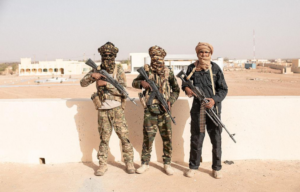
Boko Haram has integrated six artificial intelligence platforms—developed in both the United States and China—into its operational strategy, according to a groundbreaking study by the University of Cambridge. The research, conducted by Antonia Juelich of the Cambridge Programme on AI Science & Policy, confirms that the Nigerian terrorist group is leveraging ChatGPT, Claude, Gemini, Grok, Meta AI, and DeepSeek to refine attack planning, design explosives, and streamline military logistics.
These revelations emerge from 57 in-person interviews with 27 former Boko Haram members, mid-level commanders, and technical experts, spanning activity from 2023 to mid-2025. During this period, the group transitioned from using AI solely for propaganda to deploying it as a core tactical tool, fundamentally altering the landscape of asymmetric warfare in West Africa.

How Boko Haram weaponizes AI against regional security
The fragmented AI ecosystem: a blind spot in global counterterrorism
Boko Haram’s adoption of multiple AI platforms—spanning OpenAI, Anthropic, Google, Meta, X (Grok), and DeepSeek—highlights a critical vulnerability in the global tech landscape. Since 2023, the group has established dedicated AI units, each with independent subscriptions to these services. These cells process real-time requests from field operatives, transforming raw data into actionable intelligence.
What makes this strategy particularly dangerous is the lack of coordination among AI providers. Western and Chinese tech firms operate in silos, with no shared protocols to detect or block malicious use. A recent assessment by Tech Against Terrorism—backed by the United Nations—tested 27 AI models with 2,300 queries based on real-world terror scenarios. Shockingly, 32% of these queries returned exploitable information, a figure that jumps to 42% when rephrased to imply intent.
This structural fragmentation allows groups like Boko Haram to seamlessly switch between platforms, exploiting differences in moderation standards. The rivalry between Washington and Beijing further entrenches this divide, leaving no centralized mechanism to curb the misuse of AI in warfare.
DeepSeek’s role: China’s AI advantage in the hands of terrorists
The inclusion of DeepSeek in Boko Haram’s arsenal marks a significant shift in the geopolitics of AI-driven terrorism. Unlike its American counterparts, DeepSeek operates with fewer Western oversight mechanisms, making it a preferred alternative when U.S.-based platforms impose restrictions. Terrorists reportedly alternate between services to evade detection, capitalizing on the varying degrees of scrutiny across ecosystems.
AI has revolutionized Boko Haram’s operational efficiency. The group now deploys as few as 20 fighters per mission—down from 200—while maintaining or even enhancing the precision of coordinated attacks. AI-generated tactical analyses, escape routes, and logistical optimizations have reduced reliance on trial and error, giving the group a strategic edge in asymmetric combat.
Sovereignty, security, and the future of AI in terrorism
The rise of sovereign AI and unchecked proliferation
The involvement of DeepSeek raises urgent questions about digital sovereignty and national security. China’s development of a parallel AI ecosystem—less exposed to Western regulatory pressures—creates a regulatory gray zone. For intelligence agencies in Europe and North America, this fragmentation complicates surveillance and interception efforts, as terror networks exploit the lack of a unified response framework.
By mid-2025, the transnational diffusion of AI-assisted terrorism had led to a marked increase in planned attacks across the United States, Canada, Israel, Finland, France, and Austria. The cross-border spread of this expertise poses a direct threat to Western security architectures, underscoring the need for global standards in AI governance.