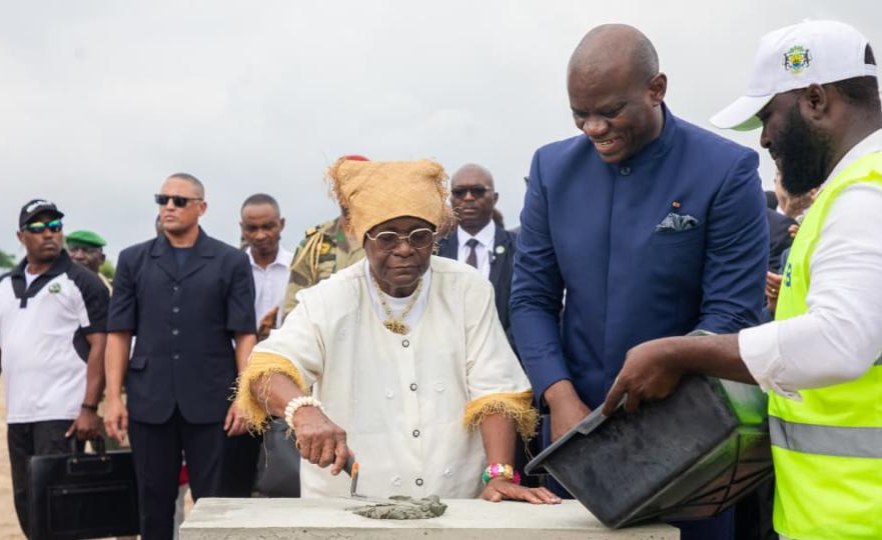
The Gabonese Republic is laying the groundwork for a post-oil industrial future. Under the leadership of President Brice Clotaire Oligui Nguema, construction has officially begun on the Kobé-Kobé deep-water port. This ambitious integrated project, anchored to one of the planet’s largest iron ore deposits and supported by new rail and energy infrastructure, seeks to fundamentally reshape the nation’s growth trajectory by 2030.
The country’s Atlantic coastline is set to welcome a world-class logistics gateway. Situated in Estuaire Province, the future Kobé-Kobé terminal will boast a draft depth of between 14 and 16 meters. This exceptional technical capability will enable the facility to accommodate ultra-large commercial vessels, significantly boosting Gabon’s competitive edge within the Gulf of Guinea’s port landscape—rivaling hubs such as Kribi in Cameroon and Pointe-Noire in the Republic of the Congo.
The true genius of Kobé-Kobé lies in its integrated design. This port is not a standalone asset but the maritime endpoint of a sweeping national value chain. The infrastructure is designed to function in tandem with three other major initiatives:
- Belinga iron ore extraction, located in Ogooué-Ivindo Province, recognized by geologists as one of the world’s most substantial and untapped high-grade iron ore reserves;
- A pioneering rail corridor linking the Belinga mining heartland directly to the deep-water port in Estuaire Province;
- The forthcoming Booué hydroelectric dam, essential for securing the autonomous energy supply required by mining and processing facilities.
This cohesive strategy marks a decisive break from Gabon’s long-standing extractive rent economy by mandating local metallurgical processing prior to any export. The project crossed a critical milestone in April 2026 with the signing of a strategic partnership agreement between the Gabonese government and Africa Global Logistics (AGL).
Beyond its infrastructural scope, Kobé-Kobé is positioned as a catalyst for social inclusion. Economic impact assessments forecast the creation of up to 160,000 jobs—both direct and indirect—across construction, deployment, and operational phases.
The initiative offers Gabon’s youth a transformative pathway into technical professions: civil engineering, port operations, energy engineering, rail maintenance, and metallurgy. The government is actively fostering systemic private sector growth by integrating local small and medium-sized enterprises (SMEs) into the project’s supply and service chains.
The launch of Kobé-Kobé carries profound political and geopolitical significance. Conceived during President Brice Clotaire Oligui Nguema’s constitutional mandate, the project embodies a national doctrine of reclaiming economic sovereignty through the restoration of critical infrastructure. Libreville is proactively preparing for the gradual depletion of petroleum reserves, which currently underpin the national budget, by pivoting toward sustainable mining industries. If consortiums adhere to the strict execution timeline, Kobé-Kobé will emerge by 2030 as the driving force behind Gabon’s industrial emergence.