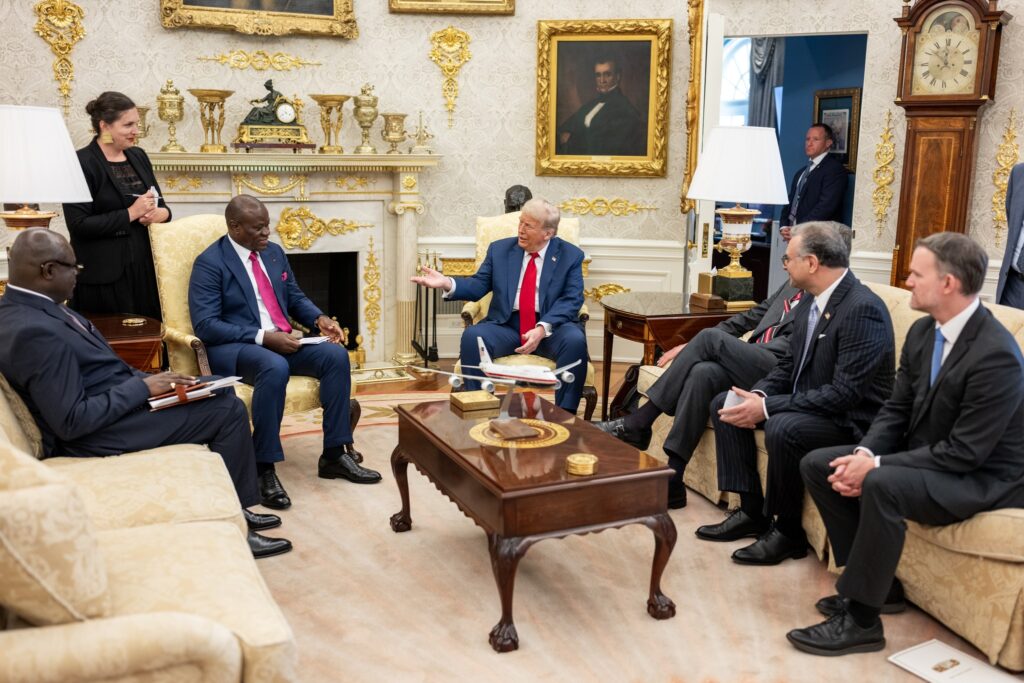
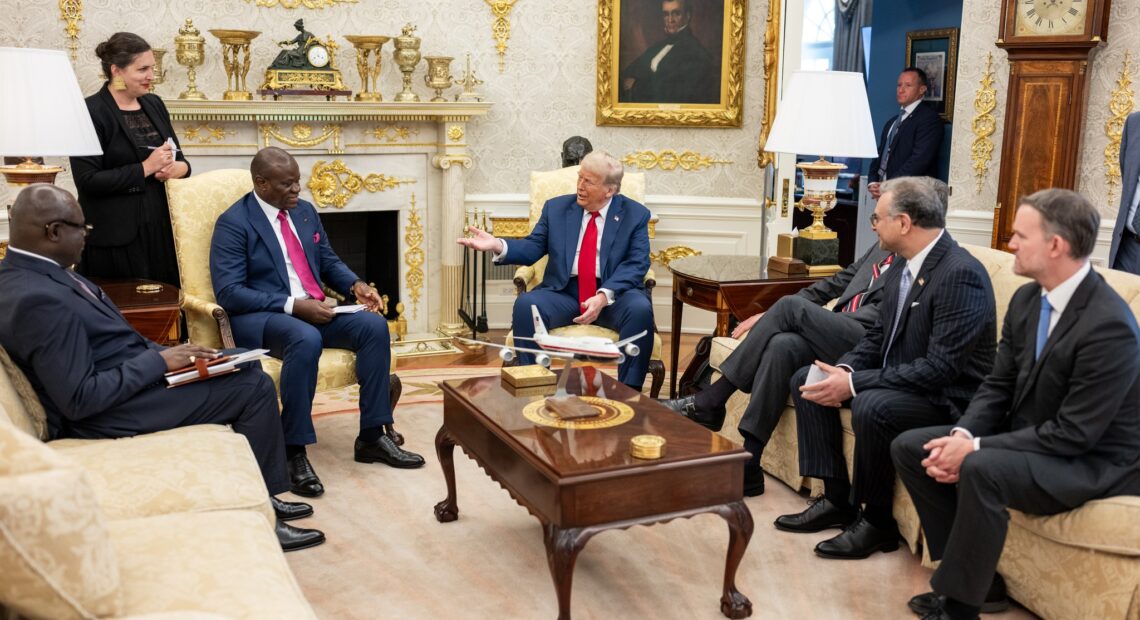
President Donald Trump speaks with President Brice Clotaire Oligui Nguema of Gabon in the Oval Office, Wednesday, July 9, 2025, before a multilateral luncheon with African leaders. (Official White House Photo by Daniel Torok)
Gabon rejects Trump’s migrant plan with firm sovereignty stance
Libreville, June 4, 2026 – By firmly rejecting a proposal to accept migrants expelled from the United States, Gabonese President Brice Clotaire Oligui Nguema has reinforced his nation’s commitment to national sovereignty. The decision, announced publicly, underscores a shifting diplomatic approach in Libreville that prioritizes Gabon’s interests while maintaining balanced relations with global powers.
The Gabonese leader left no room for doubt during his remarks. Addressing a proposal from Washington to transfer migrants to Gabon, he made his position unequivocally clear. « Gabon will not accept this arrangement. I will not welcome these individuals on Gabonese soil. There is no room for negotiation – this agreement does not serve our interests, » he stated.
This firm stance arrives at a time when Western nations, particularly the United States under Donald Trump’s administration, are increasingly seeking third-party countries to absorb migrants facing deportation. The Gabonese president’s refusal highlights a growing trend among African states to resist external pressures on migration policies.
Global migration challenges reshape diplomatic dynamics
Over recent years, migration has emerged as one of the most pressing geopolitical challenges. Western nations, including the U.S. and European countries, have pursued strategies to outsource migration management to partner states. While some African nations have agreed to such terms—such as Rwanda’s cooperation with the United Kingdom—Gabon’s refusal signals a new phase in continental diplomacy.
The Gabonese president was careful to clarify that his decision does not signal a rift with Washington. « Donald Trump remains a friend of Gabon, » he remarked with a touch of humor, referring to the U.S. leader’s signature red tie. The message was unmistakable: cooperation continues, but Gabon’s priorities remain its own.
A sovereignty-driven foreign policy
This decision aligns with a broader pattern of Gabonese policy emphasizing national independence. From renegotiating economic partnerships to reclaiming military facilities and localizing resource processing, Libreville is asserting control over key sectors. Migration policy, in this context, becomes a symbolic battleground.
Accepting foreign deportees would have placed an undetermined burden on Gabon’s administrative, social, and financial systems. With a national agenda focused on economic and social modernization, the president’s refusal reflects a commitment to addressing domestic needs first.
The decision also resonates with widespread public sentiment across Africa. Many on the continent view migration as a challenge to be managed by the countries of origin and destination—not as a problem to be outsourced to African states.
Balancing diplomacy with principled refusal
The true significance of this move lies in its diplomatic finesse. Gabon has demonstrated that it is possible to reject a major power’s proposal without escalating tensions. While other regions have seen migration disputes spark open conflicts, Libreville’s approach offers an alternative model: assertive sovereignty without confrontation.
For international observers, this reflects a broader shift in Africa’s engagement with global powers. Partnerships remain vital, but African states are increasingly negotiating from positions of strength, refusing to accept terms that compromise their sovereignty. Gabon’s stance may well set a precedent for how other African nations handle similar pressures in the future.
Ultimately, the message from Gabon is clear: the country remains open to global cooperation, but it will not allow its future to be dictated by external forces. In an era of rising fragmentation in international relations, this declaration of sovereignty could mark a defining moment for Gabonese diplomacy in the years ahead.