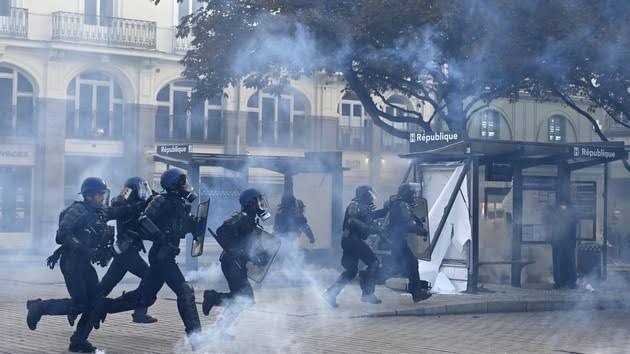
Broken shopfronts, riot police charges, burning trash bins, and tear gas clouds—every flare-up of protest in France sends shockwaves across the Sahel. But in Bamako, Ouagadougou, and Niamey, these images aren’t just news footage. They’re tactical ammunition. For the military juntas of the Alliance of Sahel States (AES), France’s domestic turmoil has become a golden opportunity to dismantle Western narratives and shore up their own legitimacy.
From criticism to counter-narrative: the boomerang effect of French instability
Scroll through social media feeds in the capitals of the AES and the picture is clear: where Western observers see protests, Sahelian pro-junta voices see proof of a collapsing colonial power. The narrative flip is deliberate. Since the coups that brought Assimi Goïta, Ibrahim Traoré, and Abdourahamane Tiani to power, the rupture with Paris hasn’t been just political—it’s been a full-blown information war.
France once tied its diplomatic support to democratic benchmarks, human rights standards, and the right to protest. Now, its own streets tell a different story. Sovereigntist activists and influencers have seized on this contradiction with glee. They equate France’s use of crowd-control grenades, parliamentary force majeure, and protest bans to the same criticisms once leveled at Sahelian transitional authorities—except now, the roles are reversed.
How chaos abroad serves power at home
The strategic benefits of highlighting France’s domestic crisis are hard to miss. For the AES juntas, every burning barricade in Paris is a political tool with three clear goals:
- Undermine democratic credibility: By painting liberal democracy as chaotic, decadent, and self-destructive, junta-aligned media present military rule as the only force capable of restoring order and national sovereignty.
- Distract from local crises: When global attention turns to France’s unrest, Sahelian publics are less likely to scrutinize the real emergencies at home—rising insecurity, runaway inflation, and daily power cuts.
- Fuel the narrative of Western decline: Amplified by networks tied to Moscow, images of French unrest reinforce the idea that the West is in terminal decline. That, in turn, justifies the AES pivot toward alternative partners like Russia, Turkey, and Iran.
The mirror’s harsh reflection: when criticism flips the script
Independent analysts warn against drawing false parallels. They point out a glaring contrast: French citizens can march, strike, and openly criticize their government—a liberty unimaginable in Sahelian regimes where dissent is swiftly labeled subversive. Yet perception often trumps reality. Every cobblestone hurled in Place de la Concorde chips away at France’s diplomatic capital across the Sahel. And with every shared video clip, the myth of France as a bastion of stability and democratic virtue cracks a little further.
For the juntas of the Sahel, France’s urban protests aren’t a sideshow. They’re a strategic windfall—one they’re using to tighten their grip on power while weakening Paris’s influence in the region.