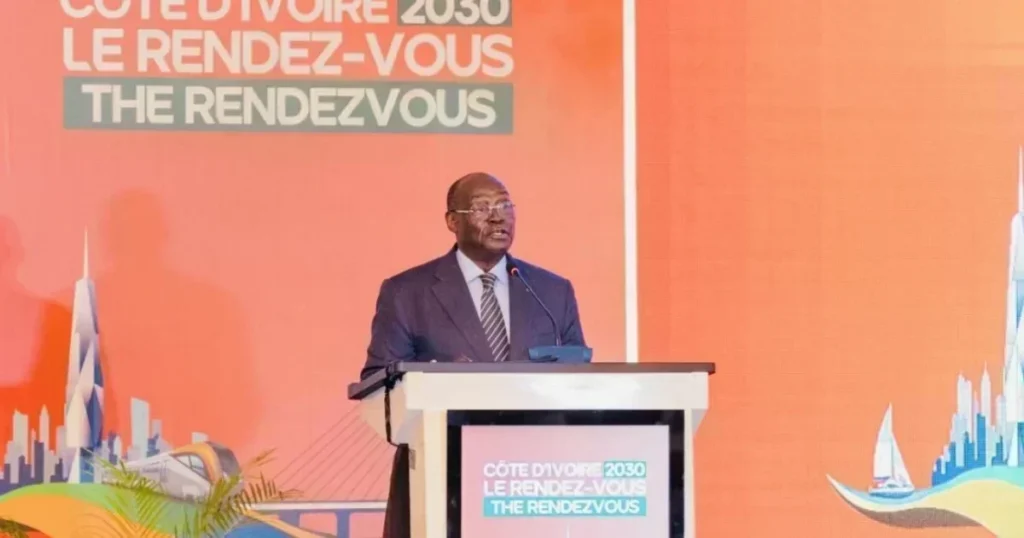
The Côte d’Ivoire has achieved a milestone by securing four times the expected international funding for its National Development Plan (NDP) through 2030. The announcement, made by the Minister of Planning, underscores the country’s economic resilience and renewed stability after overcoming a decade of political and military turmoil in the early 2000s.
Economic momentum drives investor confidence
With an average annual growth rate of 6.5% over recent years, Côte d’Ivoire has positioned itself as one of West Africa’s most dynamic economies. The government’s two-day forum in Abidjan brought together officials and investors to finalize commitments for a development plan encompassing security enhancements, agricultural modernization—accounting for 20% of GDP—the creation of national champions, and major infrastructure projects, including a high-speed rail network.
Unprecedented financial commitments from global partners
The minister confirmed that while Côte d’Ivoire initially sought approximately $20 billion in public financing, partners such as the World Bank, African Development Bank (AfDB), and European Union have pledged over $80 billion. This surge in support reflects strong confidence in the country’s economic indicators.
Private sector contributions are projected to exceed $147 billion, representing over 70% of the total NDP funding. The comprehensive plan, valued at $209 billion, combines state investments with international and domestic private capital.
Earlier this year, Côte d’Ivoire demonstrated its financial prowess by raising $1.3 billion on international markets at exceptionally favorable terms for an emerging economy. Additionally, the International Monetary Fund (IMF) approved a disbursement of $833 million under multiple assistance programs, citing the nation’s resilient economy despite an expected slight growth slowdown to 6% in 2026 from 6.5% in 2025 and projected inflation of 3.3% this year.
Diversification fuels long-term growth
Once reliant on agriculture, Côte d’Ivoire has expanded into mining, gas, and oil sectors. This diversification, coupled with robust infrastructure investments, positions the country as a regional economic leader with sustainable development prospects.