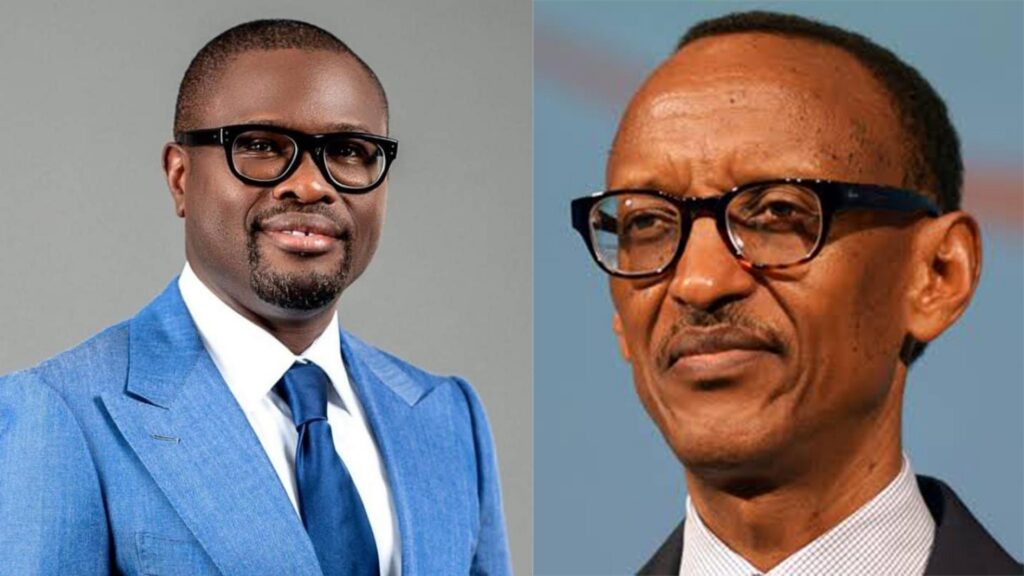
Some state visits are best measured by the length of the final communiqué. This one is better read for what sits underneath it. For his first official trip to Rwanda since his inauguration in May, Benin’s head of state, Romuald Wadagni, spent 48 hours in the Rwandan capital — a window long enough for a summit with president Paul Kagame and, more tellingly, long enough for the closed working sessions that decide whether a bilateral partnership keeps advancing or quietly loses momentum.
Read as analysis rather than ceremony, the trip answers a question that has hovered over Cotonou’s foreign policy for months: how does a new administration convert a promising relationship into an institutional habit? The presence of ministerial delegations alongside the two leaders, the choice of topics, and the stops on the programme all point in the same direction. Benin is not chasing a headline. It is banking continuity.
The calculus behind Cotonou’s push for continuity
A partnership survives on repetition, not on declarations. That is the logic driving the visit. By returning to Kigali early in his mandate, Wadagni is signalling that the Rwandan file is not the property of one government or one moment, but a standing priority of the Beninese state. Officials on both sides frame the relationship as a reference point on the continent, and the tone of the exchanges in the Rwandan capital suggests neither side wants that reputation to rest on past achievements alone.
The underlying driver is practical. Benin is pursuing economic development, technological innovation and shared security at the same time, and it has identified Rwanda as a partner that has already tested answers to several of those problems. The continuity being sealed in Kigali is therefore less about sentiment and more about scalability — keeping working channels warm so that projects do not have to be rebuilt from scratch every time a minister changes.
Security cooperation: the quiet engine of the relationship
Received with full honours at the Village Urugwiro presidential palace, the Beninese head of state held a one-on-one meeting with his Rwandan counterpart before the talks widened to the ministerial teams. Security cooperation and the modernisation of public management dominated the agenda.
On the security front, the two countries maintain a close working arrangement aimed at consolidating regional stability and the exchange of intelligence. Both leaders restated their commitment to mutual technical and logistical assistance, with particular attention to the protection of border areas. It is the least visible strand of the partnership, and arguably the one that holds the rest together.
Border zones, intelligence and the logistics of trust
Cross-border security is rarely a single-file issue. It involves shared information, joint logistics and the confidence that what is exchanged will be handled discreetly. Sustaining that confidence over time is what turns an ad hoc arrangement into a durable framework, and it explains why the security conversation keeps returning to the centre of Benin-Rwanda meetings.
What Benin is studying in Rwanda’s public administration
The economic and administrative side of the visit was just as substantive. The Beninese delegation took a close interest in how Rwanda attracts foreign direct investment and how it has moved public services online. Two areas where the country’s reputation has travelled far beyond its borders.
Romuald Wadagni, drawing on his financial and economic background, stressed the value of pragmatic synergies between Cotonou and Kigali to stimulate trade within Africa. The reasoning is simple enough:
- Digitalised services reduce friction for businesses and cut the cost of everyday administration.
- Clear investment incentives make a country legible to capital that would otherwise look elsewhere.
- Intra-African trade grows fastest where partners already share standards, payment habits and trust.
Foreign investment and paperless services as exportable models
What makes these exchanges more than a study tour is the possibility of adaptation. Benin is not looking to copy a template wholesale, but to identify which mechanisms can be transplanted into its own reform programme and which require local adjustment. That is where the partnership becomes operational rather than diplomatic.
Gisozi and the symbolic layer of the partnership
No official visit to Kigali is complete without a moment of remembrance. Following the republican tradition observed on such occasions, the Beninese president travelled to the Gisozi genocide memorial, where he laid a wreath in tribute to the victims of 1994.
The gesture carried more than protocol. It acknowledged the resilience of the Rwandan people and their capacity to rebuild a prosperous, united nation — a story that resonates with any government arguing that reconstruction and reform are achievable within a single generation. In diplomatic terms, memory is part of the architecture of trust: it tells a host country that the visitor understands where its institutions come from.
What to watch next in the Cotonou-Kigali axis
Set against the broader picture, the visit confirms that the Cotonou-Kigali axis remains a central pillar of Benin’s foreign policy, built around economic development, technological innovation and shared security. The immediate takeaway for observers is that the relationship has entered a phase of consolidation, where the value lies in implementation rather than announcement.
The next test will be less photogenic. It will be about how quickly the administrative lessons turn into functioning systems, how regularly the security channels are used, and whether the ministerial contacts established during these 48 hours become routine rather than exceptional. Partnerships of this kind are rarely decided at summits. They are decided in the months that follow — and that, more than the ceremony, is what this visit set in motion.