Congo political tensions flare ahead of july 22 opposition march
- Politics
DRC’s political divide deepens as opposition gears up for July 22 constitutional march
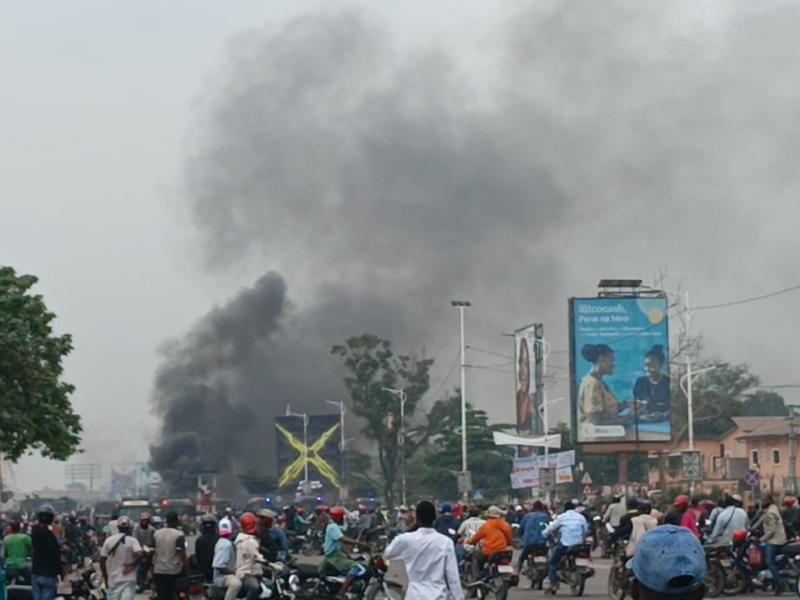
The political landscape in the Democratic Republic of Congo is heating up as the opposition-backed Coalition article 64 (C64) prepares for a major demonstration on July 22 in Kinshasa. The march, which will culminate at the Palais de la Nation, demands President Félix Tshisekedi’s resignation, accusing him of constitutional betrayal following revelations of his plans to amend the 2006 constitution.
The opposition coalition’s call to action has exposed deep divisions within the presidential majority, particularly between Augustin Kabuya, Secretary General of the ruling Union for Democracy and Social Progress (UDPS), and André Mbata, Permanent Secretary of the Sacred Union of the Nation (USN).
Mbata urges counter-protest as Kabuya calls for restraint
While Mbata, currently on an official mission in Yaoundé, Cameroon, has called on all USN member parties, associations, and political figures to mobilize for a counter-demonstration in Kinshasa, all 25 provincial capitals, and the diaspora, Kabuya has taken a diametrically opposed stance. The UDPS leader issued a strongly worded statement on July 13 urging party members to ignore the opposition’s planned routes and avoid any demonstrations on July 22.
« There is no march scheduled for that date, and members should avoid routes designated for opposition activities, » Kabuya declared in a terse communiqué, despite his personal opposition to the opposition’s initiative.
Mbata, a constitutional law professor, responded swiftly with a scathing rebuttal, accusing Kabuya’s statement of being « politically incorrect and prematurely maladroit ». In his counter-statement, Mbata emphasized that the USN, comprising over 900 political parties, associations, and groups, cannot be reduced to the position of a single component.
« Statements made by representatives of USN member organizations only bind those individuals, » Mbata asserted, adding that it was unacceptable for the presidential platform to remain silent while « ill-intentioned and constitutionally ignorant individuals » marched to demand the departure of a democratically elected president.
Past disputes resurface amid growing tensions
The current rift between Kabuya and Mbata is not an isolated incident. Their rivalry traces back to April 2026, when Mbata publicly opposed Kabuya’s candidate for the Sankuru provincial governorship. Mbata threw his support behind Jules Lodi Emongo, who ultimately won the election. This political setback led Kabuya to instruct UDPS members to stop paying dues to Mbata, further straining relations between the two leaders.
The escalating tensions within the Sacred Union of the Nation reflect broader challenges facing the presidential majority. With national elections scheduled for 2028 and President Tshisekedi’s second and final term nearing its end, internal power struggles are becoming increasingly visible. The divisions between Kabuya and Mbata highlight the fragile unity of the ruling coalition and raise questions about its ability to maintain cohesion in the face of mounting political pressures.
The July 22 protest promises to be a critical test for both the opposition and the presidential majority, as the nation watches closely to see how these deepening divisions will play out in the streets of Kinshasa.