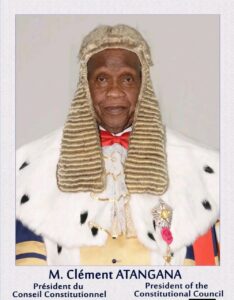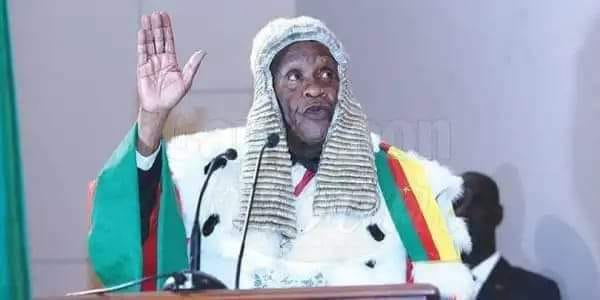
The sudden passing of Clément Atangana, Cameroon’s longest-serving president of the Constitutional Council, has sent shockwaves through the nation’s political and judicial spheres. On October 4, 2026, Atangana died in Paris following a prolonged illness, leaving behind a legacy that has shaped Cameroon’s electoral justice system for nearly nine years. His name became synonymous with contentious election rulings, where his gavel often delivered the final verdict that marked opposition appeals as irrecevable—a word now etched into the collective memory of Cameroonians. The question on everyone’s mind: what comes next for a nation already bracing for the 2027 presidential race?
Eight years of contentious rulings and a contested legacy
Atangana’s tenure at the helm of the Constitutional Council, which began in February 2018, spanned two fiercely disputed presidential elections—2018 and 2025. In both instances, his rulings upheld the official results, sparking widespread controversy. Opposition figures like Maurice Kamto (MRC) and Issa Tchiroma Bakary (opposition candidate in 2025) saw their challenges dismissed, reinforcing perceptions that the Council operated under heavy political influence. A viral video from 2025 captured Atangana’s remarks, where he congratulated supporters for their candidate’s victory and praised the work of his father—a statement that only fueled further skepticism about the Council’s impartiality.
The criticisms didn’t end there. During his eight-year tenure, Atangana and the Council never once sided with the opposition in any electoral dispute. While the institution’s decisions may have been legally sound, their consistency—regardless of merit—raised questions about whether Cameroon’s electoral oversight could ever challenge the status quo.
The man behind the robe: a judge’s remarkable career
Before steering the Constitutional Council, Clément Atangana was a titan of Cameroon’s judiciary. Born on December 20, 1941, in Ekoumeyeck (Nyong et So’o), he embarked on his legal journey in 1968 after completing his training at the National School of Administration and Magistracy (ENAM) and the International Institute of Public Administration in Paris. His career was marked by rapid ascension, as he took on pivotal roles across Cameroon’s judicial landscape:
- Investigating judge in Nkongsamba
- President of tribunals in Eséka, Bafia, Sangmélima, and Mora
- Prosecutor General in Maroua
- President of the Court of Appeals for the Centre region
- Supreme Court Justice
- President of the Administrative Chamber of the Supreme Court
After retiring from the Supreme Court in 2014, Atangana’s expertise led him back to influence when he was called upon in 2018 to preside over the Constitutional Council—a role that would cement his place in Cameroon’s political history.
The vacuum at the top: what happens now?
The death of Clément Atangana creates an immediate vacancy at the head of Cameroon’s highest electoral oversight body. By constitutional mandate, it is the President’s responsibility to appoint a successor through a presidential decree. However, with the 2027 presidential election looming, the timing of this transition couldn’t be more critical—or more uncertain. Opposition parties, already skeptical of the Council’s neutrality, will be watching closely to see whether the new president revitalizes public trust or further entrenches perceptions of judicial submission to political power.
The Council’s future now hinges on two pressing questions: Who will step into Atangana’s shoes, and will the new leader possess the credibility—or the backbone—to challenge the establishment? For Cameroonians, the stakes are high. Elections are more than just ballots; they are the bedrock of democracy, and trust in the institutions that safeguard them is non-negotiable.
A moment of reckoning for Cameroon’s electoral justice
Clément Atangana’s death isn’t just the loss of a jurist; it’s the end of an era. His legacy is a double-edged sword, leaving behind a Council that was efficient but widely viewed as an extension of the ruling power. The nation must now determine whether its highest electoral court can evolve into an independent arbiter—or if the cycle of skepticism and contention will persist. With the next presidential contest just months away, the pressure is on for Cameroon’s judiciary to prove it can rise above the shadows of its past.