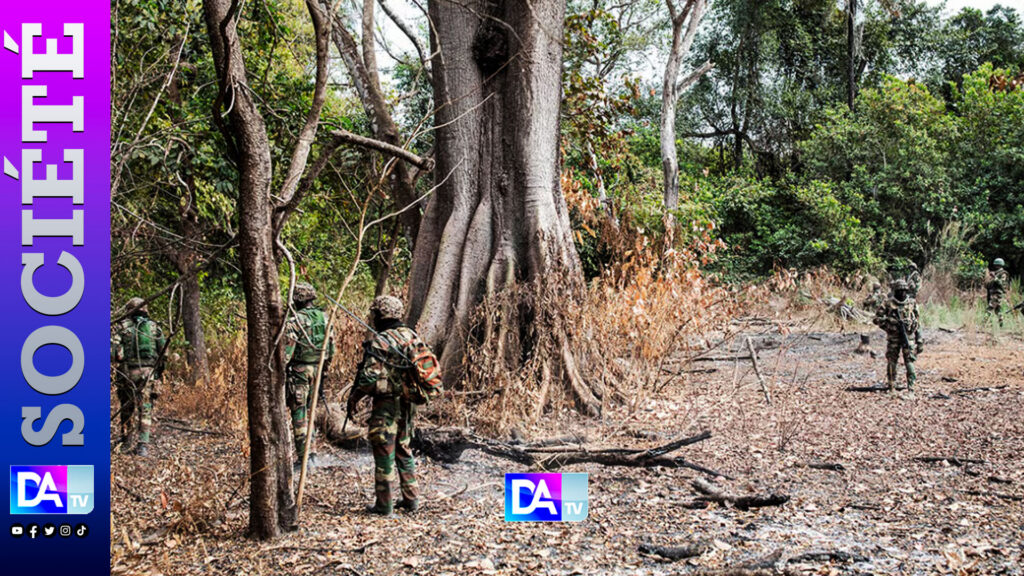
Senegalese soldiers and gendarmes, supported by sniffer dogs, recently conducted an operation to destroy cannabis fields across Casamance in early May. This action marks the latest development in one of Africa’s most enduring conflicts, a 43-year-old struggle in southern Sénégal that persists despite a significantly weakened separatist rebellion.
The military operation focused near the Gambian border, a region where rebels from the Movement of Democratic Forces of Casamance (MFDC) are known to be based. The MFDC has been fighting for the independence of this region, which is geographically separated from a portion of Sénégal by Gambia, since December 1982.
Colonel Cheikh Guèye, the army chief for the Ziguinchor region—one of Casamance’s three provinces and a historical epicenter of this low-intensity conflict that has claimed thousands of lives—informed the press that the operation was carried out “without major difficulties.” It resulted in 14 arrests, the seizure of various war weapons, and the confiscation of more than six tons of cannabis.
While the MFDC previously inflicted casualties on the army, the group is now “heavily weakened.” I have learned from an expert familiar with the situation that the MFDC now consists of “only residual troops, struggles with recruitment, and faces an aging combatant base,” contrasting sharply with the Senegalese army’s enhanced personnel and equipment.
Furthermore, the rebellion is confronting “severe divisions among its political and military factions” and “significant challenges in obtaining weapons and ammunition.” This shift is largely due to neighboring Gambia and Guinea-Bissau, once critical transit zones, now actively cooperating with Dakar in its peace efforts.
The weakening of the rebellion can also be attributed to “a progressive loss of its political and emotional base, which was once deeply rooted in local communities,” explained a prominent figure within Casamance civil society.
This individual further highlighted that “the harsh realities of the struggle have led to disillusionment and disaffection towards the MFDC among these communities, who now primarily aspire to peace.”
Moreover, the rise of Casamance-born political leaders at the national level, such as Prime Minister Ousmane Sonko, who leads the country’s majority party, “has contributed to calming the fervor” of some MFDC adherents, the same source confirmed.
According to this perspective, they “now perceive a sense of Casamance’s political vindication within the Senegalese political arena,” a space from which they previously felt marginalized.
– “40 years without controlling a village” –
Prime Minister Sonko, speaking in Ziguinchor, Casamance’s main city, in mid-March, emphasized that the MFDC has been fighting for over “40 years without controlling a single village.”
His statement followed the tragic deaths of three soldiers and injuries to three others on March 17 in an ” accidental explosion” during anti-cannabis operations. Just days earlier, on March 11, another soldier was killed and six were wounded.
In November 2025, a soldier who had been held captive for seven months by an “armed group” was successfully released.
“We do not believe that the rebels still advocate for independence, except perhaps as a matter of principle. The primary challenge now is the cultivation of hemp (cannabis). We will commit all necessary resources” to combat it, Prime Minister Sonko declared.
Cannabis “enables armed groups to secure substantial resources to fund their activities,” and the recent criminal operation in early May aimed “to strike at the core of their economy and war efforts,” Colonel Guèye elaborated.
While the border zone with Guinea-Bissau has seen calm since the army dismantled rebel bases in 2021, recent months have witnessed renewed disturbances concentrated in North Sindian, an area adjacent to Gambia.
– “Partial disarmament” –
This particular area is highly susceptible to illicit activities due to its “dense forest” and isolated nature, “despite its significant agricultural and forest productions that impoverished local populations struggle to market due to a lack of proper roads,” explained Mamadou Sadio, a former member of an army elite unit.
Local residents have reportedly admitted their reliance on cannabis trafficking, with some even “consulting imams to determine if there is a religious (Muslim) justification allowing them to cultivate it,” a local administrative official disclosed.
Prime Minister Sonko has extended an offer of dialogue to the MFDC but firmly reiterated: “We cannot accept any amputation of even the slightest portion of our territory.”
Local civil society organizations recently celebrated the third anniversary of a peace agreement between a rebel faction and the government, holding ceremonies near Ziguinchor this week.
Another accord was reached in February 2025 with a different faction in Bissau, although several other peace initiatives have failed to progress.
Across almost the entire region, refugees and displaced persons are “gradually resettling in their home villages,” a positive outcome attributed to “the cessation of hostilities and the partial surrender of weapons,” the civil society figure observed.
However, she cautioned that “the question of complete pacification remains unresolved” because “some armed elements are still reluctant to lay down their arms.”