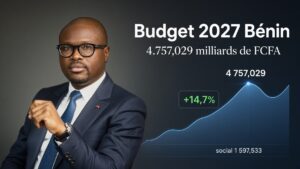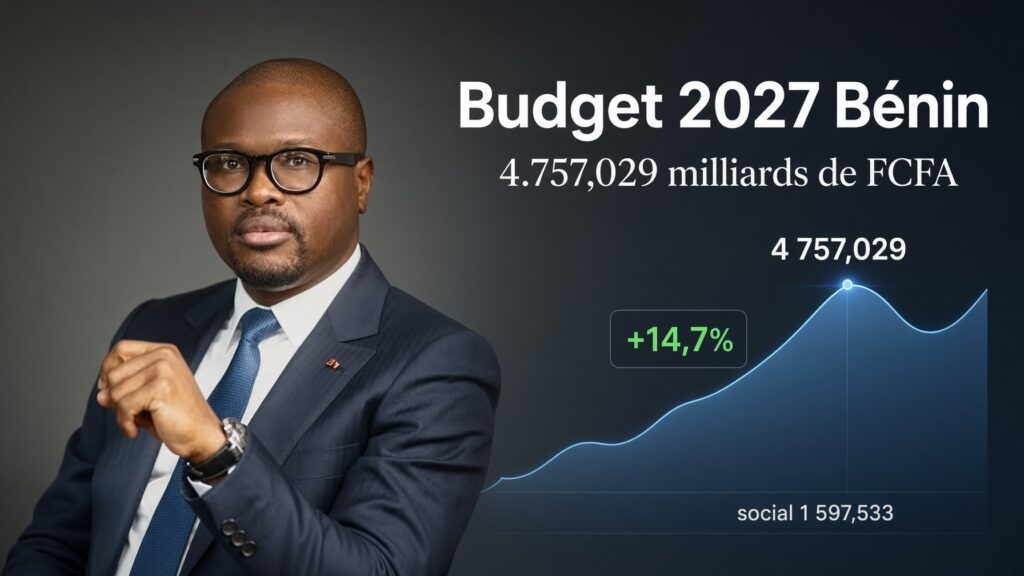
As Benin finalizes its 2027 budget proposal, one question looms large: can this historic surge in public spending truly bridge the gap between economic momentum and social equity? The draft budget, now before the National Assembly, stands at 4,757.029 billion FCFA — a 14.7% leap from the 2026 revised budget. This unprecedented allocation reflects a dual ambition: driving a 7.5% GDP growth rate while keeping the budget deficit at 2.8% and inflation at a controlled 2.0%. But will these numbers translate into tangible change for citizens?
From figures to impact: what 4.76 trillion FCFA really means for Benin
The 2027 budget represents more than just a numerical milestone. It is a strategic pivot point for Benin’s development trajectory. At 4,757.029 billion FCFA, this budget is designed to fuel public investment, strengthen macroeconomic stability, and expand social programs. Compared to the 2026 revised budget, this amounts to an additional 608.672 billion FCFA — funds earmarked for infrastructure, education, health, and industrial transformation.
Central to this plan is the government’s commitment to maintaining fiscal discipline. The deficit target of 2.8% of GDP aligns with West African economic convergence criteria, signaling a careful balance between expansion and sustainability. Meanwhile, projected inflation of 2.0% remains well below the 3.0% UEMOA threshold, helping protect household purchasing power even as the economy accelerates.
Five pillars driving Benin’s economic transformation
To deliver on these ambitions, the government has identified five key levers of action:
- Agricultural modernization: Improving productivity through better value chains and local processing, positioning agriculture as a driver of rural jobs and food security.
- Industrial promotion: Strengthening value addition on national soil, enhancing business competitiveness, and creating high-quality jobs.
- Tourism and culture: Expanding Benin’s cultural and historical appeal to diversify the economy beyond traditional sectors.
- Technological innovation: Accelerating digital transformation across public services, agriculture, and industry to improve efficiency and access.
- Human capital development: Investing in education, health, social protection, and youth employment to build a skilled, resilient workforce.
These priorities are not isolated initiatives but part of a cohesive strategy to modernize Benin’s productive base and improve the quality of life for all citizens.
Where the money goes: priorities in public spending for 2027
The budget’s allocation reflects a clear focus on high-impact sectors that drive both economic and social progress. Public spending will prioritize:
- Education: Continued construction and rehabilitation of secondary schools, expansion of digital learning platforms, and upgrade of university infrastructures.
- Health: Construction of five new zone hospitals, rehabilitation of regional health centers, and strengthening of maternal and child health programs, including expanded nutrition initiatives.
- Social protection: Scaling up the Human Capital Strengthening Insurance Program (ARCH), universalizing free secondary education for girls, and expanding school feeding programs.
- Agriculture and energy: Investment in rural infrastructure, renewable energy access, and technology adoption to boost productivity and resilience in farming communities.
- Digital transformation: Deployment of ICT tools in government services, schools, and businesses to enhance transparency, connectivity, and service delivery.
This investment strategy aims to create a durable foundation for structural transformation — one where economic growth is inclusive, sustainable, and felt across all regions of the country.
Social progress as a cornerstone: can Benin deliver?
With social spending now totaling 1,597.533 billion FCFA — up from 1,285.37 billion FCFA in 2026 — the government is doubling down on equity. Key initiatives include:
- The expansion of the ARCH program, providing cash transfers to ultra-poor households to stimulate income-generating activities.
- The full implementation of free secondary education for girls, part of a broader push to reduce gender disparities in education.
- The universalization of school feeding programs, improving attendance and learning outcomes in vulnerable communities.
- The launch of a national social benefits platform and a national emergency social assistance service to streamline support and reach those in crisis.
These measures are designed not only to alleviate immediate hardship but to build long-term resilience, particularly among women, youth, and rural populations.
Health: building resilience through infrastructure and prevention
The 2027 budget places strong emphasis on health system strengthening. In addition to the five new zone hospitals, the government plans to:
- Expand nutrition programs targeting children and pregnant women to combat chronic malnutrition.
- Intensify vaccination campaigns and malaria control efforts, building on past success in reducing child mortality.
- Upgrade equipment and staffing in regional and university hospitals to improve emergency response and specialized care.
Together, these investments aim to reduce preventable deaths, improve maternal and child health, and prepare the system for future health shocks.
Local empowerment: can communes turn resources into results?
The budget also places greater responsibility on local governments. Through the operationalization of the Communal Investment Fund (FIC) and new economic zoning mechanisms, municipalities are set to gain more control over resources and decision-making.
This decentralization push aims to:
- Increase local revenue mobilization and diversify funding sources beyond state transfers.
- Improve transparency and accountability in public spending at the grassroots level.
- Enable communes to design and implement projects that reflect local priorities — from rural roads to water access.
By empowering local authorities, the government seeks to ensure that development benefits reach every corner of Benin — not just urban centers.
The real test: turning ambition into action
While the 2027 budget sets ambitious targets — 7.5% growth, controlled inflation, expanded social protection — the ultimate test lies in execution. The numbers are impressive, but their impact will depend on:
- Effective public financial management: Ensuring timely disbursement, rigorous oversight, and minimal leakage.
- Strong public-private partnerships: Mobilizing private investment to complement public spending, especially in industry and infrastructure.
- Continuous monitoring and transparency: Tracking progress in real time and holding institutions accountable for results.
The National Assembly now holds the key. The parliamentary review and debate phase will determine whether the budget remains a bold vision or becomes a roadmap for real change. For Benin’s citizens — especially the young, the rural poor, and women — this budget is more than a fiscal document. It is a promise of a better future.
As the 2027 budget moves through the legislative process, one thing is clear: Benin stands at a crossroads. The question is not whether the resources are available — but whether the will to use them wisely, fairly, and effectively exists.