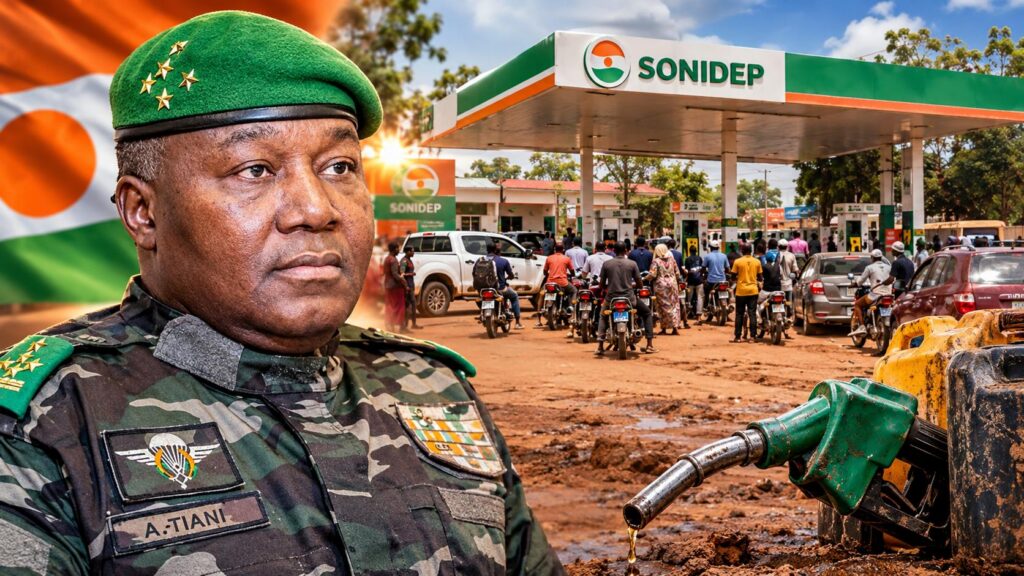
Is the Nigerien government truly the only administration capable of erasing a fuel shortage from the streets by erasing it from official statements?
While citizens queue for hours at petrol stations and supply constraints tighten across the country, Niamey’s response defies logic. State media presents the scarcity as nothing more than a baseless ‘rumour’, insisting no region of Niger faces shortages at all. Yet those same queues stretching for blocks, gripping motorists and transporters alike tell a starkly different story.
The question now stands: when official rhetoric directly contradicts lived experience, which version of reality should the public accept? Are motorists queuing for non-existent fuel? Are the long lines at stations mere digital fabrications? Or has the junta’s insistence on denial reached a point where it risks eroding its own credibility?
The Sahelian paradox: when denial outweighs evidence
Niger’s current predicament reflects a troubling regional pattern. The three nations of the Alliance of Sahel States Mali, Burkina Faso, and Niger have repeatedly faced the same dilemma: maintaining a narrative of resilience while confronting undeniable economic and logistical challenges. In Mali, authorities have openly acknowledged several months of fuel supply disruptions, despite earlier assurances. Yet instead of drawing lessons, Niamey persists in dismissing reality as mere misinformation.
This approach ignores a fundamental truth: a crisis does not vanish because a government refuses to name it. Scarcity manifests in long lines, idle taxis, shuttered businesses, and delayed agricultural shipments. It is measured in days lost to transport delays and in rising prices for essential goods. When fuel becomes scarce, whether officially labelled a ‘shortage’ or not, the impact is immediate and widespread.
Cheap fuel is no longer enough
For years, the Nigerien regime has promoted its fuel subsidies as proof of economic success, pointing to some of the lowest pump prices in West Africa. Yet low prices lose their value when fuel itself becomes unavailable. A policy judged solely by retail cost ignores its real cost: the economic paralysis that follows when supply falters.
From transporters stuck without diesel to market vendors unable to deliver goods and farmers waiting for fertiliser deliveries, the shortage’s ripple effects touch every sector. Even households face higher living costs as transport fares climb and food prices surge. The Alliance of Sahel States remains heavily reliant on fuel imports from coastal nations, leaving them exposed to global supply shocks and regional instability. Denying scarcity does not negate these vulnerabilities.
Transparency, not terminology, is the real test
The debate over whether to use the word ‘shortage’ is ultimately irrelevant. What matters is whether the government will provide verifiable data to back its claims. Where are the official stock levels? How many stations are currently operational? What volumes arrived last month, and which regions received supplies? Concrete figures offer more credibility than repeated slogans.
The deeper issue arises when citizens observe clear evidence queues, empty pumps, frustrated drivers and are told to accept the opposite. Across the Sahel, governments frequently condemn alleged ‘disinformation campaigns’, yet this very scepticism highlights how central the battle for narrative control has become. When official statements diverge from observable reality, the public’s trust is the first casualty.
Niger may continue to insist there is no fuel shortage. But as long as queues persist, as long as drivers wait day after day, and as long as businesses struggle to operate, one question will grow louder with each passing week:
Is this truly a rumour or simply a reality the leadership refuses to acknowledge?
What’s at stake beyond the pump
Economic paralysis: Delays in transporting goods and people slow commerce and raise costs.
Social strain: Families face increased expenses for food and transport, deepening poverty.
Regional isolation: Dependence on coastal fuel imports leaves landlocked nations vulnerable to external shocks.
Government credibility: Repeated denial in the face of visible evidence risks eroding public trust permanently.
By Rose Njoya — Journaliste / Rédacteur