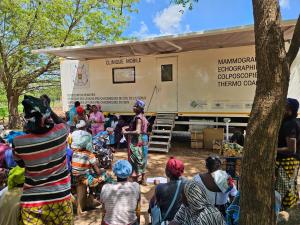
Burkina Faso’s mobile clinics boost cervical cancer screening rates
Ouagadougou — « When I heard the town crier announce that health workers were offering free screening, I hesitated: what if they told me I had the disease? How would I pay for treatment? But I thought of my children and decided to go,» shares Awa, a 48-year-old mother of six from Ipendo in Burkina Faso’s Centre-Ouest region.
Her story mirrors that of thousands of women across the country who, for years, grappled with limited access to healthcare. Cervical cancer remains one of the deadliest cancers affecting women in Burkina Faso, with screening coverage historically below 8%, particularly in rural areas. Women often faced daunting journeys—sometimes hundreds of kilometers—to reach equipped facilities, struggling with transportation costs and lack of awareness. Skilled healthcare professionals were scarce, and community outreach was nearly nonexistent.
Breaking barriers with bold government action
To address these challenges, the government of Burkina Faso implemented sweeping reforms, as explained by Professor Nayi Zongo, a Public Health physician and Head of the National Cancer Control Program (PNLC). « The government issued a decree making cervical cancer screening and precancerous lesion treatment completely free. It also equipped peripheral health centers and launched mobile clinics to reach women directly in their communities, » he notes.
These mobile clinics have become a cornerstone of health equity, traveling to villages, farms, local markets, and even family courtyards. Women no longer need to abandon their daily work—whether farming, gardening, or selling produce—to access care. « Screening is now brought closer to communities, allowing women to safeguard their health without disrupting their lives, » emphasizes Dr. Zongo.
The initiative’s strength lies in its multi-pronged strategy: eliminating financial barriers through free care, overcoming geographical hurdles with mobile units, and fostering community engagement. The country has also ramped up awareness campaigns via television, radio, and popular events like « October Rose » (Pink October). A national cancer coalition—comprising civil society, community leaders, and media—has further amplified the message, turning the fight against cervical cancer into a shared national cause.
Global support accelerates progress
The World Health Organization (WHO) played a pivotal role in turning this vision into reality. It provided technical guidance for national policies, trained healthcare workers in early detection and treatment, and supported community mobilization. « WHO’s support has been instrumental in building our capacity so that every woman, regardless of where she lives, can access this vital service, » affirms Dr. Zongo.
The results speak for themselves. Between October 2024 and September 2025, mobile clinics conducted 468 outreach missions across multiple districts. These efforts reached nearly 2 million women, performed 106,446 screenings, treated 715 precancerous lesions, and conducted 113 diagnostic follow-ups. Beyond the numbers, these outcomes represent lives saved and families protected.
For WHO, this success underscores the power of collaboration. « Burkina Faso demonstrates that with strong political will and context-specific solutions, even the most daunting barriers can be overcome, » says Dr. Seydou Coulibaly, WHO Representative in Burkina Faso. He highlights the initiative’s regional significance: « Removing financial and geographical obstacles through free care and mobile clinics sets an inspiring example for other African nations. »
Real-life impact: stories of change
Awa’s experience is a testament to the initiative’s reach. « We work in the fields, tend our gardens, and sell vegetables at the market. When we heard about screening, I was scared. But hearing other women’s stories gave me courage. On the day of my test, the health workers walked me through every step. When the result came back negative, I felt an immense sense of relief. Now, I urge all women to get screened. Early detection makes treatment so much easier, » she shares with conviction.
For many women like Awa, these mobile clinics offer more than medical care—they provide their first opportunity to learn about cervical cancer, understand its risks, and discover that it can be prevented. This initial awareness is critical, paving the way for prevention and early intervention.
The initiative transcends health, touching on dignity, social justice, and family futures. Each mobile clinic visit sends a powerful message: health is a right, not a privilege. In Burkina Faso, that right is becoming a reality.