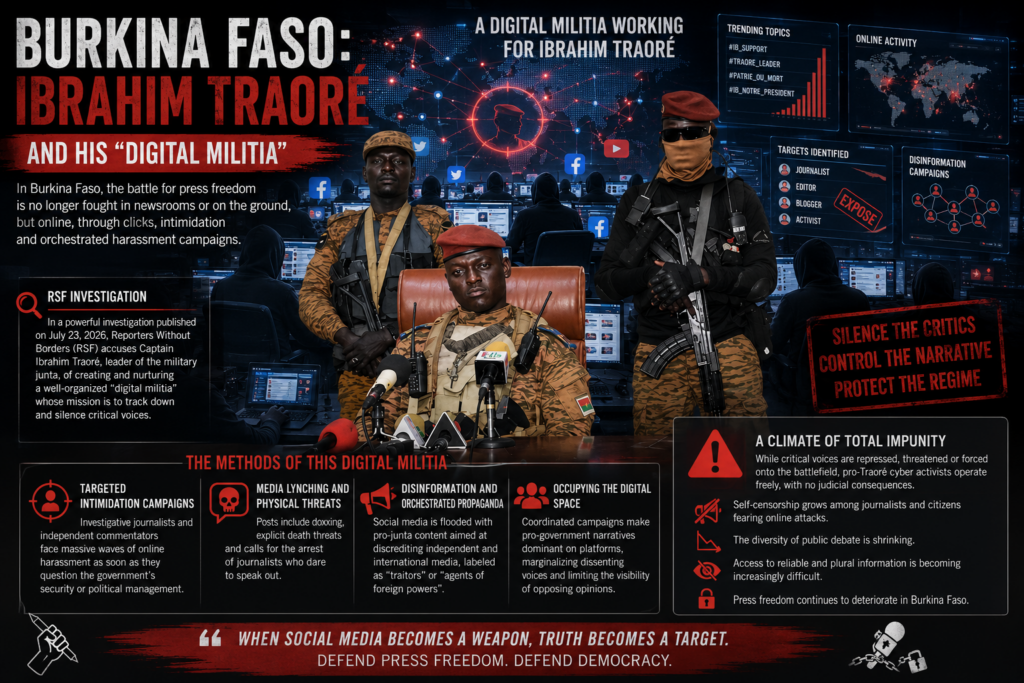
Cyber-operations under scrutiny: how Ibrahim Traoré’s regime silences dissent
In Burkina Faso, the struggle for press freedom has shifted from editorial rooms and the streets to the digital battlefield, where coordinated online harassment campaigns now silence critical voices. A recent investigation reveals the extent of this strategy, directly implicating Captain Ibrahim Traoré, the leader of the military junta.
According to findings, a structured network of cyberactivists, operating under the banner of the Bataillons d’Intervention Rapide de la Communication (BIR-C), has been deployed to dominate online discourse and suppress opposition. Unlike traditional militant groups, these digital battalions function entirely within the virtual sphere, mirroring the operational tactics of their military counterparts but replacing bullets with keystrokes.
The BIR-C: a weaponized digital force
The BIR-C’s primary objective is to monopolize public digital space, rendering any form of dissent not only invisible but also perilous. Their methods extend beyond mere political advocacy, evolving into a systematic campaign to stifle independent journalism and public debate.
Key tactics employed by these cyberunits include:
- Targeted intimidation campaigns: Journalists and independent commentators face coordinated online harassment whenever they scrutinize government policies, particularly in matters of security and national governance.
- Doxxing and physical threats: Dissidents are routinely subjected to the public release of their personal information, accompanied by explicit death threats or calls for their arrest.
- Disinformation and propaganda: Pro-regime narratives flood social platforms, labeling local and international media as « traitors » or « foreign agents » to undermine their credibility.
- Digital space saturation: Coordinated campaigns ensure pro-government narratives dominate trending topics, burying dissenting views and restricting access to alternative perspectives.
A culture of impunity
The most alarming aspect of this phenomenon is the absence of accountability. While critical voices face repression or forced conscription, cyberactivists operate with impunity, shielded by tacit state protection. This climate fosters a culture of self-censorship, where journalists and bloggers avoid sensitive topics—particularly those related to security operations or governance—to evade online harassment.
For many observers, this indirect suppression of free expression is equally damaging to democratic discourse as formal censorship. The psychological toll of constant surveillance and threats compels individuals to refrain from participating in public debate, thereby narrowing the range of available information.
The broader implications for democratic debate
Experts in political communication warn that when digital spaces become battlegrounds for coordinated disinformation, public discourse loses its plurality. Dissenting voices fade into the background, while regime-aligned narratives dominate online conversations. This polarization is particularly concerning in Burkina Faso, where persistent security challenges demand nuanced public understanding and informed decision-making.
The tactics exposed in this investigation mirror those documented in other authoritarian or hybrid regimes, where cybermilitias are mobilized to defend state narratives, discredit independent media, and manipulate digital conversations. International press freedom organizations now recognize these campaigns as a covert yet potent form of oppression, often surpassing traditional censorship in effectiveness.
An escalating crisis for press freedom
This digital crackdown is not an isolated phenomenon but part of a broader pattern of restrictions targeting media outlets. In recent years, several international news organizations have been barred from broadcasting in Burkina Faso, while local journalists report intimidation, forced interrogations, and unexplained disappearances.
Human rights advocates argue that the combination of administrative censorship, security pressures, and online harassment is systematically eroding independent journalism in the country. The result is a shrinking space for free expression, where fear of repercussion outweighs the pursuit of truth.
International repercussions
This investigation underscores the accelerating decline of democratic freedoms in Burkina Faso since the military takeover. By weaponizing social media, the regime has transformed these platforms into tools of political coercion, making independent journalism increasingly hazardous.
The findings may also amplify international concerns regarding Burkina Faso’s press freedom rankings. Investors, development partners, and multilateral organizations frequently assess such indicators when evaluating a nation’s governance and institutional stability. A sustained deterioration in these metrics could further tarnish Burkina Faso’s global reputation and deter foreign engagement.
Moreover, this report highlights a broader shift in information warfare. While propaganda once relied on state-controlled media, social networks now serve as the primary arenas for narrative battles. The speed of content dissemination, algorithmic amplification, and viral potential enable regimes to dominate conversations while marginalizing dissent. For many analysts, this evolution poses one of the most pressing challenges to press freedom and democratic resilience in politically unstable regions.