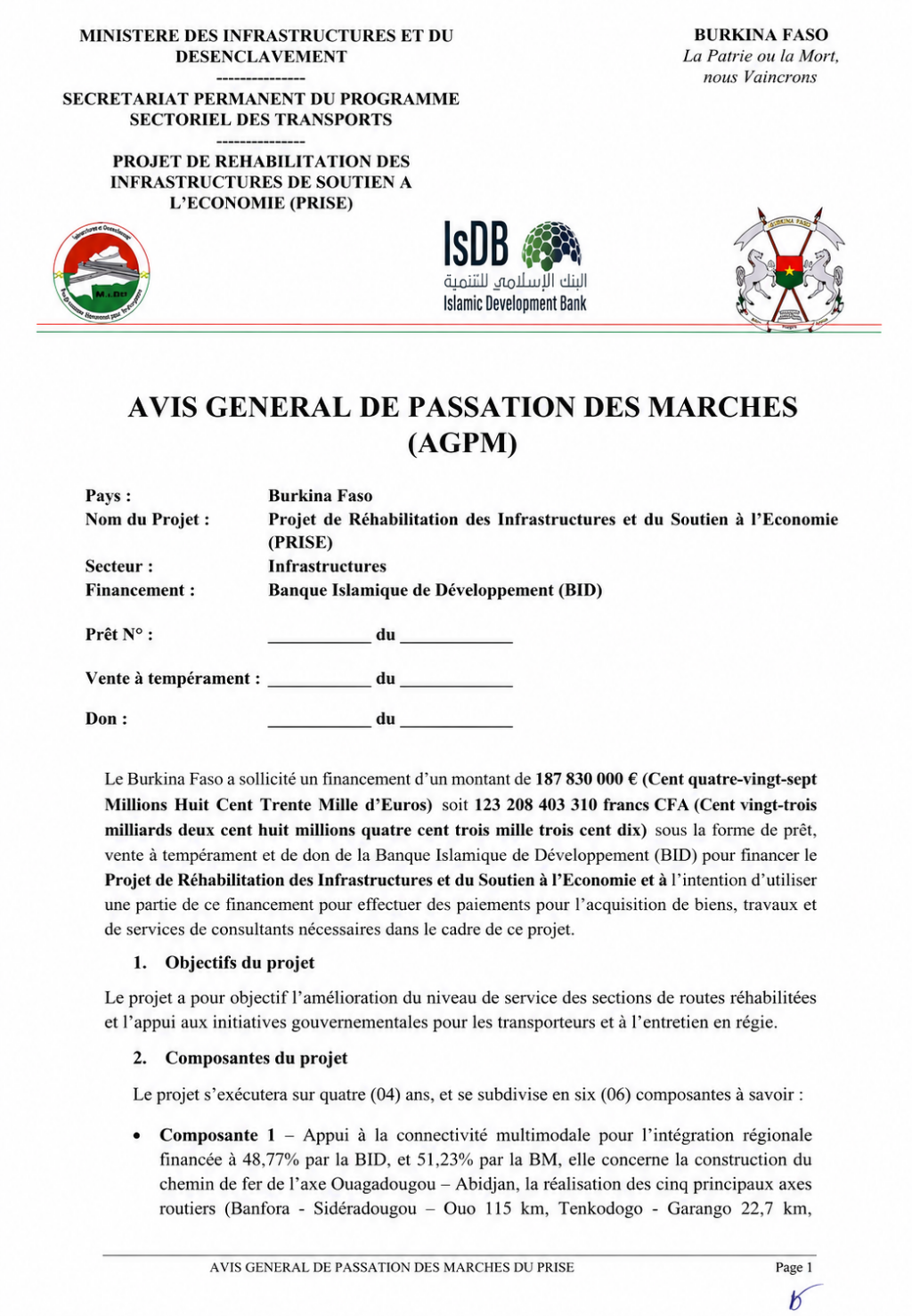
The Burkina Faso government has championed a bold narrative in recent months: a claim of financial self-sufficiency embodied in the slogan “Y’a pas crédit dedans” (“there’s no credit in it”). This phrase, repeated across official communications and social media platforms, suggests that every road rehabilitation, infrastructure project, and state modernization effort is funded entirely through domestic resources, without external borrowing.
At face value, the message is compelling—a nation advancing independently, free from the shackles of international lenders. Yet beneath the surface, a stark discrepancy emerges between the rhetoric and the financial records.
Between slogans and ledgers: the hidden truth of public financing
Economic sovereignty is a legitimate aspiration. Few would argue against reducing reliance on foreign assistance, enhancing domestic revenue collection, or strengthening national capacities. However, when official statements insist that all public investments are financed exclusively through internal funds, yet financial agreements reveal the opposite, the credibility of such claims comes into question.
Recent financing agreements with the Islamic Development Bank for major road projects in Burkina Faso serve as a case in point. These initiatives, while beneficial for connectivity and economic growth, are not funded through pure grants. They rely on concessionary loans with repayment schedules, even if terms are preferential. In accounting terms, these are liabilities, not free resources. The government’s insistence on excluding any mention of external funding raises questions over transparency and the accuracy of public financial reporting.
Why deny the obvious? The paradox of sovereign debt
Borrowing is not inherently problematic. States across the globe regularly take on debt to finance critical infrastructure when domestic resources fall short. The issue lies not in the existence of loans, but in the discrepancy between public discourse and financial reality.
Burkina Faso’s current economic climate further complicates the narrative of financial autonomy. The country faces multiple pressures:
- A deepening security crisis driving up military expenditures;
- Large-scale population displacements straining social services;
- Weakened tax revenues due to disrupted economic activity in conflict zones;
- Massive infrastructure needs to support recovery and development;
- Severe constraints on public finances.
In such a context, funding multi-billion-franc infrastructure projects entirely from domestic sources appears highly unlikely. Independent economists and financial analysts have repeatedly highlighted this inconsistency, questioning how such ambitious undertakings could proceed without external financing.
The real issue isn’t debt—it’s transparency
Public debt, when used responsibly, can be a powerful tool for development. When allocated to productive infrastructure—roads, energy, water systems—it can stimulate growth, create jobs, and improve living standards. The key lies in responsible management, clear accounting, and public accountability.
Yet the government’s refusal to acknowledge the role of external financing raises concerns. Citizens are entitled to know:
- The exact sources of funding for major projects;
- The total volume of loans contracted;
- The interest rates applied;
- The repayment timelines;
- The guarantees pledged;
- The true economic cost and long-term impact of each initiative.
Transparency isn’t optional—it is the foundation of democratic governance and fiscal responsibility.
A political message disguised as economic policy
The slogan “Y’a pas crédit dedans” is not merely a financial statement; it is a political statement. It signals a break from past practices, a reclaiming of national pride, and a reassertion of control over economic destiny. In a climate where sovereignty and self-determination dominate public discourse, such messaging resonates deeply with segments of the population.
Yet when communication eclipses clarity, the risk arises of fostering unrealistic expectations. The promise of autonomous funding may inspire hope, but it also obscures the true cost and complexity of governance. Every loan taken today will be repaid tomorrow—by future generations through tax revenues and public services. The choices made today carry long-term consequences.
Sovereignty isn’t about avoiding debt—it’s about managing it wisely
True economic sovereignty is not measured by the absence of borrowing, but by the ability to:
- Manage public finances sustainably;
- Publish accurate, accessible financial reports;
- Use borrowed funds for productive, growth-enhancing investments;
- Gradually reduce reliance on external partners through domestic economic strengthening;
- Ensure citizens can hold leaders accountable for financial decisions.
A strong nation acknowledges its commitments, explains them clearly, and ensures they serve the public good—not the other way around.
Conclusion: moving beyond slogans to sustainable governance
The phrase “Y’a pas crédit dedans” has captured attention and fueled national pride. But governance cannot be built on catchphrases alone. The reality remains: Burkina Faso, like many developing nations, continues to rely on external financing for key infrastructure projects.
The debate should not pit debt against sovereignty, but rather focus on the quality of financial stewardship, the integrity of public accounts, and the tangible benefits delivered to citizens. Ultimately, the burden of today’s financial decisions will fall on the taxpayers of today and tomorrow. Responsible leadership means ensuring that every franc borrowed today is spent wisely—and repaid sustainably.