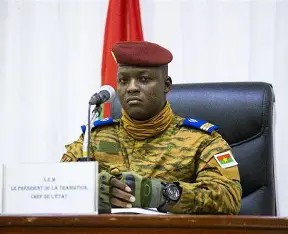
A perennial pitfall, as ancient as warfare and governmental overthrows, frequently ensnares military leaders who ascend to power: the conflation of powerful rhetoric with ground-level realities, and the misinterpretation of public silence—often born of apprehension or uncertainty—as unequivocal endorsement.
In Burkina Faso, numerous observers contend that this dynamic is now strikingly evident. Beyond the meticulously choreographed public appearances, the immaculate uniforms, the condemnations of a “perfidious West,” and the repeated warnings against any conduct deemed “anti-revolutionary,” a contrasting reality appears to be taking shape. The portrayal of an assured leadership is gradually yielding to the image of a regime grappling with escalating internal pressures.
For those critical of the administration, Captain Ibrahim Traoré increasingly appears isolated, presiding over a government where suspicion has seemingly supplanted trust. This perception is fueled by widespread rumors of destabilization attempts, shifts within the military hierarchy, and successive reconfigurations of the security apparatus.
“When a regime begins to fear its own protectors, it is no longer the nation it safeguards, but merely its own shadow.”
the purging of initial allies
African political history, mirroring that of many global regions, reveals a consistent pattern: individuals instrumental in facilitating a power seizure often become the first whom the new leader regards with suspicion once firmly established in command.
Since his assumption of power in September 2022, Ibrahim Traoré has initiated several significant adjustments within the military and security chain of command. A number of influential officers from the early days of his ascent have been replaced, reassigned, or sidelined, prompting questions about the genuine state of cohesion within the armed forces.
The removal of the director of intelligence services, widely considered a pivotal figure in the security framework, garnered particular attention. Many analysts suggest that when a head of state embarks on a profound restructuring of the very institutions tasked with ensuring their security, it often signals a loss of confidence within their immediate inner circle.
In essence, when a governing authority begins to distrust those initially charged with its protection, the issue transcends mere security; it evolves into a political crisis.
The Burkinabè army, once unified by the urgent imperative of combating armed groups, now presents an image of an institution permeated by suspicion. Successive promotions, appointments, and replacements foster the impression that personal loyalty is progressively taking precedence over operational expertise.
Several observers summarize this evolution as follows:
- Promise of unity (2022)
- ⬇️
- Persistent deterioration of the security situation
- ⬇️
- Reorganizations and reshuffles of the high command
- ⬇️
- Growing mistrust and governance under strain
fear as a governance strategy
In response to persistent security challenges, the regime appears to have opted for a political tightening.
Critics point to several concerning developments:
- Arrests targeting individuals critical of the leadership;
- Allegations of disappearances or abductions reported by human rights organizations;
- A shrinking media landscape, marked by media suspensions and restrictions imposed on journalists;
- Requisitions or mobilizations of certain civil society actors, interpreted by their supporters as retaliatory measures.
These elements are regularly cited in reports from international human rights organizations, which raise alarms about the erosion of public freedoms in Burkina Faso.
Furthermore, official communication heavily centers on the figure of the head of state. Public media and communication networks aligned with the government extensively highlight Captain Ibrahim Traoré’s travels, speeches, and initiatives, reinforcing among his opponents the notion of an increasing personalization of power.
For his detractors, this strategy does not reflect an unchallenged authority but rather a desire to compensate for the regime’s vulnerabilities through information control.
meanwhile, the security crisis endures
The primary concern, however, remains elsewhere.
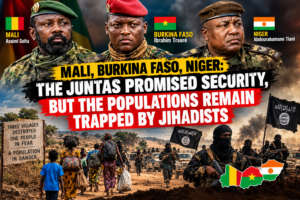
Nearly four years after the change of power, the fundamental challenges that initially justified the coup d’état largely persist.
On the ground, state control remains limited in numerous localities that continue to face threats from or operate under the influence of armed groups. The humanitarian situation also remains deeply troubling, with millions of individuals affected by forced displacement and the repercussions of insecurity. Concurrently, attacks targeting civilians, the Defense and Security Forces (FDS), and the Volunteers for the Defense of the Homeland (VDP) continue to be reported regularly. Finally, critics of the government contend that the political consolidation of the regime occupies an increasingly prominent position in governmental action, potentially relegating the response to security and humanitarian challenges to a secondary role.
Figures released in recent years by the United Nations, humanitarian organizations, and specialized research centers demonstrate that the security crisis remains profound despite military efforts. Jihadist attacks continue to impact several regions of the country, while internal displacement rates remain among the highest in the sub-region.
the peril of isolation
Patriotic rhetoric, however unifying it may be, is insufficient to restore security to a nation confronting a multidimensional crisis. Slogans cannot substitute for military achievements, the reconstruction of institutions, or the re-establishment of trust between the state and its citizens.
For critical observers of the regime, the principal danger now resides in the progressive isolation of the junta’s leader. By alienating some of his former companions, multiplying security reorganizations, and governing within an atmosphere of perpetual suspicion, Ibrahim Traoré risks undermining the very foundations of his authority.
The continent’s political history offers numerous examples of military regimes that gradually concentrated all levers of power within an increasingly restricted circle. In many such instances, internal mistrust, rather than external opposition, ultimately became the primary factor of fragility.
The true challenge for Burkina Faso thus remains unchanged: to durably re-establish security, restore confidence within its institutions, and address the expectations of a population that continues to bear the human cost of instability. For when a government expends more energy on preventing perceived conspiracies than on resolving the crises that justified its inception, it risks allowing its own political survival to become its absolute priority, to the detriment of the national interest.