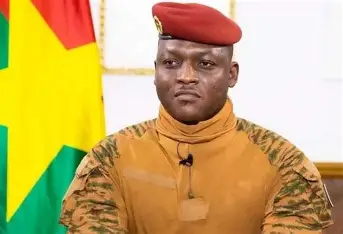
In Burkina Faso, each public statement by Captain Ibrahim Traoré deepens the discussion surrounding the nature of his leadership and the political trajectory Burkina Faso has followed since the September 2022 coup d’état. Observers note that the recent remarks made by the transitional leader leave no room for ambiguity: they reflect a clear intention to fully embrace a seizure of power achieved outside constitutional frameworks and to frame this rupture as a new political standard.
The assessment is difficult to dispute. Ibrahim Traoré did not ascend to the highest office through universal suffrage. His rise followed a military takeover that toppled Lieutenant-Colonel Paul-Henri Sandaogo Damiba, who himself had seized power in a prior coup against President Roch Marc Christian Kaboré. This chain of military overthrows signifies a profound departure from the democratic mechanisms that typically underpin the legitimacy of a head of state.
For critics of this development, the issue extends beyond the circumstances of his ascension. Of greater concern is the narrative that frames this power grab as a legitimate source of authority in itself. By openly admitting this breach of constitutional order, Ibrahim Traoré, according to detractors, sends a troubling message: that force may become an acceptable means of seizing power, provided it garners fleeting popular support.
Such reasoning carries significant risks. If political legitimacy no longer derives from institutions, elections, or the rule of law but instead from the ability of an armed faction to impose its will, future grievances could similarly justify fresh military interventions. This cycle risks permanently weakening state institutions and entrenching chronic instability, where firearms gradually overshadow ballot boxes.
Proponents of the current regime often emphasize the restoration of sovereignty, the rejection of foreign influence, and the resurgence of national pride fostered by official rhetoric. While these themes resonate with many, they cannot alone constitute a governance record. History demonstrates that nationalist slogans, regardless of their appeal, do not substitute for tangible economic outcomes, security improvements, or the proper functioning of institutions.
Indeed, some analysts argue that political communication has taken on an outsized role in governance. Speeches are prolific, patriotic symbols pervasive, and displays of support widely amplified across social platforms. Meanwhile, persistent questions linger regarding tangible results achieved against the very challenges cited to justify the coup: counterterrorism efforts, territorial reconquest, and population welfare.
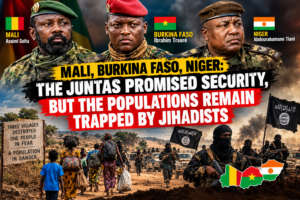
The most pressing benchmark remains security. Despite announced initiatives and military restructuring, numerous regions continue to endure deadly attacks, mass displacements, and a humanitarian crisis affecting hundreds of thousands of Burkinabè. In some areas, residents live under constant threat from armed groups, while access to healthcare, education, and public services remains severely disrupted.
On the economic front, conditions remain equally dire. Persistent insecurity undermines agricultural output, domestic trade, and investment. Citizens overwhelmingly seek tangible improvements in daily life: more jobs, higher purchasing power, reliable access to essential services, and stability to rebuild their futures. Yet these expectations struggle to gain ground against the hopes generated in 2022.
Critics also highlight the growing centralization of authority. Dissenting voices face increasing constraints, while journalists, civil society actors, and opposition figures operate in an environment where criticism is often equated with disloyalty. This conflation of national pride with blind allegiance to the regime represents a troubling deviation, particularly in a democracy where loving one’s country does not demand unquestioning support for its leaders.
The adage « Jupiter renders mad those he wishes to destroy » carries renewed relevance here—not as a personal indictment, but as a universal reflection on the corrupting influence of power. Political history abounds with leaders who became convinced that their popularity, strength, or historical mission placed them above the law. Many ultimately rejected dissent, marginalized opponents, and conflated their personal survival with the fate of the nation.
This is the risk now being flagged by observers. The more a leader consolidates power and portrays their authority as unassailable, the greater the likelihood of losing touch with ground-level realities. Ovations at rallies, orchestrated media campaigns, and manufactured displays of loyalty cannot replace honest evaluations of on-the-ground performance.
Ultimately, a head of state’s legitimacy is not forged through force, slogans, or defiant declarations. It is measured by institutional respect, the protection of citizens, the safeguarding of fundamental freedoms, sustainable improvements in living standards, and the recognition that power is a means, not an end. It is against these benchmarks that Ibrahim Traoré’s leadership will be judged. Until concrete solutions emerge to address the security, economic, and social crises, questions about the legitimacy and durability of his rule will continue to shape Burkina Faso’s political landscape.