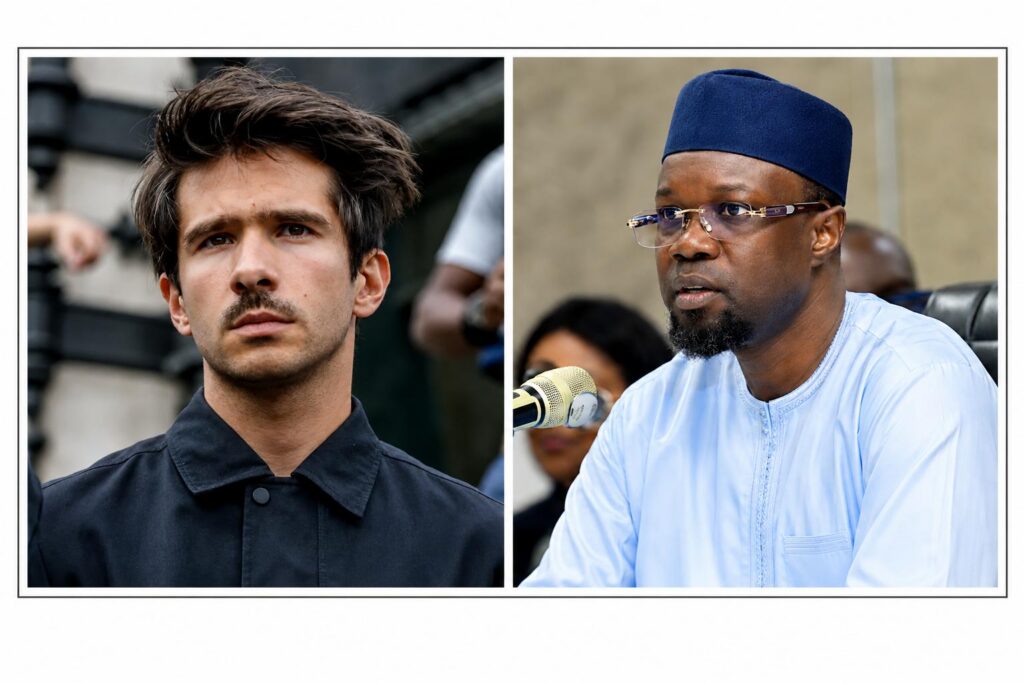
In recent days, a controversy has emerged that challenges the boundaries of political and legal norms. At its center is a leaked letter from Juan Branco, a lawyer and essayist known for his defense of Kemi Seba, addressed to Ousmane Sonko, then Prime Minister of the Republic of Senegal. The correspondence, dated February 4, 2025, outlines five key demands directed at Sonko, raising questions about the intersection of personal relationships, legal procedures, and national sovereignty.
legal maneuvering and sovereignty concerns
Branco’s letter opens with a request for intervention regarding a Spanish judge’s commission rogatoire linked to his alleged abduction in Mauritania. He subtly urges Sonko to pressure Senegalese judicial authorities to facilitate collaboration, while also questioning the integrity of Senegal’s judicial sovereignty by suggesting an underlying French influence in the case’s handling.
intelligence services and classified documents
The lawyer’s second demand involves access to classified intelligence documents from Senegal’s former regime—specifically under former President Macky Sall’s administration—allegedly implicating French intelligence agencies. Branco claims these records could counter what he describes as a coordinated disinformation campaign in France, which has fueled disciplinary and criminal proceedings against him. He cites an October 2023 incident involving a kompromat operation (a fabricated scandal) as evidence, allegedly involving a Senegalese agent ahead of a critical hearing in Senegal. However, such a request would violate Senegal’s national defense secrecy laws (Articles 61 and following of the Senegalese Penal Code), professional secrecy laws (Article 371), and the prohibition on disclosing non-public information—posing severe legal risks for both Branco and Sonko.
justice and international accountability
Branco further calls on Sonko to directly influence the Franco-ICC investigation into alleged crimes against humanity linked to former President Macky Sall. His proposal includes financial backing for these efforts, a move that could expose both individuals to serious legal repercussions. Requesting classified intelligence summaries outside judicial channels constitutes a direct incitement to violate national defense secrecy and professional confidentiality—offenses punishable under Senegalese law. Branco’s demand for public or partisan funding (via the PASTEF party) for private prosecutions in France, particularly without Senegal’s formal involvement as a civil party, risks public fund misappropriation or misuse of political resources. By bypassing official judicial channels like the commission rogatoire in favor of a politically driven arrangement, their actions could undermine the credibility of international proceedings and transform a pursuit of justice into a series of legal transgressions.
diplomatic ambitions and legal controversies
Branco reminds Sonko of his long-standing desire to represent Senegal at the United Nations in New York, framed as a symbolic gesture aligned with the current regime’s sovereignist and pan-Africanist stance. Despite his French nationality, he asserts he would loyally uphold Senegal’s diplomatic interests. However, upon learning that another diplomat had been selected, Branco pivots to a new request: obtaining Senegalese citizenship through presidential prerogative. Such naturalization would enable him to join the Senegalese Bar Association and teach at Cheikh Anta Diop University (UCAD) in Dakar. This demand highlights an attempt to circumvent republican and professional norms, raising concerns about conflicts of interest and geopolitical interference given his French nationality. Beyond these legal and ethical breaches, the shift in their relationship is striking—once framed as a shared activist alliance, it now appears transactional, with Branco leveraging his past sacrifices (detention, abduction) to demand political influence and financial compensation in exchange for his advocacy.
financial transparency and legal exposure
Branco’s letter concludes with a financial disclosure, stating he received €15,000 in fees between 2023 and 2025, including €2,000 in reimbursements from Senegalese lawyer Maître Bamba Cissé during a Dakar visit. He claims these funds covered logistical expenses (flights, travel) and administrative costs (interns, collaborators) tied to a representation mandate allegedly entrusted by Sonko’s camp. Branco argues these sums are insufficient given his legal battles in France, lost earnings from detention and abduction, and the extensive time dedicated to the case. However, the lack of a formal, public contract with Senegal raises serious concerns. If these funds originated from public sources, the off-the-books transaction—processed outside state procurement procedures and the Judicial Agent of the State—could constitute embezzlement. Additionally, the opacity of these financial flows may violate invoicing and capital flow traceability regulations. For Sonko, this financial disclosure marks a pragmatic shift: after failing to secure political appointments (UN representative, UCAD position), Branco now frames his activism as a financial transaction, revealing the erosion of their once-idealistic partnership into a purely mercenary arrangement.