Amidst significant geopolitical shifts across West Africa, Benin is charting a course of pragmatic and confident diplomacy. Recently, the Beninese ambassador to Russia engaged with authorities in Saint Petersburg, aiming to invigorate bilateral cooperation across critical sectors such as energy, agriculture, and healthcare. While this initiative underscores Russia’s growing interest in the African continent, it primarily aligns with Porto-Novo’s overarching strategy: to broaden its economic partnerships while simultaneously upholding and fortifying its robust historical and strategic collaborations with Western powers.
A strategic meeting with diverse implications
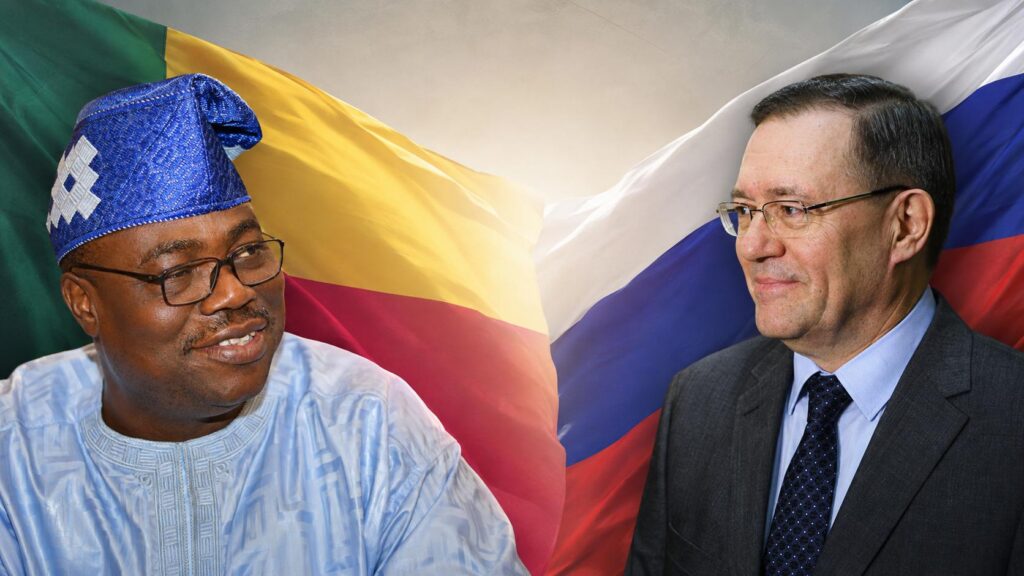
Economic diplomacy formed the core of recent discussions between Evgueni Grigoriev, a member of the Saint Petersburg government and chairman of its Committee for External Relations, and Akambi André Okounlola Biaou, Benin’s ambassador to Russia. This cordial encounter laid the groundwork for expanded cooperation between the prominent Russian metropolis and the West African nation.
At the outset of the negotiations, Mr. Grigoriev extended felicitations to his counterpart on the occasion of Benin’s Independence Day, celebrated on August 1st, signifying a spirit of mutual respect. Beyond diplomatic pleasantries, the discussions were notably concrete. An official communiqué from the Saint Petersburg committee outlined a broad spectrum of promising sectors. Energy, agriculture, the fishing industry, infrastructure projects, pharmaceuticals, and education were highlighted as top priorities.
For Benin, a nation undergoing profound transformation driven by significant structural reforms, these sectors are indispensable. Reliable energy access is crucial for its industrialization, while modernizing its agricultural sector remains a cornerstone of both its economy and food security.
The charm offensive of Saint Petersburg enterprises
To materialize these bilateral ambitions, Russia showcased its entrepreneurial prowess. The meeting saw active participation from representatives of the “Saint Petersburg Export Support Center,” an autonomous non-profit organization dedicated to promoting local expertise internationally.
They were accompanied by leaders from several prominent regional companies, who presented solutions tailored to the needs of the Beninese market. Among them was “Baltiski Bereg,” a major player in the fishing and seafood processing industry, whose expertise could bolster Benin’s fisheries development. The technology firm “Radar MMS,” specializing in information systems and infrastructure, also presented its projects. In the realms of health and food security, “Polysorb” (pharmaceutical and medical industry) and “Lignohumate” (specializing in fertilizers and agricultural yields) detailed proposals that garnered significant interest from the African delegation.
Ambassador Okounlola Biaou emphasized the strong interest these proposals generated. Seizing the opportunity, he suggested a decentralized approach: fostering direct regional interaction between Saint Petersburg and Cotonou. By targeting Benin’s largest port city and its economic heartland, this strategy aims to bypass national administrative complexities, promoting more agile and direct city-to-city commercial agreements.
Horizon 2025: 65 years of diplomatic relations and a trade mission
These preliminary exchanges are not intended to remain mere declarations of intent. Following the meeting, both parties agreed on an ambitious timeline, with the initial step being the commencement of preparations for a Beninese trade mission to Saint Petersburg.
This significant event is strategically planned to coincide with a powerful symbolic moment: the 65th anniversary of diplomatic relations between Russia and Benin, slated for the coming year. More than a simple commemoration, this commercial mission aims to translate current discussions into signed contracts and joint projects of mutual interest, thereby solidifying an economic bridge between Eastern Europe and the Gulf of Guinea.
Security and defense: the military dimension of cooperation
While economic matters dominated the agenda in Saint Petersburg, Russo-Beninese cooperation also extends to the sensitive domain of security. This economic rapprochement, in fact, mirrors recent military engagements.
Last May, a delegation from the Russian Ministry of Defense held discussions with the Beninese Naval Staff. Central to these talks was the potential for conducting joint naval exercises. In a context where the Gulf of Guinea remains a key area of concern due to maritime piracy threats, Benin is exploring all avenues to enhance the operational capabilities of its naval forces and secure its territorial waters, which are vital for its international trade.
The diplomacy of “non-alignment”: Benin firmly anchored to the West
However, it would be inaccurate to interpret this overture towards Moscow as a geopolitical pivot or a rupture with Porto-Novo’s traditional allies. On the contrary, Benin brilliantly exemplifies a multi-alignment strategy, refusing to be confined by a bloc-oriented logic.
In reality, Benin actively maintains and deepens its relationships with Western partners and powers. Unlike some of its Sahelian neighbors who have severed ties with the West in favor of exclusive new partners, the Beninese government views the European Union, the United States, and France as indispensable pillars for its development and security.
Economically, the United States remains a leading partner, notably through Millennium Challenge Corporation (MCC) programs that channel hundreds of millions of dollars into Benin’s electrical infrastructure—a sector also discussed with the Russians in Saint Petersburg. Benin further benefits from the African Growth and Opportunity Act (AGOA), which facilitates its exports to the American market.
The European Union and France, for their part, continue to be the country’s primary financial backers and trade partners. Paris and Porto-Novo share a robust, harmonious, and forward-looking relationship, recently marked by the historical restitution of artworks, alongside a strong presence of French investors in logistics, infrastructure, and services. On the security front, facing the jihadist threat impacting its northern territory, Benin relies heavily on material, logistical, and intelligence support provided by France and the United States.
The engagement with Saint Petersburg is therefore not a substitution, but an addition. By opening itself to Russian capital and expertise, Benin is asserting its sovereign interests.
The dialogue between Evgueni Grigoriev and Ambassador Akambi André Okounlola Biaou unmistakably signals a mutual desire to reactivate and enrich the Moscow-Porto-Novo axis. Through energy, agriculture, and potential naval exercises, Russia finds an open and engaging partner in Benin. Nevertheless, this initiative demonstrates the maturity of Beninese diplomacy. Far from turning its back on essential Western allies crucial for its security and economy, Benin is asserting itself as an attractive hub, ready to collaborate with any power capable of concretely contributing to its economic emergence, regardless of origin. The announced 2025 trade mission will provide a measure of the real impact of these new Russian ambitions on Beninese soil.