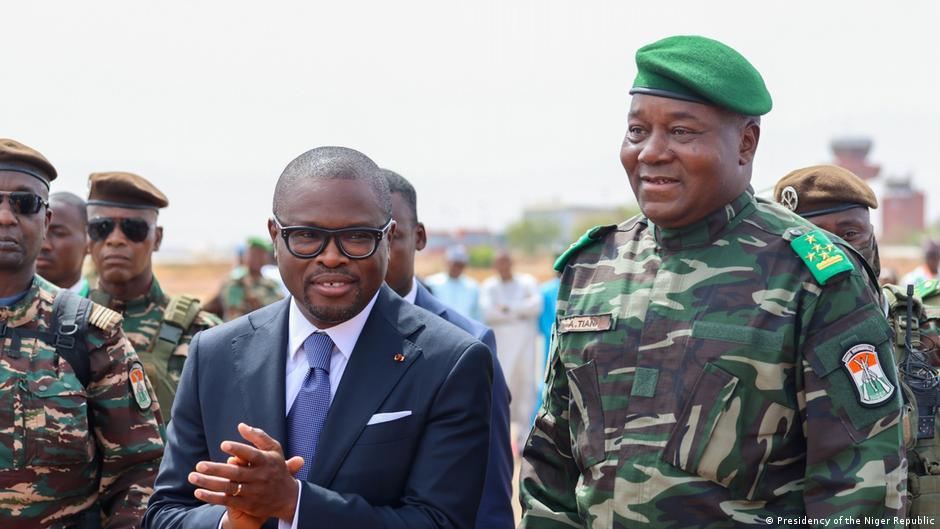
After three years of strained relations, the Niger-Bénin border crisis may finally see a breakthrough. A joint committee of experts has delivered a set of recommendations aimed at easing tensions and reopening the frontier. The proposals address key concerns around security, trade transit, and legal frameworks, though Niger’s leadership has set three non-negotiable conditions that must be met before full diplomatic ratification.
three red lines for Niamey
Niger’s authorities have made it clear: no compromise on these demands. The first is a formal defense pact with Bénin, guaranteeing mutual non-aggression and a pledge that neither nation will allow its territory to be used for destabilization campaigns against the other. While such clauses are standard in international diplomacy, analysts note their symbolic importance in light of the recent military-led transitions in both countries.
Regis Hounkpe, executive director of InterGlobe Conseils, emphasizes the practical necessity: « Mutual non-aggression isn’t just symbolic—it’s a cornerstone for rebuilding trust. The challenge now is ensuring these commitments aren’t just words on paper. Both governments must demonstrate tangible steps to enforce them. »
The second condition involves a real-time intelligence-sharing mechanism, with a joint task force to monitor cross-border threats including terrorism and smuggling. Hounkpe calls this a win-win initiative: « Transparency is key. Both sides need assurance that no hidden agendas exist—especially in an era where external military partnerships often spark suspicion. »
The third demand hits at sovereignty: full disclosure of foreign military presence near the Bénin-Niger frontier. Hounkpe frames this as a reasonable request: « Bénin has the sovereign right to partner with any nation—France, China, Russia, or others—as long as these alliances aren’t weaponized against its neighbors. The goal shouldn’t be geopolitical posturing, but regional stability. »
economic toll of a closed border
For Niger, a landlocked nation, the closed border has crippled its economic lifeline. Nearly 70% of imports—from fuel to construction materials—once flowed through Bénin’s port of Cotonou. Alternative routes via Nigeria or Togo add 30-50% to logistics costs, straining budgets already stretched thin.
The stakes are even higher for the Niger-Bénin pipeline, a 2,000-kilometer conduit carrying 90,000 barrels of crude daily to Sèmè-Kpodji. Suspended flows mean lost revenue in the hundreds of millions, a blow to Niger’s already fragile economy.
Bénin isn’t immune to the fallout. The port of Cotonou, once a regional hub, faces severe congestion as diverted cargo clogs its terminals. Customs revenues have plummeted, and sectors from transport to wholesale trade report up to 60% losses. Neighboring landlocked states like Mali and Burkina Faso also suffer, relying on Bénin for critical supplies.
human cost: livelihoods at risk
The crisis extends far beyond ledgers. At border towns like Malanville (Bénin) and Gaya (Niger), markets are half-empty. Vendors report a 50% drop in customers, with shuttered shops and lost incomes pushing families into precarity. Essential goods like rice and fuel have seen price surges, and dangerous detours via pirogue have replaced safer overland routes.
Communities once connected by trade now face isolation. Families separated by bureaucracy struggle to reunite, while vulnerable groups turn to informal networks—sometimes exploited by smugglers or racketeers—to survive. « Economic desperation breeds instability, » warns Hounkpe. « When people can’t earn a living, grievances fester. »
The human toll underscores what’s at stake: regional cohesion. As Hounkpe notes, « Geography doesn’t respect politics. Bénin and Niger are bound by necessity, not choice—and that necessity is survival. »
glimmers of progress
The thaw began with Bénin’s new president, Romuald Wadagni, who visited Niamey just days after his inauguration. The joint expert committee quickly formed, and initial talks yielded progress on security and transit. Yet political ratification hinges on Niger’s three conditions—a hurdle Wadagni’s administration is working to clear.
Hounkpe is cautiously optimistic: « The presidents aren’t just managing borders—they’re managing survival. The economic logic is undeniable: reopened trade means revived ports, restored incomes, and a chance to outpace instability. »
If negotiations succeed, a phased reopening could prioritize essential goods with strict controls. Such an accord might even ripple across the Alliance of Sahel States and ECOWAS, offering a template for bridging ideological divides with economic pragmatism—as seen recently between Mali and Côte d’Ivoire.