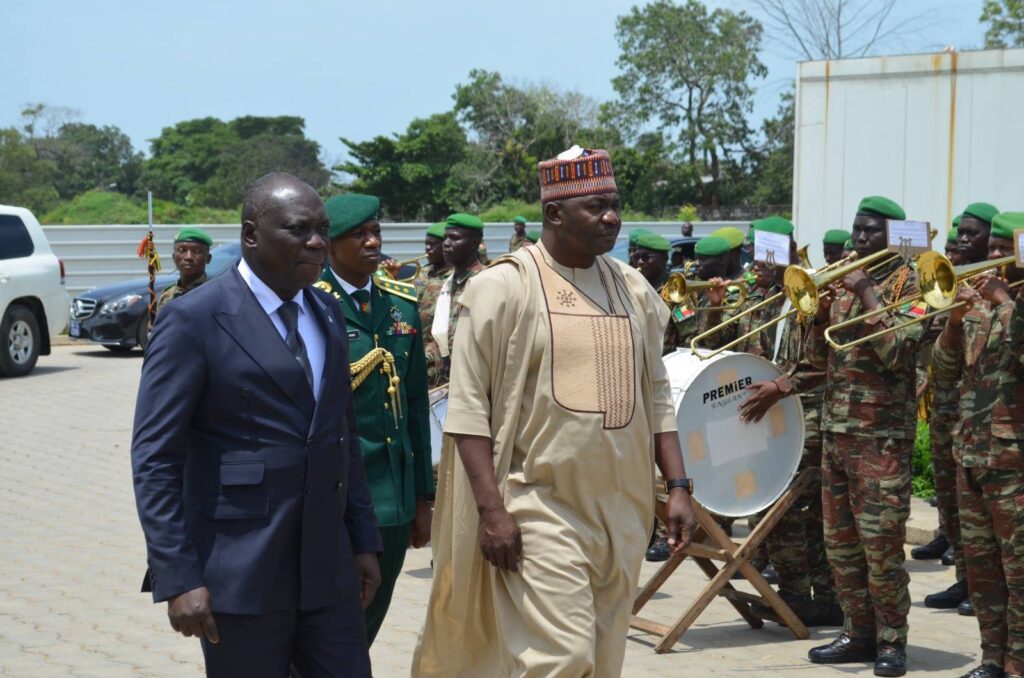
The growing threat of armed groups in West Africa has prompted Benin and Nigeria to deepen their military collaboration. On August 4, 2026, a high-level Nigerian delegation led by Defense Minister General Christopher Gwabin Musa met with his Beninese counterpart, Gildas Agonkan, in Cotonou. This strategic visit marks a pivotal step toward stronger and more practical regional cooperation.
Strategic visit underscores shared urgency
The meeting in Benin’s economic capital took place amid a shared sense of determination. General Musa’s visit—far from mere protocol—reflects the severity of the regional crisis and the need for a unified response. Before official talks began at the Ministry of Defense, the delegation toured the Togbin military barracks, where Nigerian troops were stationed for Benin’s 66th Independence Day celebrations. This presence underscores the deep historical, geographical, and cultural ties between the two nations.
Terrorism’s expanding shadow
The Sahel and Gulf of Guinea are experiencing unprecedented instability. For years, armed groups linked to Al-Qaeda and the Islamic State have pushed southward, threatening coastal states. Northern Benin, bordering Burkina Faso and Niger, faces relentless pressure, while Nigeria battles Boko Haram, ISWAP, and armed banditry on multiple fronts. The ministers agreed: isolated sovereignty is no longer enough. As General Musa emphasized, the goal is to establish the most effective mechanisms to strengthen counterterrorism efforts.
The porous nature of borders remains the terrorists’ greatest advantage. To dismantle their networks, the response must be regional, involving Benin, Nigeria, Niger, Burkina Faso, and Mali. Despite political challenges, the urgency of security demands seamless communication among Sahel and Gulf of Guinea forces.
Forging a South-South security alliance
Beninese Defense Minister Gildas Agonkan hailed the initiative as proof of political will to forge an unbreakable alliance. “Our strategies must be pooled so that, together with other regional nations, we can overcome this scourge that hinders our development,” he stated. For Benin, this cooperation means merging expertise, resources, and efforts.
The practical framework includes:
- Real-time exchange of intelligence to disrupt terrorist financing
- Joint border patrols in vulnerable zones
- Enhanced interoperability of military forces
The goal is to maintain constant cross-border pressure, preventing militants from exploiting weak points. This collaboration proves that Africa’s solutions must come from African leadership, leveraging local military expertise.
Empowering communities in the fight
Beyond military strategy, the Cotonou meeting highlighted a critical factor: civilian engagement. Terrorism thrives in isolation and economic insecurity, making military-only responses insufficient. General Musa urged Beninese and Nigerian citizens to remain vigilant, reporting suspicious activity to security forces. Without public trust and collaboration, vital intelligence fails to reach authorities. Community awareness becomes the first line of defense against ideological and operational infiltration.
Securing West Africa’s future
The deepened security coordination between Benin and Nigeria transcends bilateral ties. It serves as a cornerstone for regional stability. By securing their shared borders and streamlining cooperation, Cotonou and Abuja send a powerful message to criminal networks. Economic growth, trade, and public well-being depend on territorial safety. In early August 2026, both nations reaffirmed their commitment to acting decisively against violent extremism. The roadmap is clear: turn words into action on the ground to secure a peaceful future for generations to come.