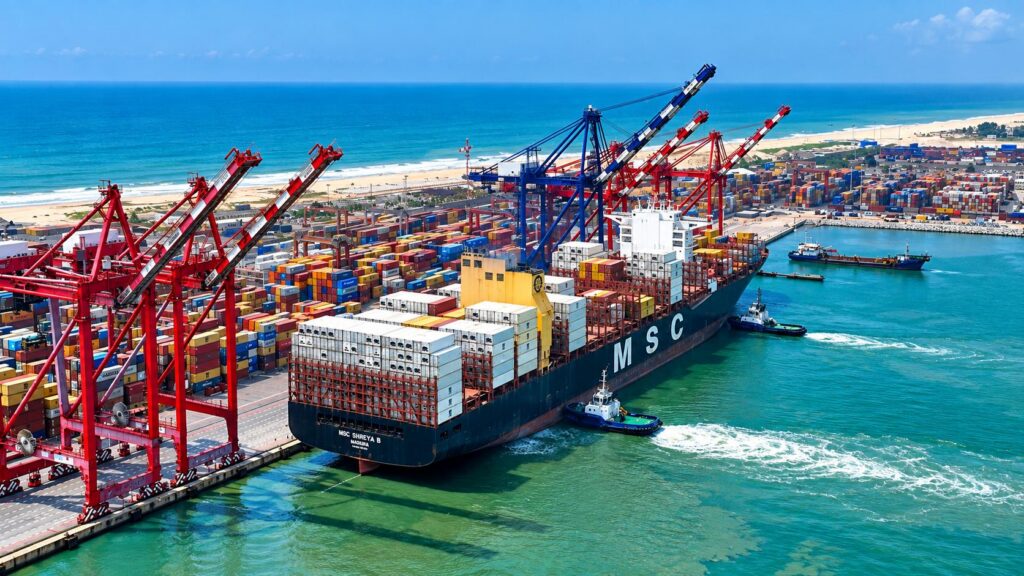
Look past the headline figure of roughly 30 million euros in European support and a more revealing picture emerges of Benin’s logistics ambitions. The real story behind the Cotonou-Niamey corridor is a calculated response to geography, regional pressure and years of underperforming infrastructure. Understanding these undercurrents explains why Cotonou is moving so decisively — and what is genuinely at stake for the wider sub-region.
The geography that made this corridor inevitable
Benin’s position on the Gulf of Guinea is not just convenient — it is structurally decisive. The country serves as the natural maritime gateway for Niger, a landlocked nation whose supply security depends directly on access to neighbouring ports. At the same time, Benin sits beside Nigeria, whose economic weight continually strains local logistics capacity. This twin pressure explains why Cotonou is investing heavily in modernising its infrastructure, aiming to cement its role as the region’s trade hub.
Inside the European-backed plan reshaping the corridor
This strategic push has reached a critical stage thanks to direct backing from international partners. The European Union and Enabel, Belgium’s development agency, are rolling out a dual logistics programme — known as Cotoni and Proport — with combined funding of approximately 30 million euros.
The Cotoni project: 729 kilometres to unblock trade with Niger
Launched last May for a four-year period, the Cotoni programme (Support Project for the Development of the Cotonou-Niamey Corridor) forms the backbone of this transformation. Its core mission is to modernise, secure and smooth the 729-km road artery linking the Autonomous Port of Cotonou to Niger’s capital — an economic lifeline for the hinterland.
To ensure lasting results, the project rests on four operational pillars:
- Stronger governance: Guaranteeing the sustainability of financial investments and funding regular road network maintenance.
- Corridor safety: Securing routes to protect hauliers while removing unnecessary bottlenecks.
- Trade facilitation: Interconnecting logistics networks to better integrate local value chains, particularly in agriculture.
- Customs performance: Improving coordination at borders through upgrades to the joint border post.
Regional synergies and smoother freight flows
This strategic road network does not stop at the Nigerien border: it also extends to crossing points into Nigeria. The long-term goal is to give transport professionals a reliable, fast and secure cross-border corridor.
The approach fits squarely within broader regional logistics shifts. The Cotoni project complements efforts to renew Benin’s truck fleet and dovetails with the future Abidjan-Lagos highway, whose partial opening is projected for 2030. In addition, customs restructuring aims to end the dysfunctions and delays seen in recent years, restoring the fluidity essential for inter-state trade.
Where the sector’s future will be decided
Cotonou will host the next edition of the Transport Logistique Cotonou (TLC) trade fair from 12 to 14 November. Organised at the Palais des Congrès in partnership with the Autonomous Port of Cotonou and ACAM, the event expects more than 2,000 economic stakeholders from across the sub-region.
Over three days, decision-makers will discuss the challenges facing African freight. In parallel, open-door days will give visitors a behind-the-scenes look at the port, from the embarkation quays to the maritime access points. It is an ideal showcase for a country determined to become the logistics engine of West Africa.