Abidjan became the epicenter of a bold African initiative this week as nations rich in critical minerals convened with global partners to chart a new course for the continent’s most valuable geological assets. The focus? Turning a staggering $29.5 trillion treasure trove of strategic resources into engines of economic growth, industrial might, and social progress across Africa.
On July 10, ministers from mineral-rich African nations gathered alongside representatives of the African Union Commission, African Continental Free Trade Area secretariat, United Nations Economic Commission for Africa, regional development banks, financial institutions, and international investors. Together, they committed to redefining Africa’s role in the global minerals economy—not as a mere supplier, but as a leader in value creation and sustainable development.
a landmark mineral pact takes shape in ivory coast
The historic conference in Abidjan underscored a unified African vision: to maximize the continent’s mineral wealth by fostering local processing, strengthening regional supply chains, and ensuring that resource revenues fuel inclusive development. With over 30% of the world’s critical mineral reserves—including cobalt, lithium, graphite, rare earths, platinum group metals, copper, manganese, and nickel—Africa stands at the crossroads of a global energy transition.
According to the African Development Bank, the continent’s untapped mineral potential alone is worth approximately $8.6 trillion. Yet, despite this abundance, Africa currently captures only a fraction of the value generated from these resources. The gathering aimed to change that narrative by promoting policies that prioritize local beneficiation, robust infrastructure, and access to fair financing for African-led industrialization.
breaking free from raw export dependency
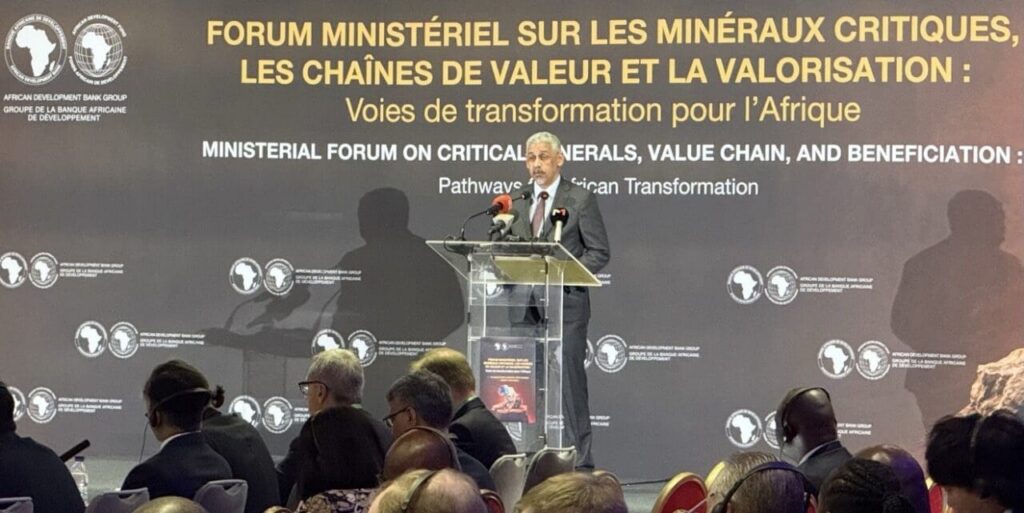
The opening remarks by Sidi Ould Tah, President of the African Development Bank, set the tone: “We are here to shift the paradigm. Africa must no longer be content with exporting raw materials; we must refine, manufacture, and innovate. That is how we create jobs, build resilient economies, and secure our future.”
He highlighted the urgent need to reform Africa’s development finance architecture, noting that while the continent hosts over 100 financial institutions dedicated to development, their combined balance sheets represent just 1% of global development finance. “We need stronger, better capitalized institutions,” he stressed, “to fund infrastructure, technology, and industrial projects that will turn our mineral wealth into lasting prosperity.”
The Bank’s strategy also emphasizes the development of resilient infrastructure and local industries—key pillars to unlocking the full potential of Africa’s mining sector and ensuring that resource revenues benefit local communities.
Côte d’Ivoire leads with bold mineral strategy
Mamadou Sangafowa-Coulibaly, Côte d’Ivoire’s Minister of Mines, Petroleum, and Energy, reinforced the call for continental solidarity. “No single country can go it alone. To transform our mineral resources into sustainable wealth, we must build regional value chains that connect producers, processors, and consumers across Africa.”
He revealed that up to 75% of Côte d’Ivoire’s territory holds potential for critical minerals, positioning the nation as a future powerhouse in the sector. Under President Alassane Ouattara’s vision, Côte d’Ivoire aims to reach upper-middle-income status by 2030—a goal anchored in a comprehensive mineral and energy strategy spanning 2026 to 2040. The plan, valued at 38 trillion CFA francs, is expected to be financed primarily by the private sector, signaling strong investor confidence in the country’s mining future.
global demand surges—can africa seize the moment?
The stakes could not be higher. Global demand for critical minerals is projected to skyrocket by 2040, with platinum group metals expected to see a 1,000%+ increase, lithium demand rising by 842%, and copper needs growing by 88% compared to 2023 levels. The electric vehicle and battery supply chain alone could expand from $7 trillion in 2030 to $59 trillion by 2050.
For Africa, this represents an unprecedented opportunity to transition from resource extraction to high-value industrialization. By investing in local processing, refining, and manufacturing, African nations can capture greater economic value, create millions of jobs, and reduce dependence on volatile global commodity markets.
The Abidjan conference sent a clear message: Africa is no longer content to be a passive supplier of raw materials. With the right policies, partnerships, and investments, the continent’s mineral wealth can become the foundation of a new era of prosperity, resilience, and self-reliance.