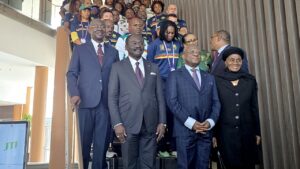
The African continent holds a significant portion of the world’s critical mineral reserves, essential raw materials for the global energy transition and digital revolution. A recent conference, held on July 27, 2026, under the theme « L’Afrique à la croisée des chemins : naviguer dans la compétition géopolitique mondiale à l’ère des minéraux critiques », starkly illuminated the immense challenges ahead. Public officials, experts from the extractive industry, and civil society representatives engaged in robust discussions, analyzing a strategic shift that is fundamentally altering Africa’s economic and security landscape.
Geopolitical competition reshapes africa’s political economy
The accelerating global demand for vital resources like cobalt, lithium, nickel, graphite, and rare earth elements is driven by the widespread electrification of transportation and the expansion of digital infrastructure. Africa, possessing nearly 30% of the world’s currently identified strategic mineral reserves, finds itself at the epicenter of intense international rivalry. Major global powers and regional players, including Washington, Beijing, Brussels, as well as Abou Dhabi, Riyad, and Ankara, are actively pursuing bilateral agreements, acquiring stakes, and channeling investments into the continent’s lucrative mining corridors.
This fervent competition is profoundly altering the continent’s political and economic dynamics. While mineral-rich nations now wield unprecedented bargaining power, they also contend with the inherent volatility of commodity prices and the persistent allure of resource rents. The Democratic Republic of Congo with its cobalt, Guinea with bauxite, Zimbabwe’s lithium, and Mozambique’s graphite exemplify diverse trajectories, where mineral wealth can either foster industrial growth or exacerbate instability.
Mining governance and security architecture under strain
The critical issue of governance dominated the discussions. Participants highlighted that the significant value addition from these minerals largely bypasses the continent. Refining, chemical processing, and battery manufacturing supply chains remain predominantly concentrated in Asia, effectively confining producing nations to the initial extraction phase. However, several recent initiatives signal a concerted effort to shift this paradigm. The groundbreaking agreement between the Democratic Republic of Congo and Zambia to establish a regional electric battery value chain stands as a leading example of this ambition.
Concurrently, the extraction of critical minerals frequently takes place in regions grappling with latent or active conflicts. Areas such as eastern Democratic Republic of Congo, the Sahel, and certain parts of the Gulf of Guinea exhibit a perilous combination of abundant subsurface wealth and institutional fragility. This convergence sustains a war economy, where armed groups exploit opaque export networks. Speakers strongly advocated for enhancing traceability mechanisms, similar to those championed by the Initiative pour la transparence des industries extractives (ITIE), and called for a more resolute pan-African collaborative approach.
Towards a second independence through local transformation
The concept of a « seconde indépendance » resonates powerfully within African mining discourse. This phrase encapsulates the continent’s profound ambition to transcend the colonial legacy of exporting raw commodities only to import high-value manufactured products. Achieving this vision necessitates substantial investments in energy infrastructure, comprehensive training for engineers, the establishment of specialized economic zones dedicated to metallurgical processing, and a fundamental rethinking of mining taxation policies.
Several nations are actively pursuing these strategic objectives. Guinea, for instance, has mandated the construction of an alumina refinery on its territory as part of the ambitious Simandou mega-project. Zimbabwe took decisive action in 2022 by prohibiting the export of raw lithium. Meanwhile, Namibia and Botswana are actively exploring regulatory frameworks that would enforce a minimum threshold for local processing. These policy shifts, though occasionally met with apprehension from international investors, signify a significant doctrinal departure from the mining liberalism prevalent in the 1990s.
Discussions at the conference also focused on the pivotal role of African financial institutions, urging them to develop tailored financing mechanisms for these transformative projects. Both the Banque africaine de développement (BAD) and Afreximbank are actively working on dedicated financial instruments, while sovereign wealth funds from the Gulf region are demonstrating increasing interest in Africa’s burgeoning mineral assets. The struggle for mineral sovereignty, it became clear, will be contested as much in the mines as it will be in the financial markets. This gathering underscored that the strategic control of critical minerals is now undeniably one of the defining indicators of African power in the 21st century.