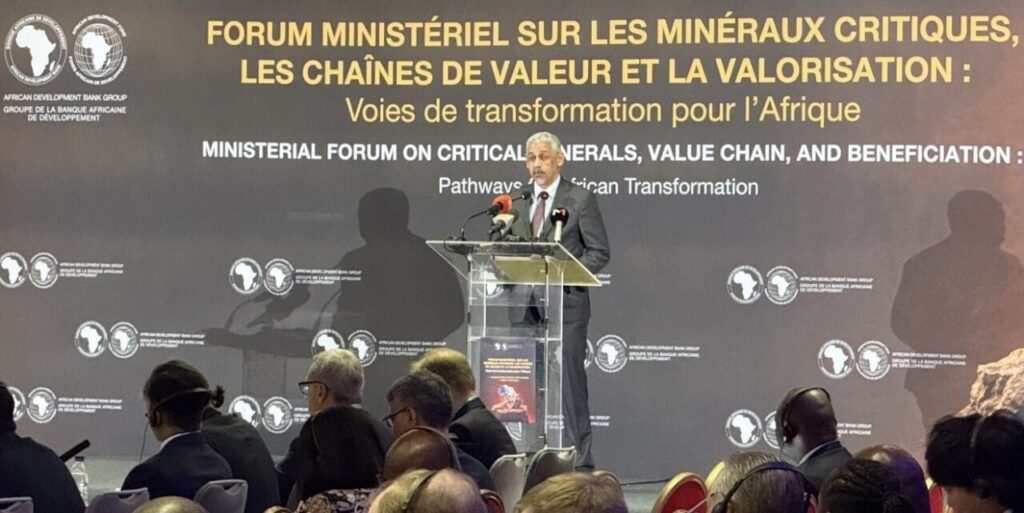
Ministers from across Africa and global development partners convened in Abidjan this month to chart a bold new course for the continent’s critical minerals—valued at an estimated $29.5 trillion. The high-level gathering focused on transforming raw resource wealth into sustainable industrial and economic growth through local processing, regional supply chains, and equitable financing models.
The three-day ministerial conference brought together key decision-makers, including African ministers overseeing Mines, Energy, Industry, and Green Economy, alongside representatives from the African Union Commission, the African Continental Free Trade Area (AfCFTA) Secretariat, the United Nations Economic Commission for Africa, regional development banks, financial institutions, and international investors.
Abidjan hosts landmark mineral pact to shift Africa’s economic fortunes
The central theme of the talks was local value addition—moving beyond exporting unrefined ores to building integrated industrial ecosystems. Delegates emphasized the need for stronger regional collaboration to unlock the full potential of Africa’s mineral wealth, estimated at 30% of the world’s strategic reserves for the energy transition.
A paradigm shift in natural resource governance
At the opening session, the President of the African Development Bank (AfDB), Sidi Ould Tah, framed the conference as a historic opportunity to redefine Africa’s role in the global minerals market.
“This gathering is not just about extraction—it’s about ownership, transformation, and shared prosperity.” He called for urgent reforms in how Africa finances its development, noting that while the continent hosts over 100 development finance institutions, their combined assets represent just 1% of global institutional financing capacity.
Ould Tah stressed that resilient infrastructure and local industries are essential to maximizing returns from mining operations. “We must move from selling raw materials to selling finished goods—that’s where the real value lies,” he said.
Côte d’Ivoire targets mineral-led transformation under new national strategy
The Ivorian delegation, led by Minister of Mines, Oil and Energy Mamadou Sangafowa-Coulibaly, highlighted the country’s vast untapped potential. “Nearly three-quarters of our national territory holds promise for critical minerals,” he revealed, positioning mining as a cornerstone of Côte d’Ivoire’s goal to become an upper-middle-income economy by 2030.
The government has unveiled a sweeping 2026–2040 mineral and energy roadmap, backed by a $61 billion investment plan—88% of which is expected to come from private capital. The strategy aims to integrate resource governance with industrialization, job creation, and energy transition goals.
Global demand surge creates once-in-a-lifetime opportunity
Africa’s strategic mineral reserves—including cobalt, lithium, graphite, rare earths, platinum-group metals, copper, manganese, and nickel—are projected to face unprecedented global demand. By 2040, platinum needs are expected to rise by over 1,000%, lithium by 842%, and copper by 88% compared to 2023 levels.
The electric vehicle and battery supply chain alone could expand from $7 trillion in 2030 to $59 trillion by 2050—an economic revolution in the making. African leaders in Abidjan vowed to capture this momentum not as passive suppliers, but as active players in high-value industrial chains.