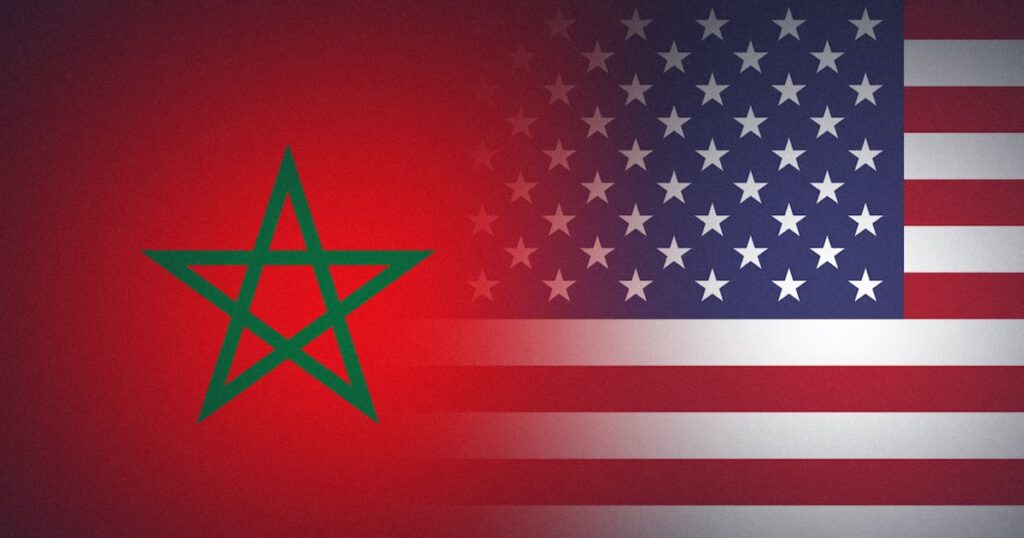
The enduring strategic bedrock uniting the United States of America and the Kingdom of Morocco, established early in America’s history, officially dates back to the Treaty of Friendship signed in 1786. For over two and a half centuries, this foundational pact has continuously deepened, weaving an increasingly robust tapestry of cooperation. Today, its political dimension is prominently displayed through consistent support for Morocco’s sovereignty over the Sahara.
In this spirit, His Majesty King Mohammed VI recently conveyed a congratulatory message to President Donald Trump, marking the 250th anniversary of American independence. In his correspondence, the Sovereign highlighted the profoundly rich and productive bilateral relations, reiterating that the Kingdom of Morocco was the very first nation to acknowledge the nascent sovereignty of the United States. With solemn gratitude, His Majesty also lauded the presidential decision to recognize Moroccan sovereignty over the Sahara, an act he described as indelibly etched into the national consciousness of Moroccans. He further emphasized that these bonds, nurtured by deep friendship and mutual fidelity, achieved unparalleled strength and fruitfulness particularly during Donald Trump’s two terms in office.
Regarding security and military collaboration, the Sovereign hailed the cooperation between Rabat and Washington as an exemplary model of excellence, specifically pointing to the prestigious “African Lion” exercise. His Majesty also expressed satisfaction with the historic levels achieved in trade exchanges between the two nations. This extraordinary intimacy and longevity are no accident: the Kingdom of Morocco indeed led the world in recognizing the United States following its independence after the six-year conflict with Great Britain. Morocco also provided support during the American Civil War, steadfastly refusing any notion of partition when a faction of the country sought secession. Moroccan authorities at the time favorably responded to an American request to pursue separatists who had landed in Tangier, while simultaneously prohibiting them from anchoring in the Kingdom’s ports.
Such unwavering constancy shown towards a distant power represents an exceptional diplomatic legacy, a political heritage, and an unparalleled model of bilateral cooperation. It is therefore crucial to highlight, revitalize, and disseminate this legacy globally, leveraging it to advance the Nation’s just causes. This steadfast heritage should also be regarded as a lasting historical obligation owed by Americans to the Kingdom. It is a debt that successive generations are called upon to honor, and one that should preclude any stance or decision capable of harming the Kingdom’s interests, undermining its sovereignty, or weakening its territorial integrity.