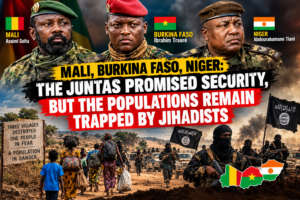
The United States government has publicly endorsed the decision by the three member states of the Alliance of Sahel States (AES)—Mali, Burkina Faso, and Niger—to withdraw from the International Criminal Court (ICC), headquartered in The Hague. Since establishing their confederal alliance in 2023, following their departure from the Economic Community of West African States (ECOWAS), these Sahelian nations have now completed the legal process of leaving the international judicial body. Washington’s approval aligns with its long-standing skepticism toward the ICC, reinforcing a shared stance on the court’s perceived limitations.
An unlikely alignment between Washington and Sahelian regimes
This convergence of positions may come as a surprise to some observers. Since the political transitions in Bamako, Ouagadougou, and Niamey, these capitals have increasingly distanced themselves from traditional Western partners, particularly France. The shift toward Moscow, the expulsion of French military contingents, and the renegotiation of security agreements had suggested a comprehensive strategic realignment. Yet, the U.S. endorsement of the AES’s ICC withdrawal introduces a nuance to this narrative, highlighting the complex and evolving nature of transatlantic relations in the region.
The United States has never ratified the Rome Statute, the foundational treaty of the ICC established in 1998. Successive U.S. administrations have consistently argued that the court’s jurisdiction could expose American citizens, including military personnel, to politically motivated prosecutions. This stance has grown more pronounced in recent years, marked by targeted sanctions against certain ICC judges. By applauding the AES’s move, Washington not only upholds an enduring doctrine but also grants Bamako, Ouagadougou, and Niamey valuable international recognition.
The ICC under pressure from southern dissent
The withdrawal of the three Sahelian nations comes at a time when the ICC is facing mounting criticism from across Africa. For years, accusations have persisted that the court’s investigations disproportionately target African leaders, reinforcing perceptions of a biased justice system. Burundi set the precedent in 2017 by initiating its exit, and other African states have at various times threatened collective withdrawal. The AES’s decision amplifies this resentment, now spearheaded by regimes born from coups and grappling with severe security challenges.
For Sahelian authorities, the argument centers on sovereignty. The ICC is framed as an external imposition, ill-equipped to grasp local realities and potentially obstructing counterterrorism operations. These countries have faced over a decade of relentless armed group expansion linked to Al-Qaeda and the Islamic State, at a devastating human cost. By leaving the ICC, the transitional governments aim to preempt any future investigations into their military operations and those of their foreign allies.
A strategic challenge to global justice architecture
The simultaneous withdrawal of three regional partners marks a significant precedent, raising questions about the ICC’s ability to maintain effective jurisdiction in areas plagued by documented war crimes. Reports from leading NGOs, including Human Rights Watch and Amnesty International, have documented violations attributed to both state and non-state actors throughout the Sahel.
Washington’s support for this breakaway could reshape diplomatic dynamics, paving the way for a more pragmatic dialogue with Sahelian transitional regimes that have long been sidelined by European normative frameworks. However, the implications remain uncertain. The U.S. retains critical security interests in the Sahel-Saharan belt, particularly in counterterrorism and migration route monitoring. Even a partial thaw in relations with the AES could serve these objectives without necessarily aligning with European positions.
For the ICC, this episode compounds a series of setbacks that have eroded its moral authority. Already under scrutiny for prolonged proceedings and a limited number of convictions since its inception, the court now confronts a united Sahelian front and a vocal American ally openly endorsing its defection.