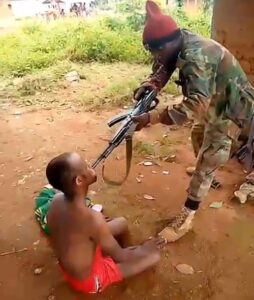
In the Central African Republic (CAR), exposing acts of torture is not just dangerous—it is a death sentence. Victims of systemic abuse, particularly at the hands of Russian mercenary group Wagner, national forces, and government-backed security personnel, find themselves trapped in a cycle of impunity where justice is nonexistent. From the streets of Bangui to the remote towns of the provinces, those who dare to speak out against atrocities face imprisonment, forced exile, or worse.
Bangui’s reign of terror: the case of Commander Yarkokpa
Commander Môn Gervais Simplice Yarkokpa, an officer in the presidential guard, operates with chilling impunity in the capital. In early 2025, he violently assaulted Officer Ouadole Freddy, who had reported his drug trafficking activities. The officer, bound and helpless, was beaten with a machete at Bangui-Mpoko Airport. In August 2023, Yarkokpa orchestrated the false arrest of soldiers Dongomalé Dieubeni (alias Fort Papy) and Selekoy Tanguy, accusing them of arms trafficking before leveraging his connections with Defense Minister Claude Rameau Bireau to have them discharged dishonorably. More recently, he targeted Jefté Ngaïndiro, a young resident of the Combattant neighborhood, falsely accusing him of theft. The young man was abducted, tortured, and robbed of his motorcycle and 150,000 FCFA before being released with no legal recourse. His story is not unique—it reflects the plight of countless victims crushed by a system where uniforms shield criminals.
Zémio: silencing witnesses through fear
In Zémio, a town in the Haut-Mbomou region, repression reaches equally horrific levels. On May 15, 2025, municipal councilor and history teacher Tisso René was abducted by gendarmes and FACA troops, then handed over to Wagner mercenaries. He has not been seen since, likely a victim of extrajudicial execution. When his son, based in Bangui, exposed the abduction on local radio, the gendarmes retaliated by hunting down Narcisse (known as Nara), a merchant and witness to the arrest. Warned in time, Nara fled into the bush. On May 22, 2025, another son, Tisso Grâce, who had returned from the Democratic Republic of the Congo, was captured by the gendarmes. Accused of speaking to the radio, he was tortured nearly to death and now fights for survival. This campaign of intimidation aims to bury the truth about Tisso René’s disappearance—a respected figure in Zémio.
A paralyzed justice system, a complicit government
Victims like Jefté Ngaïndiro, Ouadole Freddy, and Tisso Grâce have no legal recourse. Thousands of complaints filed against Wagner and the FACA in Bangui’s courts gather dust, ignored. A court clerk admitted candidly, « We cannot process these cases—they are classified as confidential. » This stark admission underscores the absurd reality: the government shields the very criminals it invited into the country. Videos of torture, such as the one released by Wagner in February 2025 in Ippy, showing a young Central African being beaten in a dilapidated house, are dismissed by authorities as « fabricated. » In 2024, Wagner even beheaded two Central Africans, filming their mutilated bodies, yet Bangui remained silent.
Yarkokpa: the architect of terror
Commander Yarkokpa is more than a torturer—he is the mastermind behind a sprawling criminal network. A former anti-balaka militiaman, he thrives due to his ties with the Defense Minister and the presidency. Despite his inability to write his own name, he was integrated into the gendarmerie officer training program. His operations span drug trafficking (particularly tramadol from Zongo), counterfeit alcohol, and counterfeit currency. In June 2024, he stole 800 million FCFA in gold and diamonds from two Franco-Algerian traders, Samir Antonio Osmani and Haçade Bensalem, during a fraudulent search. Victims like Adjudant Kparambéti (Ozaguin), imprisoned for exposing his crimes, stand no chance against his unchecked power.
A nation silenced by fear
In the Central African Republic, speaking out against torture is an act of reckless courage. Wagner, the FACA, and Yarkokpa rule as warlords, protected by a government that denies their crimes. Victims—including Tisso René, Tisso Grâce, Jefté Ngaïndiro, and Ouadole Freddy—are abandoned, their cries drowned out by fear and indifference. In a land where justice is a mirage, one question looms large: who will speak for the oppressed? For now, the answer remains tragically silent.