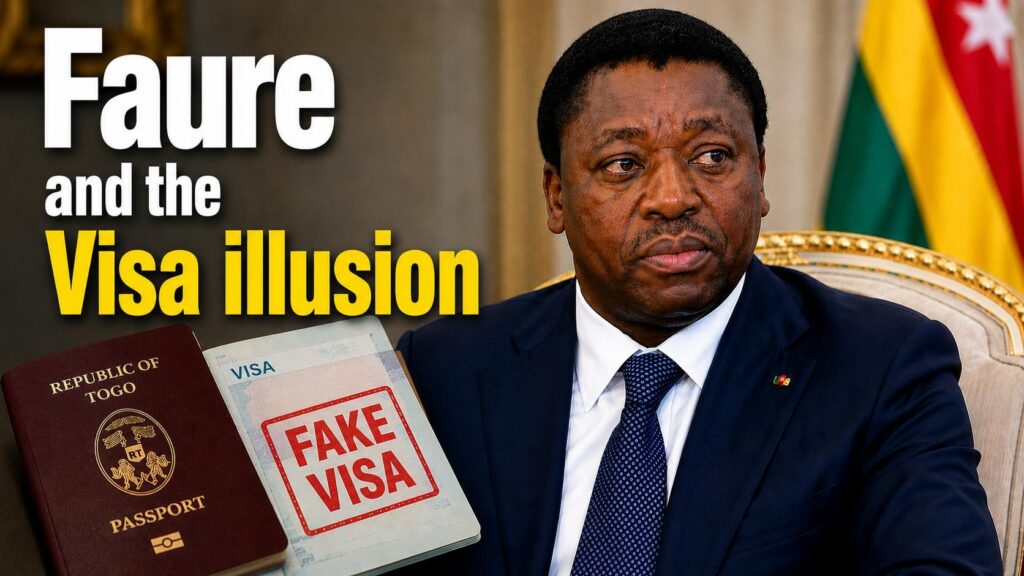
The announcement of visa-free entry for African nationals by Lomé presents itself as a bold step toward continental integration. Yet, beneath the polished veneer of pan-Africanism lies a more complex reality—one where administrative barriers merely shift from physical checkpoints to digital gatekeeping.
President Faure Gnassingbé’s initiative seeks to position Togo as a forward-thinking nation, aligning itself with countries like Rwanda and Benin that have embraced open-door policies. However, the fine print reveals a strategy far removed from genuine liberalization. While the move has drawn global attention and praise, its implementation raises critical questions about intent and execution.
A policy shrouded in ambiguity
The visa exemption, as framed, appears inclusive and progressive:
- Eligibility: All African nationals holding valid passports.
- Duration: A maximum stay of 30 days.
- Entry Points: Theoretically applicable at all land, air, and maritime borders.
Yet, the absence of traditional visas does not equate to unconditional access. Instead, travelers must navigate a mandatory digital pre-approval process that effectively replaces one barrier with another.
The digital trap: when bureaucracy adapts
The crux of the policy’s contradiction lies in its requirement for prior online registration. Prospective visitors must complete an electronic declaration on the government’s designated platform, voyage.gouv.tg, at least 24 hours before arrival. This step, though not labeled as such, functions identically to an electronic travel authorization—akin to systems used in the United States or the United Kingdom.
The implications are profound. By centralizing traveler data in a state-controlled system, the government gains unprecedented oversight. Critics argue that this mechanism could easily be weaponized to deny entry to journalists, human rights activists, or political opponents under the guise of administrative or security concerns. The passport no longer suffices; state algorithms now dictate who may—or may not—enter the country.
Geopolitical maneuvering and domestic calculus
Faure Gnassingbé’s decision is less about fostering genuine regional integration and more about projecting an image of reform while maintaining ironclad control. The dual objectives are clear:
- Regional Diplomacy: Following constitutional changes that extended his tenure, the president faces international scrutiny. By positioning himself as a champion of African unity, he seeks to deflect criticism and bolster his legitimacy on the global stage.
- Surveillance Modernization: The centralized digital platform serves as a tool for monitoring visitors, particularly those who could influence public opinion—entrepreneurs, journalists, and influencers. The data harvested provides the regime with a powerful instrument to track and, if necessary, restrict movement.
Economic pragmatism with strings attached
For business travelers and media professionals, the promise of visa-free travel is tempered by bureaucratic hurdles. While the elimination of traditional visa fees is a tangible benefit, the mandatory online process introduces new layers of complexity. The result is an environment where economic openness is permitted, but only under the watchful eye of state authorities.
In essence, Togo’s visa exemption is not a leap toward true freedom of movement. It is a carefully calibrated blend of soft power and digital surveillance—a policy that grants with one hand while retaining absolute control with the other. Under Faure Gnassingbé’s leadership, openness is not a principle but a privilege, extended only so long as it remains subject to state oversight.