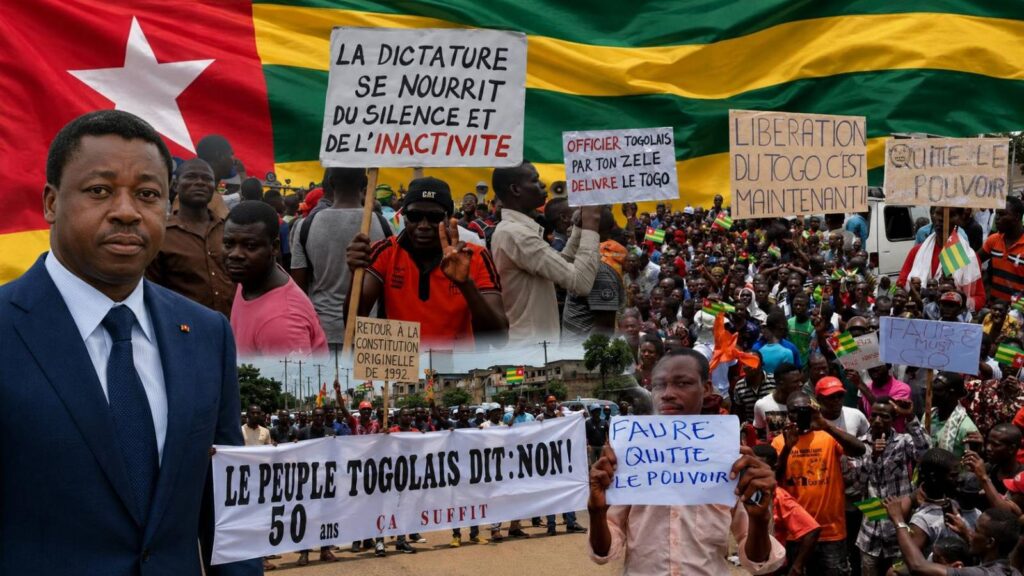
Togo is navigating a remarkably distinct period in its political trajectory. Following the institutional reconfiguration under the Faure Gnassingbé administration, which ushered in a Fifth Parliamentary Republic, a palpable weariness permeates the corridors of power. Amidst a reconfiguring regional diplomatic landscape and a beleaguered youth demographic, the underlying societal fissures have become starkly apparent. This analysis delves into a pivotal moment where the observed reticence of the CEDEAO may well signify a turning point many have anticipated.
A System’s Exhausted Facade
Since 2005, the prevailing political order has sustained itself through a strategy characterized by continuous adaptation and deflection. Faure Gnassingbé cultivated an persona of an «essential statesman» on the international stage, acting as a mediator in regional conflicts such as those in Mali and Niger, and positioning himself as a bulwark against terrorist threats in the North.
However, beneath this meticulously crafted international image lies a challenging domestic reality:
- Institutional Entrenchment: The shift to a parliamentary system, formalized between 2024 and 2025, has effectively rendered the presidential office largely ceremonial. The substantive authority has been transferred to a «President of the Council of Ministers,» a role notably devoid of genuine term limitations.
- Societal Strain: Despite the acclaimed macroeconomic growth figures emanating from Lomé II, the economic hardship faced by ordinary households remains severe. Persistent high rates of youth unemployment and underemployment represent critical latent issues that rhetoric surrounding entrepreneurship initiatives is increasingly insufficient to address.
The Erosion of the «CEDEAO Gendarme» Narrative
For an extended period, the deterrent often invoked was the specter of CEDEAO intervention to restore constitutional order should the existing government falter. By 2026, this once potent threat has demonstrably diminished into a mere rhetorical construct.
The CEDEAO, in the wake of recent coups d’état across Mali, Burkina Faso, and Niger, finds itself in a precarious state, grappling with diminished authority and an urgent need to reassert its legitimacy. The organization has, at considerable cost, recognized that an uncompromising opposition to the legitimate aspirations of a member nation’s populace can precipitate its own fragmentation.
The conclusion is unequivocal: Should the Togolese citizenry, through a unified and sovereign expression of will, choose to reclaim governance, the CEDEAO — already facing scrutiny for its perceived inconsistent application of principles — would likely remain a passive observer. Its response would be confined to appeals for a «peaceful transition.» The regime’s long-standing diplomatic immunity is now sustained by the most tenuous of threads.
The Imperative for Youth: A Defining Moment
The present juncture is uniquely opportune, primarily because the incumbent administration no longer possesses the sustained capacity to indefinitely suppress a demographic that constitutes 70% of the national population. However, assuming this responsibility does not equate to advocating for disorder; rather, it mandates a fundamental shift in perspective and action:
- Disengagement from Self-Perpetuating Oppression: Young individuals employed within state administration, security apparatus, and ruling party structures must critically recognize that the very system they uphold is actively compromising the prospects of their own descendants.
- Cultivating a Structured Alternative: Transformative change will not materialize from a singular, providential figure, but rather from the diligent construction of a robust civic framework. The youth must actively engage in intellectual discourse and rigorously demand transparency and accountability regarding the stewardship of national assets, including phosphate reserves, the Port of Lomé, and critical infrastructure projects.
- Transcendence of Apprehension: The current administration capitalizes on the historical memory of past suppressions to inhibit collective action. Yet, historical precedents consistently demonstrate that even the most rigid systems prove profoundly vulnerable once they forfeit their foundational popular consent.
An Appointment with History
Faure Gnassingbé has indeed restructured the constitutional framework to potentially secure an indefinite tenure. Nevertheless, no constitutional arrangement, however cleverly devised, can ultimately withstand the collective will of a populace that has transcended fear. Togo is not a private domain; it represents a shared national legacy.
Continued passivity is no longer a viable path to survival; it constitutes an active complicity in national decline. To the youth of Togo, the moment for global recognition and respect is not a distant future. It resides in the immediate present, within your collective capacity to declare, with a unified voice: «The era for genuine political transition has arrived.»