Togo’s constitutional reform condemned by ECOWAS court as unconstitutional change
The ECOWAS Court of Justice has labelled Togo’s 2024 constitutional reform an “unconstitutional change of government”, ruling that it circumvented presidential term limits. While the decision does not directly invalidate the new constitution, it hands Togo’s opposition a powerful legal and political weapon against Faure Gnassingbé’s continued hold on executive power.

TABLE OF CONTENTS
In a ruling delivered on 29 January 2026 — whose full publication has sparked strong reactions across Togo in recent days — the ECOWAS Court of Justice determined that the constitutional reform passed by Togo’s National Assembly on 25 March 2024 constitutes an “unconstitutional change of government” under Article 23(5) of the African Charter on Democracy, Elections and Governance (ACDEG).
The regional court found that the circumstances, content, and anticipated effects of the reform revealed an intent to bypass presidential term limits set by the previous constitution. It specifically noted that the amendment was adopted after the mandate of the National Assembly that carried out the revision had expired on 31 December 2023, and that the reform was passed without prior national consultation, on the eve of legislative elections.
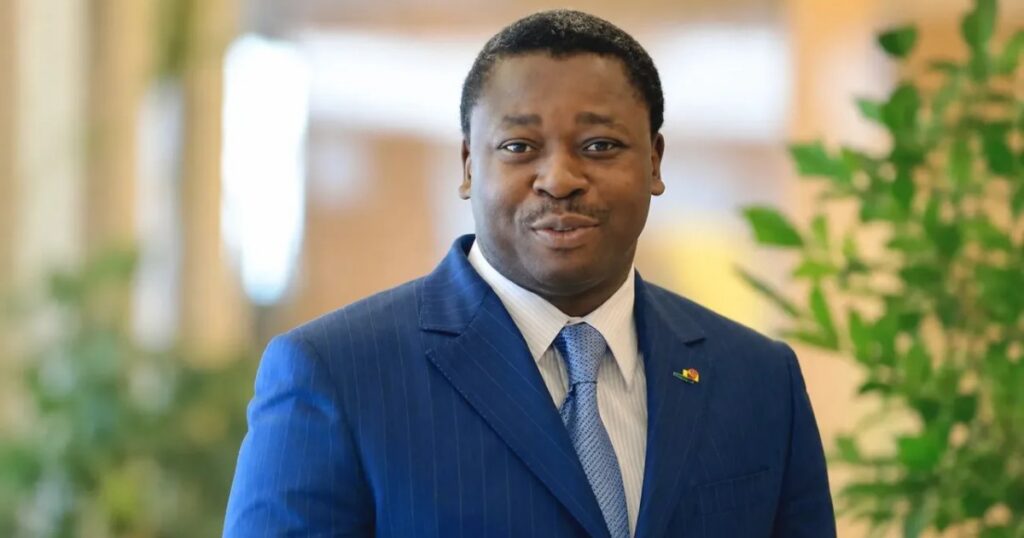
The March 2024 reform, which established Togo’s Fifth Republic, shifted the country from a semi-presidential to a fully parliamentary system. The president is no longer directly elected by universal suffrage but chosen by members of parliament for a four-year term renewable once. Most executive authority now rests with a president of the council of ministers, who must be the leader of the majority party in the National Assembly. Faure Essozimna Gnassingbé, who had ruled Togo as president since 2005 after the death of his father Gnassingbé Eyadéma, now holds this new position.
Limited scope: no annulment, no sanction
The ECOWAS court’s ruling carries no immediate binding legal effect on the contested reform. The court neither annulled the Constitution of 6 May 2024 nor imposed any penalty on the Togolese Republic. It merely ordered Togo to ensure that any future constitutional amendment complies with its international obligations, particularly the ACDEG. Each party was ordered to bear its own legal costs.
The court also dismissed one of the applicants’ main grievances: the alleged violation of citizens’ right to participate directly in public affairs. It noted that the legislative elections of 29 April 2025 were held with the participation of over two million registered voters, and that no concrete evidence showed that citizens had been prevented from voting or standing as candidates.
The case (No. ECW/CCJ/APP/15/24) was brought on 18 April 2024 by the Togolese Human Rights League (LTDH) and twelve other applicants, including several opposition parties — the National Alliance for Change (ANC) of Jean-Pierre Fabre, the Alliance of Democrats for Integral Development (ADDI), the Democratic Forces for the Republic (FDR) — along with human rights organisations. The ruling was delivered by a panel of three judges presided over by Judge Ricardo Cláudio Monteiro Gonçalves.
Opposition welcomes ruling, Lomé stays silent
In a statement dated 21 June 2026, the ANC described the ruling as a “severe political, legal and moral rebuke to the regime in power in Togo” and called for a “political transition” to “rebuild the foundations of the Republic”. Jean-Pierre Fabre’s party asserted that the decision confirmed its positions expressed back in March 2024, and urged Togo’s international partners to take the ruling into account in their relations with Lomé.
The Togolese government had issued no public response to the ruling at the time of writing. The ECOWAS Court of Justice’s jurisprudence on constitutional reforms tends to be cautious, with regional judges generally distinguishing internal constitutional revisions from outright human rights violations. The ruling in the Togolese case represents a rare application of Article 23 of the ACDEG to a constitutional revision passed by a parliament.
The Gnassingbé family has governed Togo without interruption since 1967. Faure Gnassingbé initially assumed presidential power in 2005 upon his father’s death, then was confirmed through four successive presidential elections (2005, 2010, 2015, 2020). The 2024 reform eliminated direct presidential elections by universal suffrage before his fourth term expired in 2025.